
In today’s hyperconnected global economy, businesses are under constant pressure to deliver products faster, reduce operational costs, and respond quickly to disruptions. Supply chains have become increasingly complex, involving multiple suppliers, manufacturers, logistics providers, warehouses, and distribution networks spread across different regions. As organizations strive to improve resilience and efficiency, End-to-End Supply Chain Visibility has emerged as a critical capability for modern supply chain management.
The ability to monitor products, inventory, shipments, suppliers, and operational processes across the entire supply chain enables organizations to make informed decisions in real time. In 2026, when customer expectations, regulatory requirements, and market uncertainties continue to evolve, having complete transparency across supply chain operations is no longer a competitive advantage—it is a business necessity. Organizations that lack visibility often struggle with delays, inventory imbalances, rising costs, and poor customer experiences, while those with connected and transparent supply chains can respond proactively to challenges and opportunities.
What is End-to-End Supply Chain Visibility?
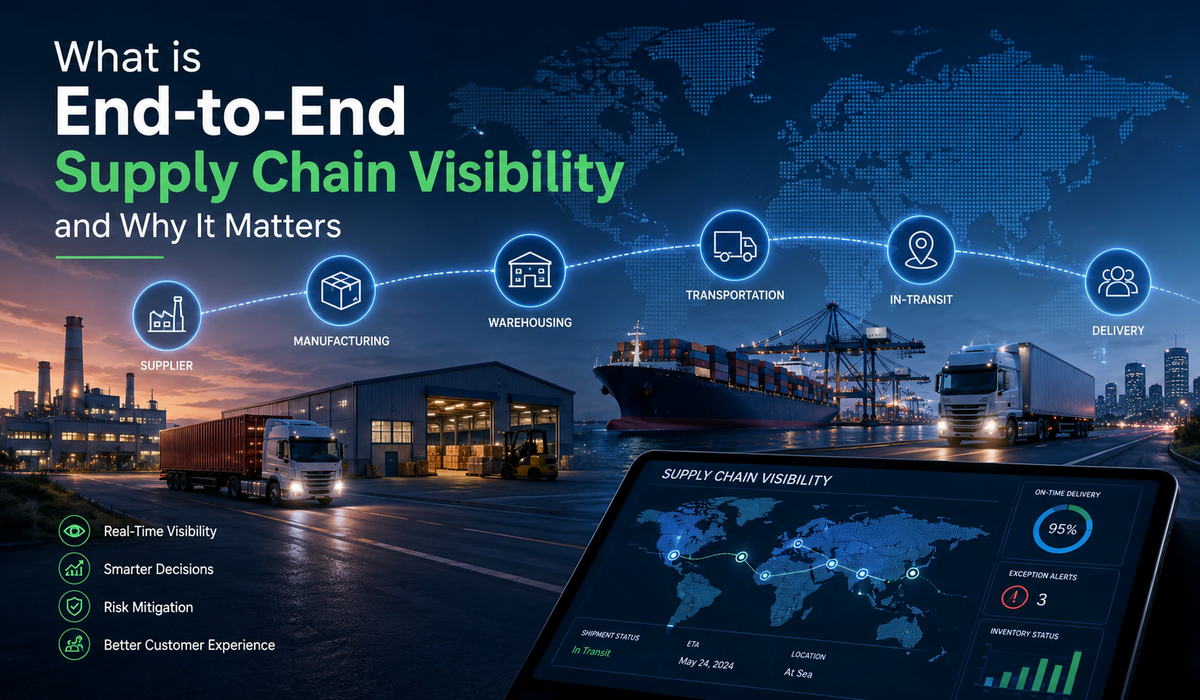
End-to-End Supply Chain Visibility refers to the capability of tracking, monitoring, and managing products, materials, information, and processes across every stage of the supply chain, from raw material sourcing to final customer delivery. It provides organizations with a unified view of supply chain activities, allowing stakeholders to access real-time information and make data-driven decisions.
Rather than operating in isolated silos, supply chain participants become part of a connected ecosystem where information flows seamlessly between suppliers, manufacturers, warehouses, transportation providers, distributors, and customers. This visibility helps organizations understand where products are located, identify potential bottlenecks, monitor inventory levels, and assess operational performance throughout the entire supply chain journey.
By leveraging digital technologies, organizations can transform fragmented operations into an integrated network that supports better planning, execution, and risk management.
Why End-to-End Supply Chain Visibility Matters in 2026
The business environment in 2026 is characterized by increasing supply chain complexity, geopolitical uncertainties, sustainability requirements, and rapidly changing customer demands. Organizations can no longer rely solely on historical data and manual reporting to manage their operations effectively.
Global disruptions, transportation delays, supplier shortages, and fluctuating market conditions require businesses to maintain a real-time understanding of supply chain performance. Without comprehensive visibility, organizations may discover issues only after they have already impacted operations and customer satisfaction.
Customers today expect accurate delivery timelines, product availability, and transparent order tracking. Regulatory authorities also require greater accountability regarding product sourcing, environmental compliance, and operational transparency. As a result, organizations need advanced monitoring capabilities that enable proactive decision-making.
Businesses that invest in visibility solutions can identify risks earlier, improve forecasting accuracy, enhance collaboration among stakeholders, and build more resilient supply chains capable of adapting to uncertainty.
Core Components of Supply Chain Visibility
Data Integration
Supply chain data often resides across multiple systems, including ERP platforms, warehouse management systems, transportation management systems, procurement tools, and supplier portals. Effective visibility requires integrating these disparate data sources into a centralized platform that provides a unified operational view.
Integrated data enables organizations to eliminate information silos and create a single source of truth for supply chain decision-making.
Real-Time Tracking
Real-time tracking provides immediate information about the location and status of goods moving throughout the supply chain. Organizations can monitor shipments, inventory movement, and transportation activities as they occur.
This capability allows businesses to identify delays, reroute shipments when necessary, and communicate accurate updates to customers and stakeholders.
Inventory Visibility
Maintaining optimal inventory levels is a major challenge for many organizations. Visibility into inventory across warehouses, distribution centers, retail locations, and transit networks helps companies avoid stockouts and excess inventory situations.
Accurate inventory information supports better demand planning and improves overall operational efficiency.
Supplier Collaboration
Supplier performance directly impacts supply chain success. Visibility solutions facilitate communication and collaboration between organizations and their suppliers by providing shared access to critical operational information.
This collaborative approach enables faster issue resolution, improved planning accuracy, and stronger supplier relationships.
Predictive Analytics
Advanced analytics technologies help organizations move beyond reactive decision-making by identifying patterns and predicting future outcomes. Predictive capabilities support demand forecasting, risk assessment, inventory optimization, and transportation planning.
Organizations can use these insights to make proactive decisions that improve operational performance.
Supply Chain Control Towers
Control towers serve as centralized command centers that provide comprehensive visibility across supply chain operations. They consolidate information from multiple sources and offer actionable insights through dashboards, alerts, and performance metrics.
Control towers enable organizations to monitor key activities and respond quickly to emerging issues.
Step-by-Step Approach to Implementing Supply Chain Visibility
Step 1: Assess Existing Supply Chain Processes
Organizations should begin by evaluating their current supply chain operations, systems, and data sources. This assessment helps identify visibility gaps, operational bottlenecks, and areas requiring improvement.
Understanding the current state provides a foundation for developing a successful implementation strategy.
Step 2: Define Business Objectives
Before selecting technologies or solutions, organizations should establish clear objectives. These objectives may include improving inventory accuracy, reducing transportation costs, enhancing customer service, or increasing supply chain resilience.
Clearly defined goals help align visibility initiatives with broader business priorities.
Step 3: Integrate Data Sources
Successful visibility depends on connecting information from suppliers, logistics providers, warehouses, manufacturing facilities, and enterprise systems.
Organizations should invest in integration capabilities that enable seamless data exchange across the supply chain ecosystem.
Step 4: Deploy Tracking Technologies
Technologies such as RFID, GPS, IoT sensors, and barcode systems provide real-time information about products, assets, and shipments.
Implementing these technologies enhances transparency and enables continuous monitoring throughout the supply chain.
Step 5: Implement Analytics and Monitoring Tools
Advanced analytics platforms help organizations transform raw data into actionable insights. Dashboards, alerts, and predictive models support informed decision-making and proactive risk management.
These capabilities enable organizations to identify opportunities and address challenges before they escalate.
Step 6: Continuously Improve Performance
Supply chain visibility is an ongoing journey rather than a one-time project. Organizations should regularly review performance metrics, gather stakeholder feedback, and refine processes to maximize value.
Continuous improvement ensures long-term success and adaptability in changing market conditions.
Key Benefits for Enterprises
Organizations that achieve comprehensive supply chain transparency experience significant operational and strategic advantages.
Improved decision-making is one of the most valuable outcomes because stakeholders gain access to accurate, real-time information. Better visibility reduces uncertainty and supports faster responses to changing conditions.
Operational costs can be reduced through improved inventory management, optimized transportation routes, and more efficient resource allocation. Organizations gain greater control over expenses while maintaining service quality.
Customer satisfaction improves when businesses can provide accurate delivery estimates, reliable order tracking, and consistent product availability. Enhanced transparency strengthens customer trust and loyalty.
Supply chain resilience also increases because organizations can identify risks earlier and implement mitigation strategies before disruptions significantly impact operations.
Collaboration among suppliers, logistics providers, and internal teams becomes more effective when everyone has access to shared information and performance insights.
Real-World Applications and Use Cases
Manufacturing Industry
Manufacturers use visibility solutions to monitor raw material availability, production schedules, inventory levels, and supplier performance. Real-time information helps prevent production delays and ensures efficient resource utilization.
For example, an automotive manufacturer can track component shipments from suppliers worldwide and proactively address potential delays before they affect assembly operations.
Retail Industry
Retail organizations leverage visibility capabilities to manage inventory across stores, warehouses, and fulfillment centers. Real-time inventory information helps improve stock availability and customer satisfaction.
Retailers can respond more effectively to demand fluctuations and reduce losses associated with overstocking or stockouts.
Logistics and Transportation
Logistics providers utilize tracking technologies to monitor vehicle locations, shipment conditions, and delivery performance. Enhanced transparency supports route optimization and improves service reliability.
Customers benefit from accurate shipment updates and predictable delivery timelines.
Healthcare Sector
Healthcare organizations rely on visibility solutions to track medical supplies, pharmaceuticals, and critical equipment. Accurate monitoring ensures product availability and regulatory compliance.
Timely access to essential medical resources contributes to improved patient care and operational efficiency.
E-Commerce Operations
E-commerce businesses use supply chain visibility to manage fulfillment processes, track customer orders, and coordinate deliveries across complex distribution networks.
Enhanced transparency improves customer experiences while supporting efficient order fulfillment.
Technologies Powering Modern Supply Chain Visibility
Several technologies play a critical role in enabling supply chain transparency and operational intelligence.
RFID technology allows organizations to automatically identify and track assets, products, and inventory throughout the supply chain. Real-time tracking improves inventory accuracy and operational efficiency.
IoT sensors provide continuous monitoring of location, temperature, humidity, and other environmental conditions. These capabilities are particularly valuable for industries managing sensitive products.
GPS tracking enables real-time shipment monitoring and transportation optimization. Organizations gain greater control over logistics operations and delivery performance.
Artificial Intelligence and Machine Learning help analyze large volumes of supply chain data, identify patterns, and generate predictive insights that support proactive decision-making.
Cloud platforms facilitate collaboration, scalability, and centralized access to supply chain information. Stakeholders can access critical data regardless of location.
Digital twin technology creates virtual representations of physical supply chain networks, enabling organizations to simulate scenarios and evaluate potential outcomes.
Blockchain enhances transparency and trust by providing secure, immutable records of transactions and product movements throughout the supply chain.
Control tower solutions integrate information from multiple sources and provide a centralized operational view for supply chain management.
Common Challenges and Best Practices
Despite its benefits, implementing visibility solutions can present several challenges. Data quality issues, system integration complexities, resistance to change, and technology adoption barriers can hinder success.
Organizations often struggle with inconsistent data formats and fragmented systems that limit information sharing. Addressing these challenges requires strong governance, standardized processes, and effective integration strategies.
Successful organizations prioritize stakeholder engagement throughout implementation efforts. Clear communication, training programs, and executive support help drive adoption and maximize value.
Investing in scalable technologies and maintaining a long-term strategic perspective also contribute to successful outcomes.
Future Trends Beyond 2026
The future of supply chain visibility will be shaped by increasing automation, advanced analytics, and intelligent decision-making capabilities. Organizations will continue adopting AI-powered control towers that provide predictive recommendations and autonomous responses to operational challenges.
Digital twins will become more sophisticated, enabling real-time simulation of entire supply chain ecosystems. Businesses will use these capabilities to evaluate risks, optimize performance, and improve strategic planning.
Sustainability tracking will gain greater importance as organizations face increasing environmental and regulatory pressures. Enhanced transparency will support responsible sourcing, emissions monitoring, and sustainability reporting.
Hyperconnected supplier networks will facilitate faster collaboration and more resilient operations. As technology continues to evolve, supply chains will become increasingly intelligent, adaptive, and responsive.
Conclusion
As global supply chains become more interconnected and complex, organizations must adopt strategies that provide greater transparency, agility, and resilience. The ability to monitor operations from sourcing to final delivery enables businesses to make faster decisions, reduce risks, improve customer experiences, and optimize performance across the value chain. Companies that invest in modern visibility solutions are better positioned to navigate disruptions and capitalize on emerging opportunities.
In 2026 and beyond, supply chain transparency will continue to evolve through advanced technologies such as AI, IoT, digital twins, and predictive analytics. Organizations seeking to strengthen operational efficiency and build future-ready supply chains should prioritize visibility initiatives as part of their digital transformation strategy.
People Also Ask (FAQs)
Q1. What is supply chain visibility?
Supply chain visibility refers to the ability to track, monitor, and access information about products, inventory, shipments, suppliers, and operational activities throughout the supply chain. It provides organizations with real-time insights that support informed decision-making and proactive management. Improved visibility helps businesses reduce risks, enhance customer service, optimize inventory levels, and respond more effectively to disruptions.
Q2. Why is End-to-End Supply Chain Visibility important?
End-to-End Supply Chain Visibility is important because it enables organizations to monitor operations across the entire supply chain, from sourcing to customer delivery. This comprehensive perspective helps identify risks early, improve operational efficiency, enhance customer satisfaction, and support strategic decision-making. Organizations with strong visibility capabilities are better equipped to navigate disruptions and maintain competitive advantage.
Q3. How does supply chain visibility improve customer satisfaction?
Supply chain visibility improves customer satisfaction by providing accurate information regarding product availability, order status, and delivery timelines. Customers receive timely updates and experience fewer delays, resulting in increased trust and loyalty. Businesses can also respond more quickly to issues and maintain consistent service quality.
Q4. What technologies are used for supply chain visibility?
Organizations commonly use RFID, IoT sensors, GPS tracking, Artificial Intelligence, Machine Learning, cloud computing, blockchain, and digital twin technologies. These solutions help collect, analyze, and share information across supply chain operations, enabling real-time monitoring and improved decision-making.
Q5. What are the biggest challenges in achieving supply chain visibility?
Common challenges include fragmented systems, poor data quality, limited supplier collaboration, integration difficulties, and resistance to organizational change. Overcoming these challenges requires strong leadership, effective governance, standardized processes, and investment in modern technology solutions.
Q6. Can small and medium-sized businesses benefit from supply chain visibility?
Yes. Small and medium-sized businesses can improve inventory management, reduce operational costs, enhance customer service, and strengthen supplier relationships through visibility initiatives. Cloud-based solutions have made advanced visibility capabilities more accessible and affordable for organizations of all sizes.
Q7. What is the future of supply chain visibility?
The future will involve greater use of Artificial Intelligence, predictive analytics, automation, digital twins, and real-time collaboration platforms. Organizations will increasingly leverage intelligent systems that provide proactive recommendations and support autonomous decision-making across supply chain operations.
