

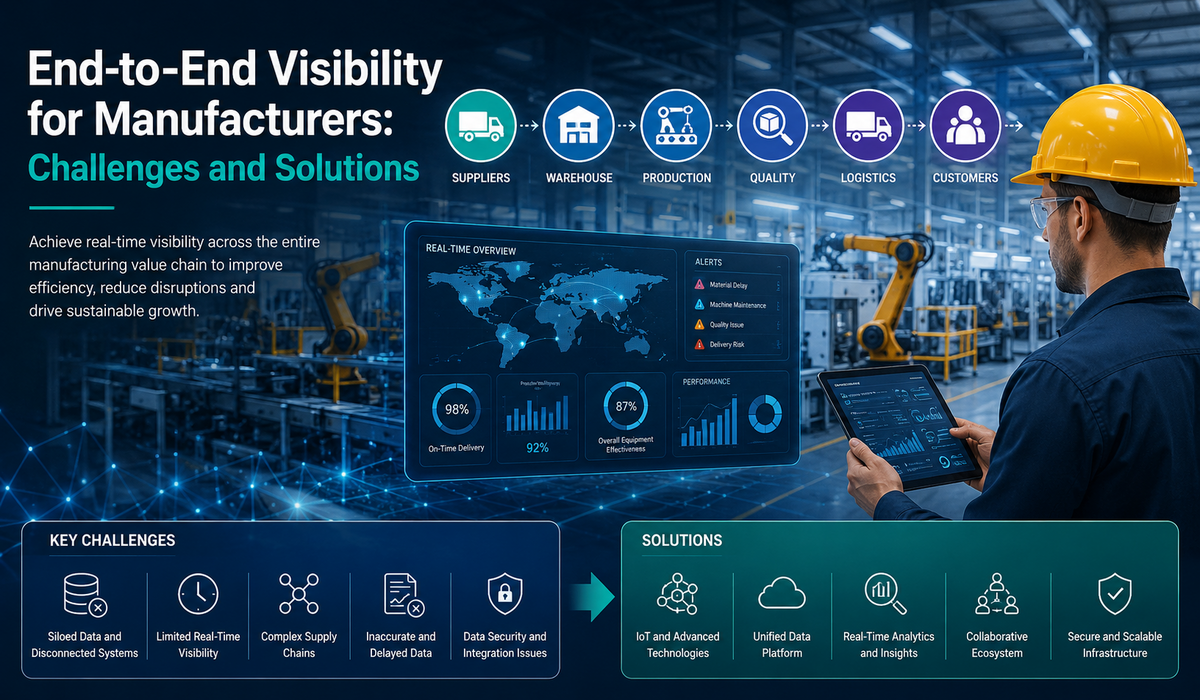
In today’s highly competitive manufacturing environment, visibility across the entire supply chain has become a critical requirement rather than a competitive advantage. Manufacturers are under constant pressure to meet customer expectations, reduce operational costs, improve production efficiency, and respond quickly to disruptions. However, achieving complete transparency across procurement, production, inventory, logistics, and distribution remains a significant challenge for many organizations.
End to End Visibility Manufacturers solutions enable businesses to monitor and manage every stage of the manufacturing and supply chain process in real time. By providing comprehensive insights into operations, these solutions help manufacturers make informed decisions, minimize risks, and optimize performance. As supply chains become increasingly complex and globalized, the importance of end-to-end visibility continues to grow.
This article explores the key challenges manufacturers face in achieving complete visibility and examines the technologies and strategies that can help overcome these obstacles.
Understanding End-to-End Visibility in Manufacturing
End-to-end visibility refers to the ability to track, monitor, and analyze every process, asset, and transaction throughout the manufacturing and supply chain lifecycle. It encompasses visibility into raw material sourcing, supplier performance, inventory levels, production activities, warehouse operations, transportation, and final product delivery.
For manufacturers, visibility extends beyond internal operations. It also includes gaining real-time insights into suppliers, distributors, logistics partners, and customers. When all stakeholders are connected through a unified system, organizations can respond more effectively to changing market conditions and operational challenges.
The growing demand for faster delivery times, customized products, and resilient supply chains has made End to End Visibility Manufacturers initiatives a top priority across industries.
Why End-to-End Visibility Matters for Manufacturers?
Manufacturing operations involve numerous interconnected processes. A delay in raw material delivery can affect production schedules, which may subsequently impact customer deliveries and revenue. Without accurate visibility, identifying and resolving such issues becomes difficult.
End to End Visibility Manufacturers solutions enable organizations to detect disruptions early and take corrective actions before problems escalate. Real-time access to operational data improves forecasting accuracy, inventory management, production planning, and resource allocation. It also helps manufacturers maintain compliance, enhance product quality, and strengthen customer satisfaction while gaining greater control over their supply chain operations.
Furthermore, visibility allows manufacturers to identify inefficiencies, reduce waste, and improve collaboration across departments and external partners. As businesses strive to build agile and resilient supply chains, visibility serves as the foundation for operational excellence.
Key Challenges Facing End to End Visibility Manufacturers Today
Despite its importance, many manufacturers struggle to achieve complete visibility due to several operational and technological barriers.
Fragmented Data Across Multiple Systems
One of the most common challenges is the presence of disconnected systems across different business functions. Manufacturing organizations often use separate platforms for procurement, production, inventory management, logistics, and finance. These isolated systems create data silos that prevent information from flowing seamlessly throughout the organization.
As a result, decision-makers lack access to a unified view of operations. Critical information may be delayed, duplicated, or inconsistent, making it difficult to gain accurate insights into supply chain performance.
Limited Visibility Beyond Internal Operations
Many manufacturers have visibility into their own facilities but struggle to monitor activities occurring outside their direct control. Suppliers, logistics providers, warehouses, and distributors often operate using different systems and processes.
This lack of external visibility makes it challenging to track shipments, monitor supplier performance, and anticipate disruptions. Without real-time information from partners, manufacturers may face unexpected delays and operational bottlenecks.
Increasing Supply Chain Complexity
Globalization has significantly expanded manufacturing supply chains, making End to End Visibility Manufacturers initiatives more important than ever for tracking materials, inventory, production processes, and shipments across multiple countries and supplier networks.
As supply networks become more complex, managing and monitoring every component becomes increasingly difficult. Even minor disruptions can create ripple effects throughout the supply chain, impacting production schedules and customer commitments.
Inaccurate or Delayed Data
Effective visibility depends on accurate and timely information. However, many manufacturers still rely on manual processes and outdated reporting methods. Human errors, delayed updates, and incomplete records can compromise data quality and reduce the effectiveness of visibility initiatives.
When decision-makers operate using inaccurate information, the risk of inventory shortages, production delays, and forecasting errors increases substantially.
Lack of Real-Time Monitoring
Traditional manufacturing systems often provide historical reports rather than real-time operational insights. While historical data is valuable for analysis, it may not be sufficient for responding to rapidly changing conditions.
Without real-time monitoring capabilities, organizations may discover problems only after they have already affected production, inventory, or customer deliveries.
Cybersecurity and Data Integration Challenges
As manufacturers adopt digital technologies to improve visibility, they must also address cybersecurity concerns. Integrating data from multiple systems, suppliers, and devices increases the potential attack surface for cyber threats.
Organizations pursuing End to End Visibility Manufacturers initiatives must ensure that visibility solutions provide secure data sharing while maintaining compliance with industry regulations and data protection requirements.
Technologies Enabling End-to-End Visibility
Modern digital technologies are transforming how manufacturers achieve comprehensive visibility across their operations.
Internet of Things (IoT)
IoT devices play a crucial role in collecting real-time data from machines, equipment, vehicles, and inventory assets. Sensors continuously monitor operational conditions and transmit data to centralized systems.
This real-time information enables manufacturers to track production performance, monitor asset health, and gain greater control over supply chain activities.
Artificial Intelligence and Advanced Analytics
Artificial intelligence helps manufacturers transform large volumes of operational data into actionable insights. AI-powered analytics can identify patterns, predict disruptions, optimize inventory levels, and improve demand forecasting.
By leveraging predictive intelligence, organizations can proactively address issues before they impact business performance.
Cloud-Based Manufacturing Platforms
Cloud technology enables seamless data sharing across departments, facilities, and external partners. Centralized cloud platforms eliminate information silos and provide stakeholders with access to real-time operational data from any location.
Cloud-based solutions play a vital role in enabling End to End Visibility Manufacturers initiatives by supporting scalability, flexibility, and faster implementation compared to traditional on-premise systems.
RFID and Asset Tracking Technologies
RFID technology enables manufacturers to track materials, components, and finished products throughout the supply chain. Automated tracking reduces manual intervention while improving inventory accuracy and operational transparency.
By providing real-time location and status information, RFID solutions significantly enhance visibility across manufacturing operations.
Digital Twins
Digital twin technology creates virtual representations of physical assets, processes, and supply chains. Manufacturers can use digital twins to simulate different scenarios, monitor performance, and identify potential bottlenecks.
This technology provides deeper operational insights and supports data-driven decision-making across the organization.
Effective End to End Visibility Manufacturers Strategies for Operational Excellence
Achieving visibility requires more than implementing technology. Manufacturers must adopt a strategic approach that combines people, processes, and digital solutions.
Organizations should begin by establishing a unified data management framework that integrates information from all business systems. Eliminating data silos creates a single source of truth and improves decision-making accuracy.
Collaboration with suppliers and logistics partners is equally important. Sharing real-time information across the supply chain enhances coordination and reduces uncertainty.
Manufacturers should also invest in automation to minimize manual data entry and improve information accuracy. Automated data collection ensures timely updates and reduces the risk of human error.
Real-time dashboards and analytics tools play a crucial role in End to End Visibility Manufacturers strategies by providing stakeholders with instant access to key performance indicators, helping teams identify issues proactively, optimize operations, and respond quickly to emerging challenges.
Continuous monitoring and performance evaluation should become part of daily operations. By regularly analyzing operational data, manufacturers can identify improvement opportunities and strengthen supply chain resilience.
Benefits of End-to-End Visibility for Manufacturers
Manufacturers that successfully implement visibility solutions gain significant operational and strategic advantages.
Improved visibility enhances inventory accuracy, reduces stockouts, and minimizes excess inventory costs. Production planning becomes more efficient because organizations can align resources with actual demand conditions.
Supply chain disruptions can be identified and addressed more quickly, reducing downtime and improving service levels. Better collaboration across stakeholders leads to smoother operations and stronger business relationships.
Real-time insights support faster decision-making and enable manufacturers to adapt to changing market conditions with greater agility. Enhanced transparency also contributes to improved compliance, quality control, and customer satisfaction.
Most importantly, End to End Visibility Manufacturers initiatives create a foundation for long-term operational excellence and sustainable growth.
The Future of End-to-End Visibility in Manufacturing
The future of manufacturing will be increasingly driven by connected ecosystems, intelligent automation, and data-driven decision-making. Emerging technologies such as artificial intelligence, machine learning, blockchain, and advanced IoT networks will continue to enhance visibility capabilities across the supply chain.
Manufacturers will move beyond reactive operations toward predictive and autonomous decision-making. Real-time insights will enable organizations to anticipate disruptions, optimize performance, and improve customer experiences with unprecedented accuracy.
As digital transformation accelerates, end-to-end visibility will become a fundamental requirement for manufacturers seeking to remain competitive in an increasingly dynamic global marketplace.
Conclusion
Achieving complete visibility across manufacturing operations remains a complex challenge, but it is essential for improving efficiency, resilience, and profitability. Fragmented systems, supply chain complexity, limited partner collaboration, and data quality issues often hinder visibility efforts. However, advancements in IoT, artificial intelligence, cloud platforms, RFID technology, and analytics are providing manufacturers with powerful tools to overcome these barriers.
By implementing the right technologies and adopting a strategic approach to data integration and collaboration, organizations can unlock the full potential of End to End Visibility Manufacturers solutions. The result is a more agile, transparent, and efficient manufacturing ecosystem capable of meeting the demands of modern business environments while driving long-term growth and success.
Frequently Asked Questions (FAQs)
Q1. What is end-to-end visibility in manufacturing?
End-to-end visibility in manufacturing refers to the ability to monitor and track every stage of the production and supply chain process, from raw material sourcing and procurement to manufacturing, warehousing, transportation, and final product delivery. It provides manufacturers with real-time insights that support better decision-making and operational efficiency.
Q2. Why is end-to-end visibility important for manufacturers?
End-to-end visibility helps manufacturers identify disruptions early, improve inventory management, optimize production schedules, reduce operational costs, and enhance customer satisfaction. It enables organizations to respond quickly to changing market conditions while maintaining efficient and resilient supply chain operations.
Q3. What are the biggest challenges in achieving end-to-end visibility?
The most common challenges include fragmented data across multiple systems, limited visibility into supplier and logistics partner operations, increasing supply chain complexity, inaccurate data, lack of real-time monitoring capabilities, and cybersecurity concerns associated with digital transformation initiatives.
Q4. Which technologies support end-to-end visibility for manufacturers?
Several technologies contribute to improved visibility, including Internet of Things (IoT) sensors, RFID tracking systems, cloud-based manufacturing platforms, artificial intelligence (AI), machine learning, advanced analytics, and digital twin technology. These solutions help manufacturers collect, analyze, and share real-time operational data.
Q5. How can manufacturers improve end-to-end visibility across their supply chains?
Manufacturers can improve visibility by integrating data from multiple business systems, adopting real-time tracking technologies, enhancing collaboration with suppliers and logistics partners, automating data collection processes, and leveraging analytics platforms to gain actionable insights into supply chain and production performance.
