
The pharmaceutical industry faces one of its biggest challenges in ensuring that every medicine reaching patients is genuine, safe, and sourced through authorized channels. Counterfeit drugs continue to threaten public health worldwide, causing financial losses for manufacturers while putting countless lives at risk. Traditional tracking systems have improved supply chain visibility, but they often struggle with fragmented data, limited transparency, and the inability to provide real-time verification across multiple stakeholders. Web3 NFT pharma anti-counterfeit traceability is emerging as a transformative approach to solving these long-standing issues.
By combining decentralized blockchain technology with Non-Fungible Tokens (NFTs), pharmaceutical companies can establish a secure, transparent, and tamper-proof record for every drug manufactured and distributed. Unlike conventional databases that rely on centralized control, Web3 enables trusted collaboration among manufacturers, distributors, logistics providers, pharmacies, hospitals, regulators, and even patients.
As global pharmaceutical supply chains become increasingly complex, organizations are exploring innovative technologies that strengthen trust while simplifying compliance. They are becoming valuable tools for product authentication, digital ownership, traceability, and supply chain security. This article explores how these technologies are reshaping pharmaceutical traceability, preventing counterfeit medicines, and building a safer future for healthcare.
Understanding Counterfeit Challenges in the Pharmaceutical Industry
Counterfeit medicines represent a growing concern for healthcare systems across the world. Fake drugs may contain incorrect ingredients, harmful substances, or no active pharmaceutical ingredients at all. These products often enter legitimate distribution channels through unauthorized suppliers, making detection extremely difficult with conventional systems.
Modern pharmaceutical supply chains involve multiple manufacturers, packaging facilities, warehouses, distributors, transportation providers, wholesalers, pharmacies, and healthcare institutions. Every transfer increases the possibility of data inconsistencies, manual errors, or fraudulent activities if records are not securely maintained.
Traditional ERP systems and centralized databases provide inventory management capabilities, but they cannot always guarantee that historical records remain unchanged or independently verifiable across every participant. This limitation creates opportunities for counterfeit products to infiltrate legitimate supply chains.
The industry requires a system where every transaction is permanently recorded, instantly verifiable, and trusted by all stakeholders without depending on a single centralized authority. This is precisely where Web3 technologies introduce significant value.
What is Web3 in Pharmaceutical Supply Chains?
Web3 represents the next generation of internet infrastructure built on decentralized blockchain networks. Instead of relying on a single organization to store and verify information, data is distributed across multiple nodes, creating transparency, security, and immutability.
Within pharmaceutical supply chains, Web3 enables every participant to access a synchronized and verified history of a medicine’s lifecycle. Manufacturing records, quality certifications, shipping updates, warehouse movements, temperature logs, regulatory approvals, and ownership transfers can all be recorded on a decentralized ledger.
Once information is written to the blockchain, altering or deleting it becomes extremely difficult. This immutable record creates greater confidence among manufacturers, regulators, healthcare providers, and patients while reducing opportunities for fraud.
Rather than replacing existing ERP or supply chain systems, Web3 enhances them by providing an additional layer of trusted verification that spans organizational boundaries.
Understanding NFTs Beyond Digital Collectibles
Many people associate NFTs with digital artwork, but their real-world applications extend far beyond collectibles. An NFT is essentially a unique digital certificate stored on a blockchain that represents ownership or identity for a specific asset.
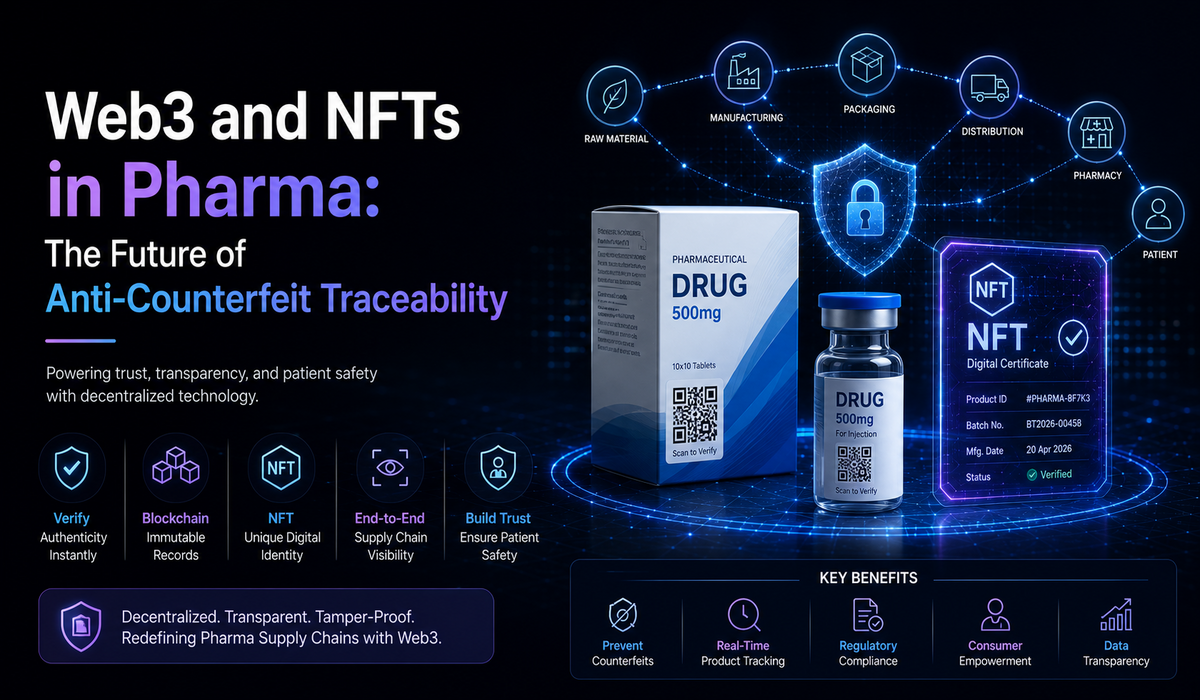
In pharmaceuticals, every production batch or even every individual medicine package can be assigned its own NFT. This NFT becomes the product’s secure digital identity throughout its lifecycle.
Unlike QR codes or serial numbers alone, NFTs cannot simply be duplicated because their authenticity is verified through blockchain consensus. Every ownership transfer, shipment, inspection, and verification becomes permanently linked to the product’s digital identity.
This approach creates an auditable and transparent chain of custody from manufacturing to patient delivery.
How Web3 NFT Pharma Anti-Counterfeit Traceability Works
The implementation of web3 nft pharma anti-counterfeit traceability begins during pharmaceutical manufacturing. As each medicine batch is produced, a unique NFT is generated to represent that specific product or batch.
The NFT stores references to manufacturing information, production timestamps, batch numbers, quality assurance reports, regulatory certifications, expiration dates, and serialization details. Sensitive business information remains securely stored while blockchain records verify authenticity.
As products move through warehouses, distributors, logistics providers, wholesalers, pharmacies, and hospitals, every transfer updates the NFT’s ownership history on the blockchain.
IoT sensors may continuously monitor storage conditions such as temperature, humidity, and transportation status. These sensor readings can also be associated with the NFT, creating a complete history of product handling.
When pharmacists or patients receive a medicine, they can scan its secure identifier to instantly verify authenticity, manufacturing history, and supply chain journey. Any mismatch immediately indicates possible tampering or counterfeit activity.
Why Blockchain Creates Stronger Pharmaceutical Traceability
Blockchain introduces a level of transparency that traditional databases cannot easily provide. Every authorized participant accesses the same trusted information, eliminating discrepancies caused by disconnected systems.
Each transaction is cryptographically secured and permanently recorded, making unauthorized modifications practically impossible without network consensus. This dramatically reduces opportunities for counterfeit products to enter legitimate supply chains unnoticed.
Since every movement is timestamped and digitally verified, investigators can rapidly identify where anomalies occurred, simplifying recalls, compliance audits, and regulatory investigations.
Manufacturers also benefit from increased visibility into product distribution, helping identify unauthorized resale channels and gray market activities before they become major problems.
The Role of Smart Contracts in Pharmaceutical Security
Smart contracts automate many processes that traditionally require manual verification and approvals.
When predefined conditions are satisfied, smart contracts automatically execute specific actions without human intervention. For example, ownership transfers can occur automatically once shipment verification is complete. Payments may be released only after quality inspections pass predefined standards. Temperature-sensitive medicines can trigger alerts if storage conditions exceed acceptable thresholds.
Automation reduces paperwork, minimizes processing delays, decreases operational costs, and improves trust among supply chain participants.
Most importantly, smart contracts reduce human error while enforcing standardized compliance procedures throughout pharmaceutical distribution.
Benefits of Web3 NFT Pharma Anti-Counterfeit Traceability
The adoption of web3 nft pharma anti-counterfeit traceability delivers value across the pharmaceutical ecosystem by improving security, operational efficiency, and patient confidence.
Manufacturers gain stronger protection against product counterfeiting while maintaining complete visibility over distribution channels. Regulators receive immutable audit trails that simplify inspections and compliance verification. Logistics companies benefit from real-time shipment tracking and transparent handoffs. Pharmacies can authenticate products before dispensing medicines, reducing the risk of counterfeit inventory reaching patients.
Patients also experience greater confidence because they can independently verify whether medicines originated from authorized manufacturers through secure digital verification.
Integration with Existing Pharmaceutical Systems
Organizations do not need to replace their existing infrastructure to adopt Web3 technologies.
Modern blockchain platforms integrate with ERP software, Warehouse Management Systems, Manufacturing Execution Systems, Laboratory Information Management Systems, RFID solutions, IoT platforms, and serialization software through secure APIs.
This hybrid approach allows pharmaceutical companies to preserve existing investments while adding blockchain-based verification capabilities.
Operational workflows remain familiar for employees while blockchain continuously strengthens transparency behind the scenes.
Regulatory Compliance and Future Readiness
Pharmaceutical regulations continue evolving to improve medicine safety, serialization, and supply chain visibility. Regulatory agencies worldwide increasingly emphasize end-to-end traceability, product authentication, and electronic recordkeeping.
Web3 technologies naturally align with these objectives because they provide immutable transaction histories, transparent audit trails, and secure digital identities for pharmaceutical products.
As governments introduce stricter anti-counterfeit regulations, organizations that invest early in blockchain-powered traceability will be better positioned to adapt without major infrastructure changes.
Beyond compliance, decentralized traceability systems also support faster recalls, improved pharmacovigilance, stronger collaboration across international supply chains, and enhanced patient safety.
Challenges That Organizations Must Address
Despite its advantages, implementing Web3 in pharmaceutical supply chains requires careful planning. Blockchain scalability, interoperability between platforms, governance models, cybersecurity considerations, and regulatory acceptance remain important factors during implementation.
Organizations must also establish clear standards for NFT creation, digital identity management, data privacy, and stakeholder access permissions.
Employee training, technology integration, and collaboration among manufacturers, distributors, regulators, and healthcare providers are equally important to achieving successful adoption.
The Future of Pharmaceutical Supply Chains
The future of pharmaceutical supply chains will increasingly depend on trusted digital ecosystems where every product carries a secure and verifiable digital identity. Web3 technologies, NFTs, IoT devices, AI-powered analytics, RFID systems, and cloud platforms will work together to create highly intelligent, automated, and transparent supply chains.
Real-time verification will become standard practice rather than an additional security feature. Patients will expect instant confirmation that their medicines are authentic. Healthcare providers will gain deeper visibility into product history, while manufacturers will achieve stronger protection against counterfeit distribution networks.
As digital transformation accelerates, decentralized technologies will play an increasingly important role in strengthening pharmaceutical security and improving patient trust worldwide.
Conclusion
Counterfeit medicines remain one of the most serious threats to global healthcare, making secure product authentication and end-to-end visibility more important than ever. Web3 NFT pharma anti-counterfeit traceability provides an innovative framework that combines blockchain transparency, NFT-based digital identities, smart contract automation, and immutable records to create trusted pharmaceutical supply chains.
Rather than replacing existing enterprise systems, these technologies enhance them by introducing secure verification, decentralized trust, and real-time transparency across every stage of the medicine lifecycle.
Frequently Asked Questions (FAQs)
Q1. What is Web3 NFT pharma anti-counterfeit traceability?
Web3 NFT pharma anti-counterfeit traceability is a blockchain-based approach that uses Web3 technology and Non-Fungible Tokens (NFTs) to create a secure digital identity for pharmaceutical products. It enables manufacturers, distributors, regulators, and healthcare providers to track medicines throughout the supply chain and verify their authenticity, helping prevent counterfeit drugs from reaching patients.
Q2. How do NFTs help prevent counterfeit medicines?
NFTs assign a unique digital identity to each pharmaceutical product or batch, making it difficult for counterfeit products to imitate genuine medicines. Every transaction, ownership transfer, and supply chain event is recorded on the blockchain, allowing stakeholders to verify a product’s origin and distribution history in real time.
Q3. Can Web3 technology integrate with existing pharmaceutical systems?
Yes. Web3 solutions can integrate with existing ERP systems, Warehouse Management Systems (WMS), RFID platforms, IoT devices, and serialization software through APIs. This allows pharmaceutical companies to enhance traceability and security without replacing their current infrastructure.
Q4. What are the main benefits of implementing Web3 and NFTs in pharmaceutical supply chains?
The key benefits include improved product authentication, enhanced supply chain transparency, reduced counterfeit risks, faster product recalls, better regulatory compliance, secure data sharing among stakeholders, and increased trust for healthcare providers and patients.
Q5. Is Web3 NFT pharma anti-counterfeit traceability the future of pharmaceutical supply chains?
As pharmaceutical regulations become stricter and global supply chains grow more complex, Web3 NFT pharma anti-counterfeit traceability is expected to play a significant role in the future of the industry. By providing secure, transparent, and tamper-proof product tracking, it supports safer medicine distribution and strengthens trust across the pharmaceutical ecosystem.
