
Modern supply chains are under constant pressure to deliver products faster, improve inventory accuracy, reduce operational costs, and maintain complete visibility across every stage of logistics. Traditional tracking methods often fail to provide real-time information, making it difficult for businesses to respond quickly to disruptions. This is where IoT Sensors in Supply Chain operations have become a game-changing technology. By collecting and transmitting real-time data from assets, warehouses, vehicles, and products, IoT sensors enable organizations to make informed decisions, automate processes, and improve operational efficiency.
From monitoring shipment conditions to tracking equipment utilization and optimizing warehouse operations, IoT sensors provide valuable insights that help businesses minimize losses and maximize productivity. As supply chains continue to evolve, investing in connected sensor technology is becoming essential for organizations looking to build resilient, data-driven logistics networks.
Understanding IoT Sensors in Supply Chain
IoT sensors are connected devices that capture physical data such as temperature, humidity, vibration, motion, pressure, location, and light. These sensors communicate with cloud platforms or enterprise systems through wireless networks, allowing businesses to monitor assets in real time.
Within supply chain operations, these sensors are installed on vehicles, shipping containers, warehouse equipment, storage facilities, inventory, and even individual products. Instead of relying on manual inspections or delayed reports, organizations gain continuous visibility into every movement and condition across the supply chain.
The collected information is analyzed to identify operational bottlenecks, detect anomalies, predict maintenance requirements, and support faster business decisions. This real-time intelligence helps organizations improve efficiency while reducing operational risks.
Why IoT Sensors Are Becoming Essential in Modern Supply Chains
Global supply chains have become more complex due to increasing customer expectations, expanding distribution networks, and rising transportation costs. Companies need accurate information throughout procurement, manufacturing, warehousing, and delivery processes to remain competitive.
IoT sensors eliminate many of the visibility gaps that exist in traditional logistics systems. Instead of waiting for manual updates, supply chain managers receive continuous data streams that allow immediate responses to delays, equipment failures, or environmental changes.
The ability to monitor products throughout their journey also improves customer satisfaction, regulatory compliance, and inventory management while reducing unnecessary operational expenses.
Key Use Cases of IoT Sensors in Supply Chain
Real-Time Asset Tracking
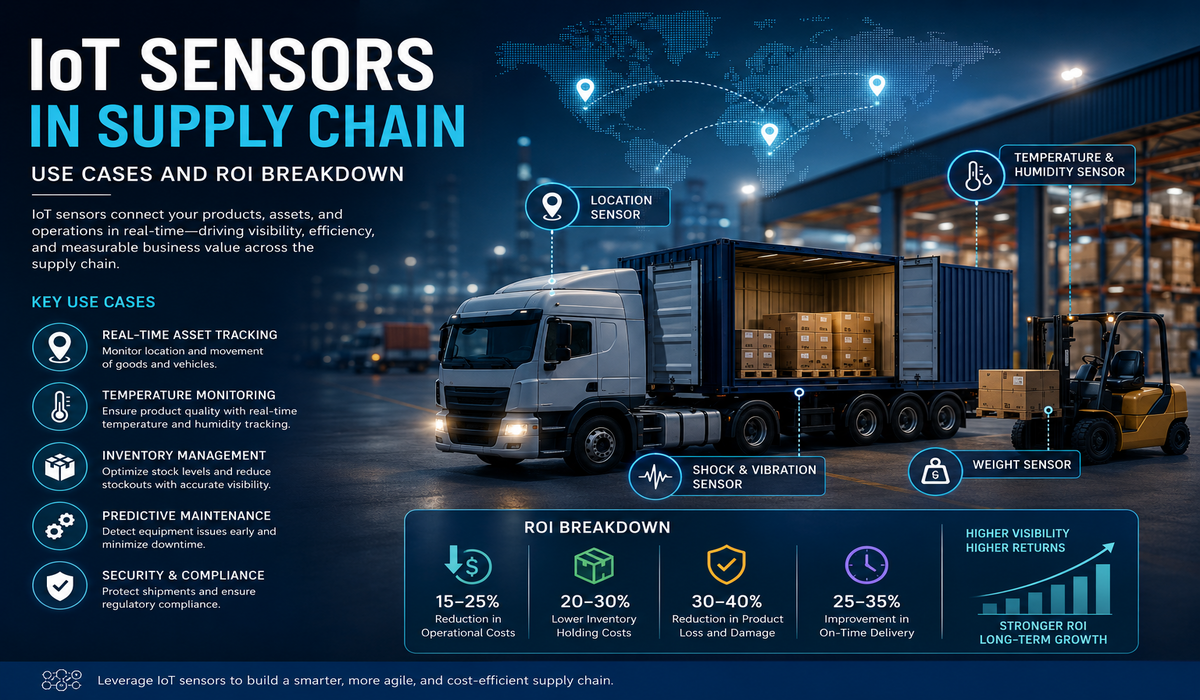
One of the most common applications of IoT sensors is tracking valuable assets throughout the logistics network. GPS-enabled sensors allow organizations to know the exact location of vehicles, containers, pallets, or equipment at any given time.
Real-time tracking improves shipment visibility, enhances delivery planning, reduces theft, and allows businesses to respond immediately when unexpected delays occur. Customers also benefit from accurate delivery updates, improving trust and transparency.
Temperature Monitoring for Sensitive Goods
Industries such as pharmaceuticals, food processing, biotechnology, and healthcare require strict environmental control during transportation and storage. Temperature fluctuations can damage products and result in significant financial losses.
IoT temperature sensors continuously monitor storage conditions and automatically generate alerts whenever temperatures move outside acceptable ranges. This enables logistics teams to take corrective action before products become unusable, helping organizations maintain compliance and reduce waste.
Warehouse Environment Monitoring
Warehouses contain thousands of products that require proper storage conditions. IoT sensors monitor humidity, air quality, lighting, and temperature throughout storage facilities.
Continuous environmental monitoring helps protect inventory while reducing the risk of product damage. Facility managers can also optimize energy consumption by automatically controlling heating, ventilation, and cooling systems based on real-time sensor data.
Inventory Management
Maintaining accurate inventory remains one of the biggest challenges for supply chain operations. IoT sensors simplify inventory management by providing continuous visibility into stock levels, product movement, and storage utilization.
Instead of relying solely on periodic manual counts, businesses receive automated inventory updates that improve forecasting accuracy and reduce stock shortages or excess inventory. Better inventory visibility also enables faster order fulfillment and improved customer service.
Fleet Performance Monitoring
Transportation plays a major role in supply chain costs. IoT sensors installed in commercial vehicles collect information about engine performance, fuel consumption, driving behavior, tire pressure, and vehicle health.
Fleet managers use this data to optimize routes, improve fuel efficiency, reduce maintenance expenses, and increase vehicle utilization. Predictive maintenance alerts also help prevent unexpected breakdowns that could disrupt deliveries.
Predictive Maintenance for Equipment
Warehouse machinery, conveyor systems, forklifts, and manufacturing equipment are critical assets that require regular maintenance. IoT vibration, pressure, and performance sensors continuously monitor equipment conditions.
Instead of following fixed maintenance schedules, organizations can identify early signs of equipment wear and perform maintenance only when necessary. This reduces downtime, extends equipment lifespan, and lowers maintenance costs.
ROI Breakdown of IoT Sensors in Supply Chain
Reduced Operational Costs
One of the biggest financial benefits of implementing IoT sensors is operational cost reduction. Automated monitoring reduces manual inspections, minimizes paperwork, and decreases labor-intensive processes.
Real-time data also allows businesses to optimize transportation routes, reduce fuel consumption, improve warehouse utilization, and eliminate unnecessary operational inefficiencies.
Lower Product Losses
Damaged goods, spoilage, theft, and transportation errors can significantly impact profitability. IoT sensors continuously monitor product conditions and asset movement, helping organizations detect problems before losses occur.
By preventing temperature excursions, unauthorized access, or shipment delays, businesses can reduce waste and improve overall supply chain reliability.
Improved Inventory Accuracy
Inventory inaccuracies often lead to delayed shipments, excess stock, and dissatisfied customers. IoT-enabled inventory monitoring provides accurate stock visibility across warehouses and distribution centers.
Improved inventory accuracy reduces carrying costs while ensuring products remain available when customers need them.
Increased Equipment Availability
Unexpected equipment failures can halt warehouse operations and delay deliveries. Predictive maintenance supported by IoT sensors helps identify potential failures before they become critical.
As equipment availability improves, organizations experience higher productivity, reduced repair expenses, and more efficient resource utilization.
Better Decision-Making Through Data
The value of IoT extends beyond automation. The continuous flow of operational data enables supply chain leaders to identify performance trends, forecast demand, optimize processes, and make evidence-based business decisions.
Organizations gain better visibility into every stage of their logistics network, improving long-term planning and operational resilience.
Challenges of Implementing IoT Sensors
Although the benefits are significant, implementing IoT sensors requires careful planning. Businesses must ensure secure network connectivity, reliable cloud infrastructure, and integration with existing enterprise systems.
Managing large volumes of sensor-generated data can also become challenging without proper analytics platforms. Organizations should establish clear data governance policies while investing in cybersecurity measures to protect connected devices from unauthorized access.
Employee training is equally important, as successful adoption depends on how effectively teams can interpret and utilize real-time sensor insights.
Best Practices for Successful Implementation
Organizations should begin with clearly defined business objectives before deploying IoT sensors across their supply chain. Identifying high-value use cases such as fleet tracking, inventory monitoring, or predictive maintenance allows businesses to demonstrate measurable results early in the implementation process.
Choosing scalable IoT platforms ensures future expansion without requiring major infrastructure changes. Integration with ERP, warehouse management systems, transportation management systems, and analytics platforms also maximizes the value of collected data.
Regular sensor maintenance, network monitoring, and cybersecurity assessments help maintain long-term system reliability while protecting operational data.
The Future of IoT Sensors in Supply Chain
The future of supply chain management will be increasingly driven by intelligent automation and real-time decision-making. IoT sensors will continue evolving alongside artificial intelligence, edge computing, machine learning, and digital twin technologies.
Organizations will gain even greater visibility into global logistics operations through autonomous monitoring systems capable of detecting risks before they impact business performance. Advanced analytics will transform sensor data into predictive insights, enabling companies to optimize inventory, transportation, and warehouse operations with greater precision.
As connected ecosystems become more sophisticated, IoT sensors will play a central role in building resilient, sustainable, and highly efficient supply chains.
Conclusion
The adoption of IoT Sensors in Supply Chain operations is transforming how organizations monitor assets, manage inventory, optimize transportation, and improve operational efficiency. By delivering real-time visibility across every stage of logistics, IoT sensors enable businesses to reduce costs, improve customer satisfaction, minimize product losses, and make faster, data-driven decisions.
While successful implementation requires careful planning, secure infrastructure, and system integration, the long-term return on investment often outweighs the initial deployment costs. As supply chains continue embracing digital transformation, organizations that invest in IoT sensor technology today will be better positioned to build smarter, more responsive, and future-ready logistics networks.
FAQs
Q1. What are IoT sensors in supply chain management?
IoT sensors in supply chain management are connected devices that collect and transmit real-time data such as location, temperature, humidity, vibration, and movement. This information helps businesses monitor shipments, optimize inventory, improve warehouse operations, and increase overall supply chain visibility.
Q2. How do IoT sensors improve supply chain efficiency?
IoT sensors improve supply chain efficiency by providing real-time tracking, automating inventory monitoring, reducing manual processes, enabling predictive maintenance, and helping organizations respond quickly to operational disruptions. These capabilities lead to faster decision-making and lower operational costs.
Q3. Which industries benefit the most from IoT sensors in supply chain operations?
Industries such as manufacturing, retail, healthcare, pharmaceuticals, food and beverage, logistics, automotive, and e-commerce benefit significantly from IoT sensors. They rely on real-time monitoring to protect products, improve inventory accuracy, and ensure timely deliveries.
Q4. What is the return on investment (ROI) of implementing IoT sensors in supply chains?
The ROI of implementing IoT sensors in supply chains comes from reduced transportation costs, lower product losses, improved inventory accuracy, minimized equipment downtime, better asset utilization, and enhanced operational productivity. These benefits often lead to long-term cost savings and improved business performance.
Q5. What challenges should businesses consider before deploying IoT sensors in supply chains?
Before implementing IoT sensors, businesses should consider factors such as network connectivity, cybersecurity, data integration, scalability, sensor maintenance, and compatibility with existing ERP or warehouse management systems. Proper planning ensures a successful and secure deployment.
