

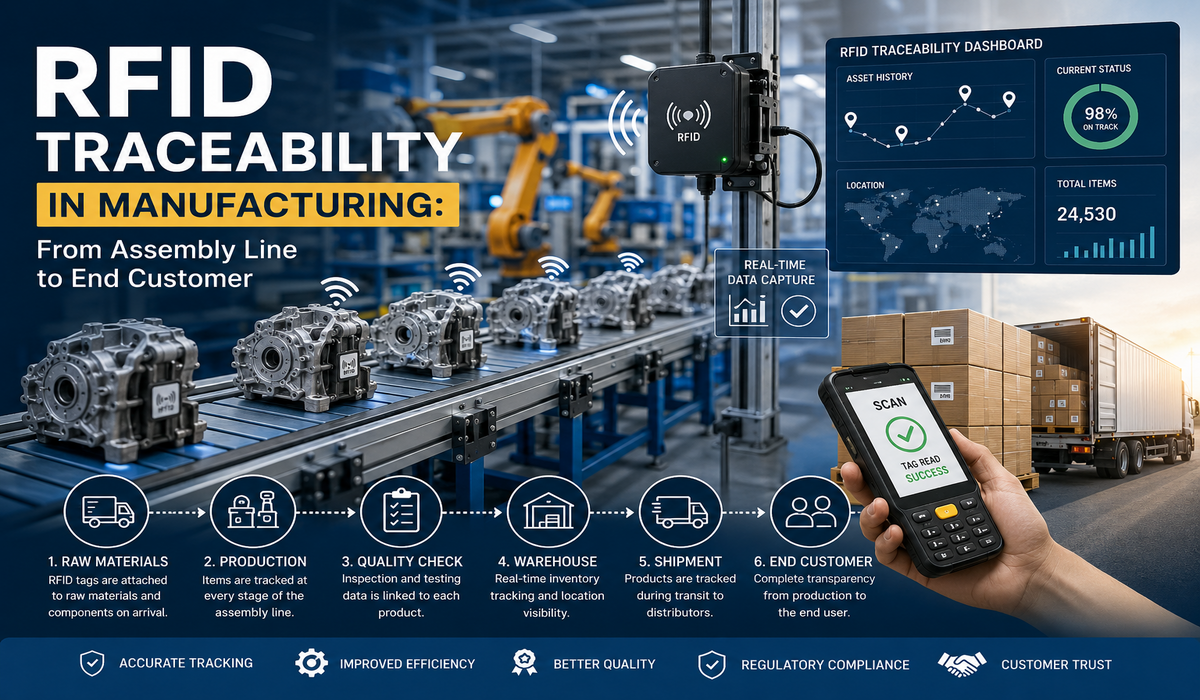
Manufacturing has evolved significantly over the past decade, with businesses increasingly relying on digital technologies to improve operational efficiency, product quality, and supply chain visibility. As production volumes continue to grow and customer expectations become more demanding, manufacturers need accurate methods to monitor products throughout every stage of their lifecycle. This is where RFID Traceability plays a crucial role.
Unlike traditional tracking methods that depend on manual barcode scanning, RFID technology enables manufacturers to identify, monitor, and record product movements automatically. Every component, finished product, and shipment can be tracked in real time, providing complete visibility from the assembly line to the end customer.
Whether manufacturers operate in the automotive, electronics, pharmaceutical, aerospace, food processing, or consumer goods industries, RFID traceability helps reduce errors, improve compliance, streamline inventory management, and strengthen customer trust. As Industry 4.0 continues to reshape manufacturing, RFID traceability has become an essential investment rather than an optional technology.
Understanding RFID Traceability
RFID Traceability refers to the process of tracking materials, components, work-in-progress items, and finished products throughout the manufacturing lifecycle using Radio Frequency Identification technology. Each item is assigned a unique RFID tag containing digital information that can be read automatically without direct line-of-sight.
Unlike conventional barcode systems, RFID readers can capture multiple tags simultaneously, even when products are moving rapidly on conveyor belts or stored inside containers. This enables manufacturers to maintain continuous visibility without slowing production.
The collected data is automatically transferred to enterprise systems such as ERP, Manufacturing Execution Systems (MES), Warehouse Management Systems (WMS), and supply chain management platforms. As a result, organizations gain a centralized view of product movement, inventory status, production history, and customer delivery information.
How RFID Traceability Works in Manufacturing
RFID Tagging During Raw Material Intake
The RFID traceability journey begins when raw materials or components arrive at the manufacturing facility. Each incoming item receives an RFID tag or already contains one provided by the supplier.
The RFID tag stores important information such as supplier identification, batch number, production date, material specifications, inspection records, and inventory location. Once scanned automatically, this information becomes instantly available within the manufacturer’s digital systems.
This eliminates manual data entry while reducing receiving errors and improving inventory accuracy from the very beginning of the manufacturing process.
Tracking Components Throughout Production
As materials move through various production stages, RFID readers installed at workstations automatically capture product movement. Every production activity is recorded without interrupting manufacturing operations.
Manufacturers can identify which workstation processed a component, which operator handled it, which machine was used, and how much time was spent during production. This detailed production history helps improve process transparency while supporting quality assurance initiatives.
Because RFID scanning happens automatically, manufacturers gain continuous visibility without requiring employees to perform repetitive scanning tasks.
Monitoring Work-in-Progress Inventory
Manufacturing environments often contain thousands of semi-finished products moving between assembly stations. Keeping track of work-in-progress inventory manually is both difficult and time-consuming.
RFID traceability allows organizations to monitor every partially completed product in real time. Supervisors can immediately identify production bottlenecks, delayed orders, missing components, and inventory shortages before they impact delivery schedules.
This visibility improves production planning while enabling faster operational decisions.
Recording Quality Inspection Data
Quality control plays an important role in manufacturing, especially for industries operating under strict regulatory requirements.
RFID traceability links inspection reports directly to individual products. Whenever a product undergoes testing, calibration, or inspection, the results become part of its permanent digital history.
If quality issues arise later, manufacturers can quickly determine where the defect occurred and which production batch was affected. This significantly reduces investigation time while improving product reliability.
Warehouse and Inventory Management
After production is completed, RFID traceability continues within warehouses and distribution centers.
RFID readers automatically update inventory records whenever products enter storage locations, move between warehouse zones, or leave for shipment. This real-time inventory visibility minimizes stock discrepancies while improving warehouse efficiency.
Manufacturers can locate products instantly without performing lengthy manual inventory searches.
Shipment Tracking and Customer Delivery
RFID traceability extends beyond manufacturing facilities into the logistics network.
As products leave warehouses, RFID readers record shipment details automatically. Manufacturers can verify shipment accuracy while tracking products throughout transportation until they reach distributors, retailers, or end customers.
This end-to-end visibility reduces shipping errors and provides customers with greater confidence regarding product authenticity and delivery status.
Key Components of an RFID Traceability System
RFID Tags
RFID tags are attached to products, pallets, containers, or individual components. They contain unique identification numbers and additional manufacturing information that supports complete lifecycle tracking.
Manufacturers select passive, active, or semi-passive RFID tags depending on product type, environmental conditions, and reading distance requirements.
RFID Readers
RFID readers capture information stored within RFID tags automatically. Fixed readers are installed along production lines, warehouse entrances, loading docks, and conveyor systems, while handheld readers provide flexibility for manual inspections and inventory verification.
RFID Antennas
Antennas determine reading range and communication accuracy between RFID tags and readers. Proper antenna placement ensures consistent data collection across production facilities.
RFID Software Platform
The software platform processes RFID data and integrates it with existing enterprise applications. It provides dashboards, analytics, inventory visibility, production reports, and historical tracking information for management teams.
Enterprise System Integration
RFID traceability becomes significantly more valuable when integrated with ERP, MES, SCM, and WMS platforms. This integration creates a unified digital environment where production, inventory, logistics, and quality information remain synchronized across departments.
Benefits of RFID Traceability in Manufacturing
Improved Product Visibility
One of the biggest advantages of RFID Traceability is complete visibility across the manufacturing lifecycle. Organizations always know where products are located, which production stage they have reached, and when they are ready for shipment.
This visibility improves operational planning while reducing uncertainty throughout manufacturing operations.
Enhanced Product Quality
By maintaining detailed production histories, manufacturers can quickly identify the source of defects and isolate affected products.
Instead of recalling entire production batches, companies can perform highly targeted recalls that minimize financial losses and protect brand reputation.
Greater Inventory Accuracy
Real-time inventory tracking significantly reduces stock inaccuracies caused by manual counting and human error.
Manufacturers maintain accurate inventory records while improving material planning and reducing excess inventory costs.
Faster Recall Management
Product recalls are often expensive and time-sensitive. RFID traceability enables manufacturers to identify affected products within minutes rather than days.
Complete production histories allow organizations to locate specific batches immediately, improving customer safety while minimizing operational disruption.
Increased Manufacturing Efficiency
Automated identification eliminates repetitive manual scanning activities throughout production.
Employees spend less time recording product movement and more time focusing on value-added manufacturing tasks, increasing overall productivity.
Better Regulatory Compliance
Industries such as pharmaceuticals, food manufacturing, medical devices, and aerospace must maintain complete product traceability for regulatory compliance.
RFID traceability automatically creates accurate digital records that support audits, certifications, and compliance reporting.
Improved Customer Satisfaction
Customers increasingly expect transparency regarding product origin, manufacturing quality, and delivery status.
RFID traceability allows manufacturers to provide reliable product information, increasing customer confidence while strengthening long-term business relationships.
Industries Benefiting from RFID Traceability
Automotive Manufacturing
Automotive manufacturers use RFID traceability to monitor engines, transmissions, electronic components, and vehicle assemblies throughout production. This improves quality control while supporting warranty management.
Electronics Manufacturing
Electronic manufacturers rely on RFID traceability to track sensitive components, reduce assembly errors, and improve inventory accuracy across high-volume production environments.
Pharmaceutical Manufacturing
RFID traceability helps pharmaceutical companies monitor medicine production, prevent counterfeit products, maintain regulatory compliance, and ensure patient safety.
Food and Beverage Manufacturing
Food manufacturers use RFID traceability to monitor ingredient sourcing, production batches, storage conditions, and product distribution while supporting food safety regulations.
Aerospace Manufacturing
Aircraft manufacturers require complete documentation for every component used during production. RFID traceability provides permanent digital records that support maintenance, safety inspections, and regulatory compliance.
Challenges of Implementing RFID Traceability
Although RFID traceability offers significant advantages, successful implementation requires careful planning.
Manufacturers must evaluate infrastructure requirements, RFID tag selection, reader placement, software integration, and employee training. Production environments containing metal surfaces or liquid products may require specialized RFID solutions to ensure reliable performance.
Organizations should also focus on integrating RFID systems with existing ERP and manufacturing software to maximize operational value. Working with experienced RFID solution providers helps overcome implementation challenges while ensuring long-term success.
Future of RFID Traceability in Manufacturing
As Industry 4.0 technologies continue to advance, RFID traceability is becoming more intelligent and data-driven.
Artificial intelligence is helping manufacturers analyze RFID data to predict equipment failures, optimize production schedules, and improve quality control. IoT connectivity enables continuous monitoring of products throughout global supply chains, while cloud-based platforms allow manufacturers to access real-time traceability information from anywhere.
Digital twins, predictive analytics, and automation technologies will further enhance RFID traceability, enabling manufacturers to build smarter, more connected production environments that deliver higher efficiency and better customer experiences.
Conclusion
RFID Traceability has become a critical technology for modern manufacturing, enabling complete visibility from raw material intake to final customer delivery. By automating product identification, improving inventory accuracy, strengthening quality control, and supporting regulatory compliance, RFID traceability helps manufacturers operate more efficiently while reducing operational risks.
As manufacturing becomes increasingly connected through Industry 4.0, organizations that invest in RFID traceability will be better positioned to improve productivity, deliver superior product quality, and build resilient supply chains. Businesses looking to modernize their manufacturing operations should consider RFID traceability as a strategic investment that supports long-term operational excellence and customer satisfaction.
Frequently Asked Questions (FAQs)
Q1. What is RFID Traceability in manufacturing?
RFID Traceability is the process of using Radio Frequency Identification (RFID) technology to track raw materials, components, work-in-progress items, and finished products throughout the manufacturing lifecycle. It provides real-time visibility, improves inventory accuracy, and helps manufacturers maintain complete product history from production to delivery.
Q2. How does RFID Traceability improve manufacturing efficiency?
RFID Traceability automates the identification and tracking of products without requiring manual scanning. This reduces human errors, speeds up production workflows, improves inventory management, minimizes delays, and enables manufacturers to monitor operations in real time.
Q3. What industries benefit the most from RFID Traceability?
RFID Traceability is widely used in industries such as automotive, electronics, pharmaceuticals, food and beverage, aerospace, healthcare, and consumer goods manufacturing. These industries rely on accurate product tracking to ensure quality, regulatory compliance, and efficient supply chain management.
Q4. What are the main benefits of implementing RFID Traceability?
Implementing RFID Traceability helps manufacturers improve product visibility, enhance quality control, reduce inventory errors, streamline warehouse operations, support faster product recalls, ensure regulatory compliance, and provide better customer service through end-to-end product tracking.
Q5. Can RFID Traceability be integrated with existing ERP and manufacturing systems?
Yes. Modern RFID Traceability solutions can integrate seamlessly with Enterprise Resource Planning (ERP), Manufacturing Execution Systems (MES), Warehouse Management Systems (WMS), and other business applications. This integration enables real-time data sharing, better production planning, and improved operational decision-making.
