

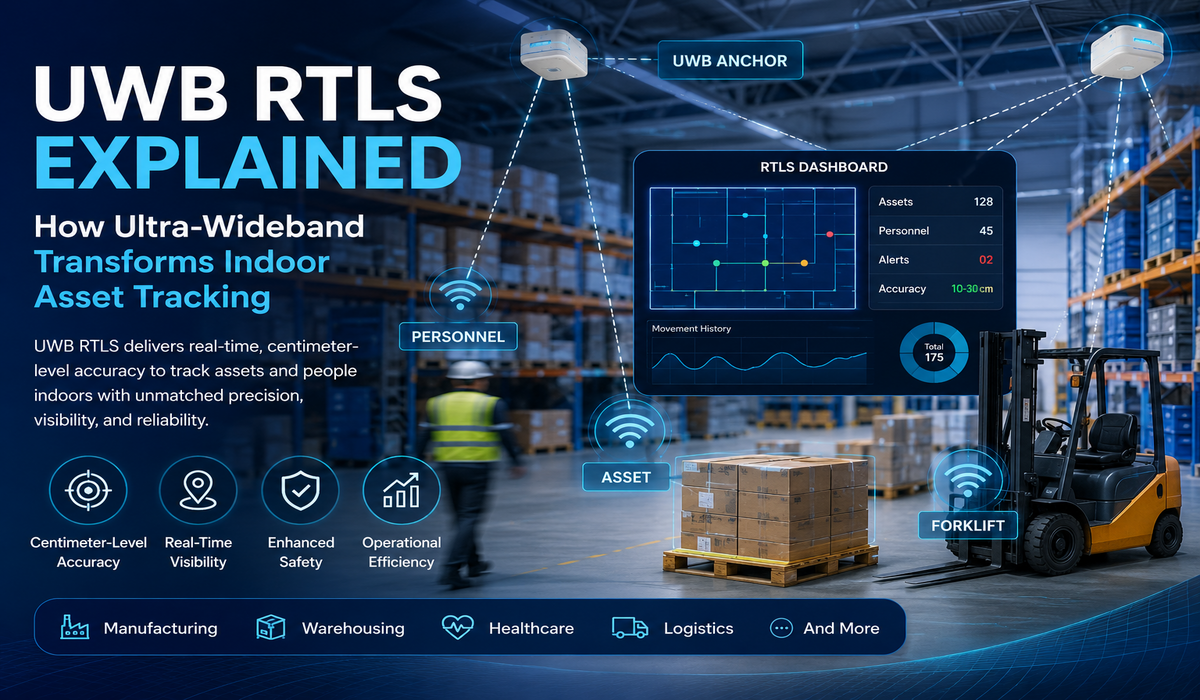
As industries continue to embrace digital transformation, the need for precise indoor asset tracking has become more important than ever. Traditional tracking technologies such as barcodes, RFID, Wi-Fi, and Bluetooth have helped businesses improve visibility, but they often fall short when centimeter-level accuracy is required. This is where UWB RTLS is changing the landscape.
UWB RTLS (Ultra-Wideband Real-Time Location System) enables organizations to locate and monitor assets, equipment, vehicles, and personnel with exceptional precision in real time. From manufacturing plants and warehouses to hospitals and logistics centers, businesses are using this technology to reduce operational delays, improve resource utilization, and strengthen workplace safety.
This article explains what UWB RTLS is, how it works, its major components, business benefits, industry applications, implementation considerations, and why it is becoming the preferred indoor positioning technology for modern enterprises.
What is UWB RTLS?
UWB RTLS is a real-time location tracking system that uses Ultra-Wideband radio technology to determine the precise location of tagged objects or people inside buildings. Unlike GPS, which performs well outdoors but struggles indoors, UWB RTLS is specifically designed for highly accurate indoor positioning.
The technology operates by transmitting extremely short radio pulses across a wide frequency spectrum. These pulses enable the system to calculate the exact position of an asset with an accuracy that can reach 10–30 centimeters, making it one of the most precise indoor positioning technologies available today.
Organizations deploy UWB RTLS to gain complete visibility of critical assets, automate operational workflows, reduce search times, and improve productivity across facilities.
How Does UWB RTLS Work?
A UWB RTLS solution consists of multiple hardware and software components working together to provide continuous location updates.
UWB Tags
Small battery-powered UWB tags are attached to valuable assets, machinery, inventory, tools, medical devices, or employee badges. These tags periodically transmit ultra-wideband signals.
UWB Anchors
Anchors are installed throughout the facility at fixed positions. They receive signals transmitted by UWB tags and accurately calculate their location using Time Difference of Arrival (TDoA), Two-Way Ranging (TWR), or Angle of Arrival (AoA) techniques.
Location Engine
The collected data is processed by a location engine that determines the real-time coordinates of every tagged object.
RTLS Software Platform
The software visualizes assets on interactive facility maps, provides alerts, maintains historical movement records, generates reports, and integrates with ERP, WMS, MES, or enterprise management systems.
The entire process occurs within milliseconds, allowing organizations to monitor moving assets continuously without manual intervention.
Why Traditional Indoor Tracking Falls Short
Many organizations rely on RFID, Wi-Fi, Bluetooth Low Energy (BLE), or barcode systems for asset tracking. While these technologies are useful for many applications, they often lack the positioning accuracy required for critical operations.
Barcode systems require manual scanning, making them unsuitable for continuous tracking. Passive RFID identifies whether an item passed through a checkpoint but cannot provide constant location updates. Wi-Fi positioning generally offers room-level accuracy, while Bluetooth performs better but still struggles in environments requiring highly precise positioning.
UWB RTLS addresses these limitations by delivering real-time location data with centimeter-level accuracy, making it ideal for industries where every second and every meter matter.
Key Features of UWB RTLS
Centimeter-Level Accuracy
One of the biggest advantages of UWB RTLS is its exceptional location precision. Businesses can determine the exact location of equipment within a room rather than simply identifying the building or floor.
Reliable Performance in Complex Environments
Industrial facilities contain machinery, metal structures, racks, and equipment that often interfere with wireless communication. UWB technology performs significantly better in these challenging environments compared to many conventional wireless tracking systems.
Real-Time Visibility
Organizations receive continuous updates regarding asset movement instead of periodic location checks. This enables faster decision-making and immediate response to operational changes.
Low Signal Interference
Ultra-Wideband signals are resistant to interference from Wi-Fi networks and other wireless communication systems, ensuring stable tracking performance even in busy industrial environments.
Enhanced Security
UWB technology supports secure ranging capabilities, reducing the risk of spoofing and unauthorized location manipulation.
Business Benefits of UWB RTLS
Improved Asset Utilization
Many organizations unknowingly purchase duplicate equipment because existing assets cannot be located quickly. UWB RTLS provides complete visibility into asset availability, helping businesses maximize equipment utilization while reducing unnecessary purchases.
Increased Employee Productivity
Employees often spend valuable time searching for tools, machinery, inventory, or medical equipment. With UWB RTLS, assets can be located instantly, allowing employees to focus on higher-value activities.
Better Operational Efficiency
Real-time asset visibility streamlines workflows across warehouses, manufacturing plants, hospitals, and distribution centers. Automated tracking eliminates manual record keeping while improving process efficiency.
Reduced Equipment Loss
Misplaced or stolen assets create financial losses and operational disruptions. UWB RTLS continuously monitors asset movement and can trigger alerts whenever equipment enters unauthorized areas.
Enhanced Workplace Safety
Organizations can monitor employee locations, identify restricted zone violations, and quickly locate personnel during emergencies. This improves overall workplace safety and supports regulatory compliance.
Better Decision-Making
Historical movement data helps businesses analyze asset utilization, identify process bottlenecks, optimize facility layouts, and improve resource allocation.
Industries Using UWB RTLS
Manufacturing
Manufacturing companies use UWB RTLS to monitor production equipment, tools, work-in-progress inventory, forklifts, and automated guided vehicles. Real-time tracking reduces downtime and improves production efficiency.
Warehouse and Logistics
Distribution centers use UWB RTLS to locate pallets, containers, forklifts, and inventory in real time. Faster asset retrieval improves order fulfillment while reducing operational delays.
Healthcare
Hospitals rely on UWB RTLS to track medical devices, infusion pumps, wheelchairs, patient beds, surgical equipment, and healthcare staff. Quick equipment location improves patient care while reducing equipment shortages.
Automotive Manufacturing
Automotive facilities track vehicle components throughout assembly lines to improve production visibility and minimize delays caused by misplaced inventory.
Airports
Airports use UWB RTLS to manage baggage carts, ground support equipment, maintenance tools, and operational vehicles, improving turnaround times and operational efficiency.
Mining and Heavy Industries
Mining companies monitor vehicles, equipment, and personnel operating in hazardous environments. Real-time visibility improves worker safety and emergency response capabilities.
UWB RTLS Compared with Other Tracking Technologies
UWB RTLS vs RFID
RFID is excellent for identification and checkpoint-based tracking, while UWB RTLS provides continuous real-time location tracking with much higher positioning accuracy.
UWB RTLS vs Bluetooth
Bluetooth Low Energy offers lower deployment costs but generally provides meter-level accuracy. UWB RTLS delivers significantly higher precision for applications requiring exact positioning.
UWB RTLS vs Wi-Fi
Wi-Fi infrastructure can support basic location tracking, but its accuracy is typically limited. UWB RTLS is designed specifically for precise indoor positioning where reliable real-time location data is essential.
UWB RTLS vs GPS
GPS works exceptionally well outdoors but loses effectiveness inside buildings. UWB RTLS fills this gap by providing accurate indoor positioning where satellite signals cannot reach.
Key Components of a Successful UWB RTLS Deployment
Facility Assessment
Every deployment begins with understanding the building layout, operational workflows, environmental conditions, and tracking objectives.
Infrastructure Planning
Anchor placement plays a significant role in achieving accurate positioning. Proper planning ensures complete coverage across the facility.
Integration with Existing Systems
Modern UWB RTLS platforms integrate with warehouse management systems, manufacturing execution systems, ERP platforms, IoT applications, and analytics dashboards to create a unified operational ecosystem.
Staff Training
Employees should understand how tagged assets are managed, how dashboards function, and how alerts are handled to maximize system adoption.
Ongoing Optimization
Regular monitoring, software updates, battery management, and calibration help maintain long-term system performance and accuracy.
Challenges of Implementing UWB RTLS
Although UWB RTLS offers significant advantages, organizations should prepare for several implementation considerations.
Initial deployment costs may be higher than simpler tracking technologies because of the required infrastructure and hardware. Proper anchor placement and calibration are critical for achieving maximum accuracy. Large facilities require careful planning to ensure consistent coverage across all operational areas. Integration with legacy enterprise systems may also require custom development depending on the existing IT environment.
Despite these considerations, the operational savings and productivity improvements often justify the investment over time.
Future of UWB RTLS
The future of UWB RTLS is closely connected with Industry 4.0, Industrial IoT, Artificial Intelligence, robotics, and smart manufacturing. As organizations continue to automate operations, demand for highly accurate indoor positioning will continue to grow.
Artificial intelligence will increasingly analyze RTLS data to predict equipment utilization, optimize workflows, and automate decision-making. Integration with autonomous mobile robots, digital twins, predictive maintenance platforms, and smart factory solutions will further expand the value of UWB RTLS across industries.
With advancements in hardware, lower deployment costs, and wider industry adoption, UWB RTLS is expected to become a standard technology for enterprise asset visibility.
Best Practices for Maximizing UWB RTLS Performance
Organizations should begin with clearly defined business objectives before deploying a UWB RTLS solution. Selecting the right hardware, performing comprehensive site surveys, and ensuring proper anchor placement are essential for achieving consistent positioning accuracy.
Integrating RTLS data with existing enterprise applications helps unlock greater business value by enabling automated workflows and actionable analytics. Continuous monitoring, preventive maintenance, and periodic system optimization ensure reliable long-term performance while maximizing return on investment.
Conclusion
As businesses strive to improve operational efficiency, reduce asset losses, and enhance workplace safety, UWB RTLS has emerged as one of the most effective technologies for indoor asset tracking. Its ability to provide real-time, centimeter-level location accuracy makes it significantly more capable than many traditional indoor positioning solutions.
From manufacturing and healthcare to logistics, mining, and smart factories, organizations are adopting UWB RTLS to gain complete visibility into their operations, streamline workflows, and make faster, data-driven decisions. As Industry 4.0 continues to evolve, UWB RTLS will play an increasingly important role in creating intelligent, connected, and highly efficient enterprise environments.
For organizations planning to modernize their asset tracking capabilities, investing in a well-designed UWB RTLS solution can deliver long-term operational improvements, stronger resource utilization, and a measurable competitive advantage.
Frequently Asked Questions (FAQs)
Q1. What is UWB RTLS and how does it work?
UWB RTLS (Ultra-Wideband Real-Time Location System) is an indoor positioning technology that tracks the real-time location of assets, equipment, and personnel with centimeter-level accuracy. It works by using UWB tags attached to assets and fixed anchors installed throughout a facility. The anchors communicate with the tags and send location data to an RTLS software platform, which displays the precise position of tracked items in real time.
Q2. What are the main benefits of using UWB RTLS?
UWB RTLS improves asset visibility, reduces the time spent searching for equipment, enhances workplace safety, minimizes asset loss, increases operational efficiency, and provides valuable location data for better decision-making. Its high accuracy makes it ideal for industries where precise indoor tracking is essential.
Q3. Which industries can benefit from UWB RTLS?
UWB RTLS is widely used in manufacturing, healthcare, warehousing, logistics, automotive, mining, airports, and other industries that require accurate indoor asset tracking. It helps organizations optimize workflows, improve resource utilization, and maintain real-time visibility of critical assets.
Q4. How is UWB RTLS different from RFID and Bluetooth tracking?
While RFID is mainly used for identification and checkpoint-based tracking, and Bluetooth provides approximate location tracking, UWB RTLS offers continuous real-time tracking with centimeter-level accuracy. This makes it a better choice for applications that require precise indoor positioning and instant asset visibility.
Q5. Is UWB RTLS suitable for large industrial facilities?
Yes, UWB RTLS is highly suitable for large industrial facilities such as factories, warehouses, distribution centers, and hospitals. With proper planning and anchor placement, it can provide reliable coverage across extensive indoor environments, helping organizations efficiently track thousands of assets and personnel simultaneously.
