

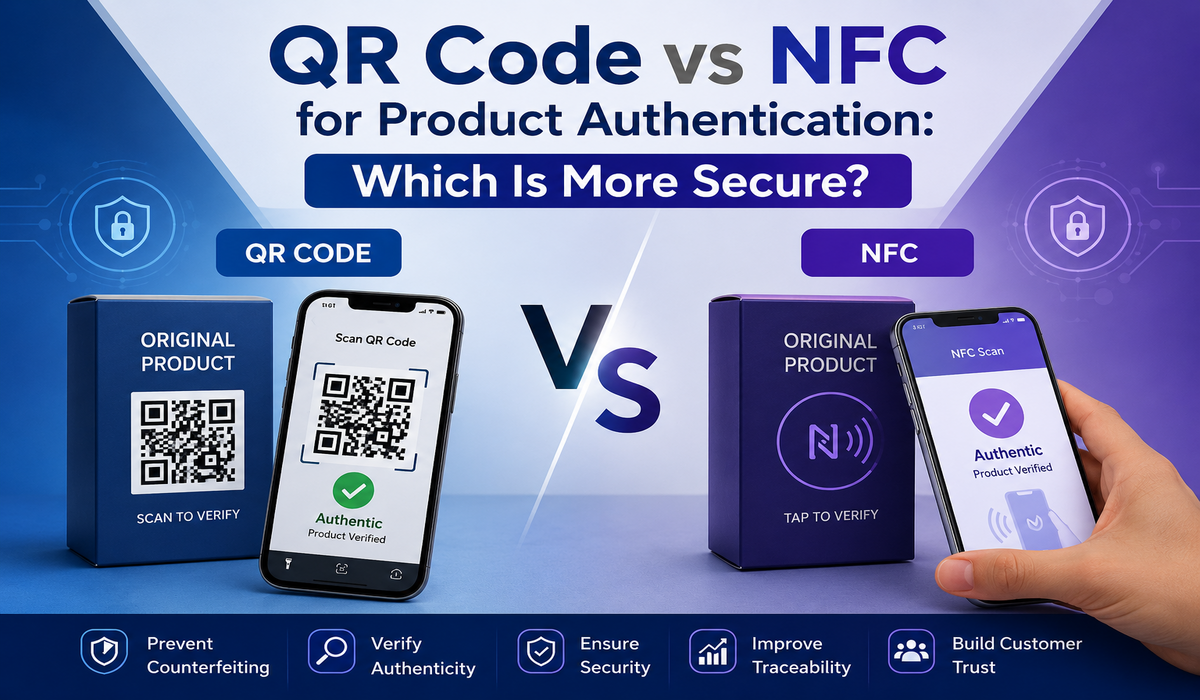
Product counterfeiting has become a serious concern for manufacturers, retailers, brands, and consumers. As products move through complex supply chains, businesses need reliable ways to verify whether an item is genuine before it reaches the customer. This is where QR Code Product Authentication has become increasingly important, alongside NFC-based authentication technologies.
Both QR codes and NFC can connect a physical product to digital information, allowing users to verify authenticity through a smartphone. However, they work in different ways and provide different levels of security, convenience, traceability, and protection against duplication.
Understanding Product Authentication
Product authentication verifies whether a physical product is genuine. It also confirms that the brand legitimately produced or distributed it. Traditional authentication methods often relied on printed labels, serial numbers, holograms, or special packaging elements. While these methods can still provide value, many can be copied or reproduced by counterfeiters.
Digital authentication connects the physical product with a unique digital identity. When someone scans or taps the product, the system checks its identifier. It compares the identifier with data stored in the backend.
What is QR Code Product Authentication?
QR Code Product Authentication uses a QR code printed, engraved, or attached to a product or its packaging. When a customer scans the code using a smartphone camera, the QR code directs the user to a verification page or authentication platform.
The QR code alone does not prove that a product is genuine. Instead, it generally acts as an identifier or access mechanism that connects the physical product to authentication data stored in a digital system.
This distinction is important because the security of QR Code Product Authentication depends heavily on the complete authentication architecture rather than the visual QR code alone.
How QR Code Authentication Works
A manufacturer first assigns a unique digital identity to each product or product unit. That identity is associated with information stored in the authentication database.
The QR code representing the identity is then printed or applied to the product. When a customer scans it, the system receives the identifier and checks it against the backend.
If the identifier is valid and the scanning pattern is normal, the customer can receive a genuine-product confirmation. If the same identifier has been scanned repeatedly from unusual locations or appears on multiple products, the system can flag the activity for investigation.
This makes QR authentication particularly useful for brands that want authentication to be combined with product information, warranty registration, customer engagement, or supply-chain traceability.
What Is NFC Product Authentication?
NFC, or Near Field Communication, allows compatible devices to exchange information over a very short distance. For product authentication, an NFC chip or tag can be embedded into or attached to a product.
Instead of opening a camera and scanning a visible code, the customer typically brings an NFC-enabled smartphone close to the product. The phone communicates with the NFC tag and retrieves the associated information.
NFC tags can also support security features that are difficult to reproduce with ordinary printed identifiers. Depending on the technology and implementation, NFC authentication can use secure elements, cryptographic functions, protected tag data, or dynamic authentication mechanisms.
How NFC Authentication Works
An NFC authentication system assigns an identity to an NFC-enabled product. The tag stores information that allows the authentication platform to identify the item.
When a smartphone taps the tag, the system reads the relevant information and communicates with the authentication platform. The backend can then verify the product and determine whether the authentication request is legitimate.
Advanced NFC solutions can use cryptographic authentication, making it significantly harder for counterfeiters to simply copy the visible identifier from one genuine product and reproduce it elsewhere.
QR Code vs NFC: Which Is More Secure?
The answer depends on how each technology is implemented. A simple static QR code can be relatively easy to copy because the code is visible and can potentially be photographed, reproduced, and placed on counterfeit products.
NFC has an inherent advantage in physical interaction because the tag must normally be brought very close to the smartphone. More importantly, secure NFC technologies can provide cryptographic authentication that goes beyond a simple identifier.
However, this does not mean every NFC solution is automatically more secure than every QR solution. A poorly implemented NFC system can still have weaknesses, while a well-designed QR authentication platform can use unique identifiers, server-side validation, scan monitoring, tamper-evident labels, and dynamic verification methods to provide strong protection.
Security Comparison Between QR Codes and NFC
Resistance to Code Duplication
QR codes are visible by design. A counterfeit producer can potentially photograph a genuine QR code and reproduce the same visual pattern. If the authentication system accepts the same identifier repeatedly without checking usage patterns, this can create a vulnerability.
NFC tags are less convenient to copy physically because the technology requires an NFC tag and appropriate data configuration. Secure NFC implementations can make duplication substantially more difficult by using cryptographic authentication.
Protection Against Identifier Reuse
A static QR code may identify the same product every time it is scanned. If the system does not monitor repeated scans, counterfeiters can potentially exploit the identifier.
Modern QR Code Product Authentication platforms can reduce this risk by assigning unique identifiers to individual products and monitoring scan behavior. The system can identify when a code that should belong to one product suddenly appears in different cities or is scanned an unusual number of times.
Physical Security
QR codes can be printed directly on packaging, labels, or products. This makes them inexpensive and easy to deploy but also means that the visible identifier may be exposed.
NFC tags can be embedded inside products, labels, or packaging. This can make unauthorized replacement more difficult and can also allow brands to create tamper-evident authentication solutions.
Customer Convenience
QR codes have a major advantage in accessibility. Most modern smartphones can scan QR codes using their standard camera application, so customers generally do not need additional hardware.
NFC can be extremely convenient for users with NFC-enabled smartphones because authentication can happen through a simple tap. However, the experience can vary depending on device support, operating system behavior, NFC settings, and the implementation of the authentication solution.
Cost and Deployment Considerations
Cost is another important factor when selecting an authentication technology.
QR codes can be incorporated into existing packaging and printing processes with relatively little additional hardware. This makes them attractive for products manufactured in large volumes where authentication must remain cost-effective.
NFC requires physical tags or chips, which generally increases the per-unit cost. Businesses also need to consider tag attachment, encoding, testing, and integration with manufacturing processes.
For high-value products such as luxury goods, electronics, pharmaceuticals, premium beverages, and specialized industrial products, the additional cost of NFC may be justified by the security benefits.
Can QR Codes Provide Strong Product Security?
Yes. The security of a QR-based system can be significantly improved through proper architecture.
Instead of using one static QR code for an entire product category, manufacturers can assign unique identifiers to individual products. These identifiers can be generated securely and linked to backend records.
The authentication platform can also monitor where and when codes are scanned. If one product identifier is scanned thousands of times or appears in locations that do not match expected distribution patterns, the system can generate an alert.
Therefore, QR Code Product Authentication should not be viewed simply as printing a QR code on a package. It is most effective when the QR code is part of a broader digital authentication system.
Where NFC Has a Stronger Advantage
NFC becomes particularly attractive when product value and counterfeit risk are high.
Luxury brands, premium electronics, pharmaceuticals, automotive components, and high-value industrial products may benefit from NFC because authentication can be integrated into a physical chip rather than relying entirely on a visible printed identifier.
Secure NFC technologies can also support cryptographic verification, helping the authentication platform determine whether the interaction originates from a legitimate tag rather than a copied identifier.
When QR Code Authentication Is the Better Choice
QR codes are often the better choice when businesses need large-scale deployment, broad smartphone compatibility, and lower implementation costs.
They are especially useful when authentication is combined with customer-facing digital experiences. After scanning, a brand can provide product information, warranty registration, usage instructions, loyalty programs, or customer support in addition to authenticity verification.
QR codes also make it easier to integrate authentication into existing packaging workflows without requiring significant changes to the physical product.
For many consumer brands, a secure QR authentication platform with unique identifiers and backend monitoring can provide a practical and scalable solution.
Combining QR Codes and NFC for Stronger Authentication
Businesses do not always have to choose one technology.
A hybrid authentication strategy can combine QR codes with NFC. QR codes can provide easy access for customers using almost any smartphone, while NFC can provide an additional authentication mechanism for products that require stronger security.
For example, a premium product could include a visible QR code for general verification while also containing an NFC tag for advanced authentication. The backend system can compare information from both interactions and use additional signals such as scan frequency, location, device information, and authentication history.
Best Practices for Secure Product Authentication
Give Every Product a Unique Digital Identity
Authentication becomes much stronger when every individual product receives a unique identifier instead of using one code across thousands of products. This allows the system to track individual authentication events and identify suspicious activity.
Use a Secure Backend
The authentication interface should not be treated as the security layer by itself. Product identities, verification records, and authentication rules should be managed through a secure backend system with appropriate access controls and data protection.
Monitor Scanning Behavior
A genuine product should normally follow a reasonable authentication pattern. Unusual activity can indicate that a code has been copied or that counterfeit products are circulating. Monitoring scan frequency, timing, and geographic patterns can help businesses identify potential fraud.
Add Tamper-Evident Protection
Authentication technology becomes more effective when counterfeiters cannot easily remove the original identifier and place it on another product. Tamper-evident labels, embedded tags, and secure product packaging can reduce this risk.
Connect Authentication With Supply Chain Data
Product authentication becomes more valuable when it is connected with manufacturing, distribution, inventory, and logistics information. Businesses can then compare authentication events with the expected movement of products through the supply chain.
Final Thoughts
Both QR codes and NFC can play an important role in modern product authentication, but neither technology should be considered secure simply because it is used on a product. For businesses serving large consumer markets, QR Code Product Authentication can provide a strong combination of accessibility, cost efficiency, traceability, and fraud detection when implemented correctly. For high-value products where stronger physical and cryptographic protection is required, NFC may be the better choice.
Ultimately, the most effective authentication strategy is the one that matches the product’s value, counterfeit risk, customer behavior, manufacturing process, and security requirements. In many cases, combining QR and NFC technologies with a secure backend can deliver the best balance between convenience and protection.
Frequently Asked Questions
Q1. Is NFC more secure than QR codes for product authentication?
Yes, NFC can provide stronger security, especially when secure NFC tags use cryptographic authentication. However, a well-designed QR authentication system with unique identifiers and backend monitoring can also provide strong protection.
Q2. Can counterfeiters copy a QR code?
Yes, a static QR code can potentially be photographed and reproduced. QR Code Product Authentication becomes more secure when each product has a unique identifier and the system monitors unusual or repeated scans.
Q3. Why should businesses use QR codes for product authentication?
QR codes are affordable, easy to deploy, and compatible with most smartphones. They allow businesses to verify products while also providing access to product information, warranties, and other digital services.
Q4. Can NFC tags be duplicated?
Basic NFC tags may be copied depending on their configuration, but secure NFC technologies can use cryptographic features that make unauthorized duplication significantly more difficult.
Q5. Should a business choose QR codes or NFC for product authentication?
The choice depends on the product and security requirements. QR codes are suitable for scalable, cost-effective authentication, while NFC is often better for high-value products requiring stronger physical and cryptographic security.
