
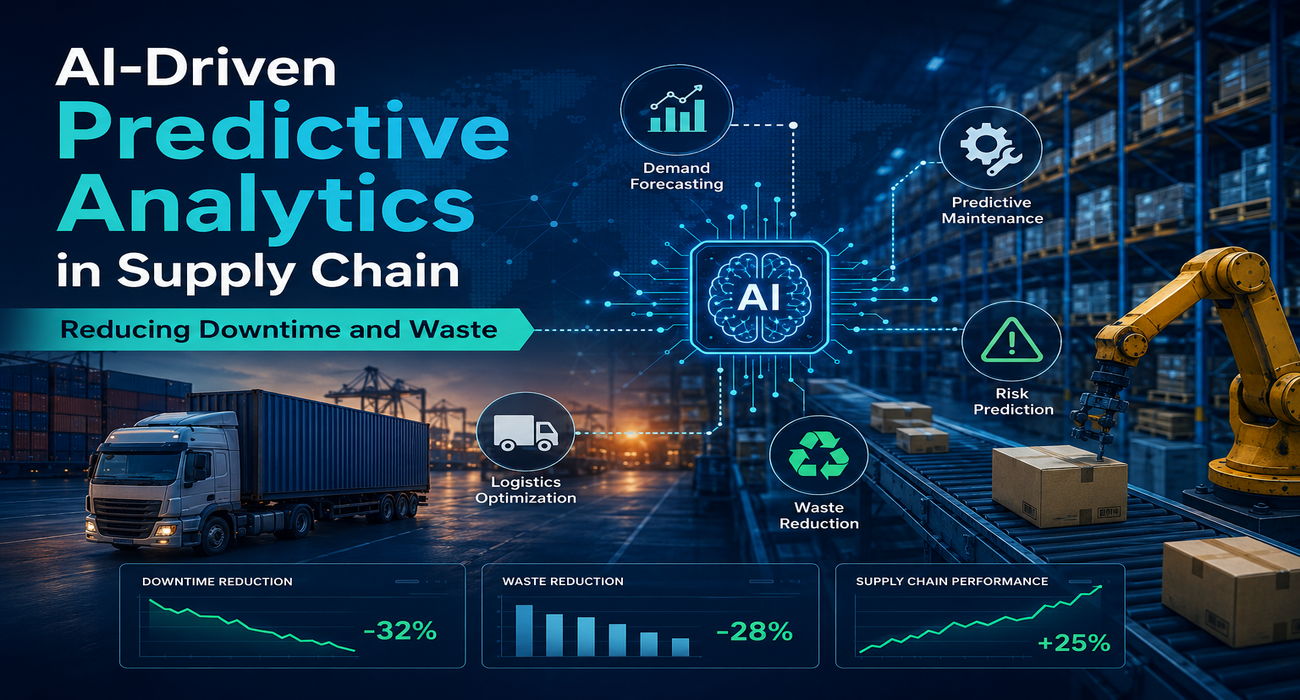
Supply chains are becoming more complex as businesses manage changing customer expectations, global sourcing, transportation challenges, inventory pressures, and unpredictable market conditions. A small disruption at one point in the supply chain can quickly affect production schedules, inventory levels, delivery timelines, and customer satisfaction. This is where Predictive Analytics in Supply Chain operations is becoming increasingly valuable for businesses that want to identify potential problems before they become costly disruptions.
Traditional supply chain management often depends on historical reports and manual decision-making. While these methods can help businesses understand what happened in the past, they are less effective at predicting what may happen next. AI-driven predictive analytics changes this approach by analyzing historical and real-time data to identify patterns, forecast demand, detect risks, and support proactive decisions.
By combining artificial intelligence, machine learning, IoT data, and advanced analytics, organizations can gain better visibility into supply chain operations. This enables them to reduce equipment downtime, minimize material waste, improve inventory planning, optimize transportation, and build more resilient supply networks.
What Is Predictive Analytics in Supply Chain?
Predictive Analytics in Supply Chain refers to the use of historical, real-time, and operational data to forecast future supply chain events and identify potential risks. Instead of simply reporting what has already happened, predictive analytics helps organizations estimate what is likely to happen and take action before an issue affects operations.
AI and machine learning models can analyze large volumes of information from different sources, including sales records, inventory systems, supplier data, warehouse operations, transportation systems, production equipment, and IoT sensors. These models identify relationships and patterns that may not be obvious through manual analysis.
For example, a manufacturer can use machine learning to analyze equipment temperature, vibration, operating hours, maintenance records, and production data. If the system identifies patterns associated with equipment failure, it can alert the maintenance team before the machine breaks down. This can prevent unexpected production stoppages and reduce the cost of emergency repairs.
Similarly, a retailer can analyze historical sales, seasonal trends, customer behavior, promotions, and external factors to forecast product demand. This allows the business to maintain appropriate inventory levels instead of relying entirely on reactive replenishment.
How AI-Driven Predictive Analytics Reduces Supply Chain Downtime
Downtime can have a significant impact on supply chain performance. When production equipment fails, warehouse systems stop operating, or transportation is delayed, the resulting disruption can affect multiple stages of the supply network.
Predictive Maintenance for Critical Equipment
One of the most valuable applications of AI-driven analytics is predictive maintenance. Instead of servicing equipment only according to fixed schedules or waiting for a failure, organizations can use operational data to estimate when maintenance may be required.
IoT sensors can continuously collect information such as temperature, pressure, vibration, energy consumption, and machine performance. AI models can evaluate these signals and identify unusual patterns that indicate potential equipment problems.
This approach allows maintenance teams to intervene at the right time. Businesses can avoid unnecessary maintenance while reducing the risk of unexpected equipment failures. Over time, this can improve asset utilization, extend equipment life, and maintain more consistent production schedules.
Early Detection of Operational Bottlenecks
Supply chain bottlenecks can occur because of production capacity limitations, warehouse congestion, labor shortages, transportation delays, or supplier problems. Predictive analytics can help organizations identify conditions that could create bottlenecks before they significantly affect operations.
AI models can compare current operational conditions with historical patterns and identify areas where delays are becoming more likely. Managers can then adjust production schedules, inventory allocation, staffing, or transportation plans before the bottleneck becomes a major disruption.
Reducing Waste Through Smarter Forecasting
Waste is another major challenge across modern supply chains. Excess inventory, expired products, damaged materials, inefficient transportation, and production errors can all increase operational costs.
Improving Demand Forecasting
Accurate demand forecasting is essential for controlling inventory waste. When demand is underestimated, businesses may experience stockouts and lost sales. When demand is overestimated, organizations may hold excessive inventory that becomes difficult or expensive to sell.
AI-driven predictive analytics can evaluate historical sales data alongside factors such as seasonality, promotions, customer behavior, market trends, and product performance. Machine learning models can continuously improve forecasts as new data becomes available.
This allows organizations to make more informed purchasing and production decisions. Instead of maintaining inventory based primarily on fixed assumptions, businesses can adjust stock levels according to predicted demand.
Minimizing Overstock and Product Waste
For industries dealing with perishable goods, excess inventory can directly translate into financial losses. Food, pharmaceuticals, chemicals, and other products may have limited shelf lives or specific storage requirements.
Predictive models can estimate future demand and help organizations determine how much inventory should be ordered, where it should be stored, and when it should be replenished. This reduces the likelihood of products remaining unused until they expire.
Better inventory forecasting can also improve warehouse space utilization because businesses have greater visibility into which products are likely to move quickly and which may require different inventory strategies.
Predicting Supplier and Logistics Risks
Supply chain performance depends heavily on suppliers and logistics partners. A supplier delay or transportation disruption can quickly create downstream problems.
Identifying Supplier Risks
AI models can analyze supplier delivery history, quality records, lead times, order fulfillment performance, pricing changes, and other operational indicators. This information can help businesses identify suppliers that may present a higher risk of delays or inconsistent performance.
Organizations can then take preventive measures, such as adjusting order schedules, increasing safety stock for critical materials, or developing alternative supplier relationships.
Predictive analytics does not eliminate supplier risk, but it gives organizations more time to respond to potential disruptions.
Forecasting Transportation Delays
Transportation data can also provide valuable predictive insights. Businesses can analyze historical delivery times, route performance, traffic patterns, weather conditions, vehicle information, and shipment data to estimate the likelihood of transportation delays.
When a delay becomes more likely, logistics teams can explore alternative routes, carriers, or delivery schedules. This proactive approach can help organizations maintain more reliable delivery performance and reduce the operational impact of transportation disruptions.
The Role of Real-Time Data in Predictive Supply Chains
The effectiveness of predictive analytics depends heavily on data quality and availability. Modern supply chains generate data continuously through ERP systems, warehouse management platforms, transportation management systems, CRM platforms, IoT devices, RFID systems, barcode technologies, and other operational applications.
Connecting Data Across Supply Chain Systems
Many organizations still operate with data distributed across multiple systems. Procurement information may exist in one platform, inventory information in another, and transportation data somewhere else. This fragmented environment can make it difficult to develop a complete view of supply chain performance.
AI-driven predictive analytics becomes more effective when relevant data can be brought together. An integrated data environment allows organizations to analyze relationships between different supply chain activities.
For example, a business may discover that supplier delays are contributing to production schedule changes, which subsequently increase transportation costs. Such relationships can be difficult to identify when each dataset is analyzed separately.
Using IoT for Continuous Monitoring
IoT devices can provide real-time operational information from factories, warehouses, vehicles, and distribution centers. This creates a continuous flow of data that predictive models can use to identify emerging problems.
For instance, sensors attached to refrigeration equipment can monitor temperature continuously. If the system detects a pattern suggesting that temperature conditions may move outside an acceptable range, an alert can be generated before stored products are damaged.
Business Benefits of Predictive Analytics in Supply Chain Management
Implementing AI-driven predictive analytics can provide benefits across multiple areas of supply chain management. One of the most important advantages is improved decision-making because managers can act based on forecasts and risk indicators rather than relying solely on historical reports.
Businesses can also reduce operational costs by minimizing equipment downtime, excess inventory, emergency shipments, and avoidable waste. Better demand forecasting can improve inventory turnover, while predictive maintenance can help organizations use equipment more efficiently.
Another important benefit is improved supply chain resilience. When businesses can identify potential disruptions earlier, they have more time to develop alternative strategies. This can make supply chains more adaptable when facing changing demand, supplier issues, transportation problems, or unexpected operational events.
Predictive analytics can also improve customer satisfaction. More accurate inventory planning and delivery forecasting can help businesses provide more reliable product availability and delivery commitments.
Challenges of Implementing AI-Driven Predictive Analytics
Although predictive analytics offers significant opportunities, successful implementation requires more than deploying an AI model. Data quality is one of the biggest challenges. Inaccurate, incomplete, outdated, or inconsistent data can reduce the reliability of predictions.
Organizations also need suitable technology infrastructure to collect, integrate, store, and process large volumes of supply chain data. Legacy systems may require integration before predictive analytics can operate effectively across the organization.
Another challenge is organizational adoption. Supply chain teams need to understand how predictive insights should influence operational decisions. AI should support human decision-making rather than operate as an isolated technology project.
Security and data governance are also important. Supply chains often involve sensitive business information, supplier data, customer information, and operational records. Organizations need appropriate controls to protect this information and maintain reliable data governance.
The Future of Predictive Analytics in Supply Chain Operations
The role of AI in supply chain management is expected to expand as organizations gain access to larger volumes of real-time data and more advanced machine learning capabilities. Predictive analytics will increasingly become part of connected supply chain platforms rather than operating as a separate analytical function.
Future systems will likely combine predictive analytics with automation, digital twins, computer vision, IoT, and AI-powered decision support. This could allow businesses to simulate different supply chain scenarios, evaluate potential risks, and automatically recommend the most suitable response.
For example, a supply chain platform could detect an expected supplier delay, estimate its impact on production, evaluate available inventory, identify alternative suppliers, and recommend an adjusted procurement strategy. This moves supply chain management from reactive problem-solving toward proactive and increasingly intelligent operations.
Conclusion
AI-driven Predictive Analytics in Supply Chain management is helping businesses move beyond reactive decision-making toward proactive planning. By analyzing historical and real-time data, organizations can predict equipment failures, forecast demand, identify supplier risks, anticipate transportation delays, and reduce unnecessary waste.
The value of predictive analytics extends beyond cost reduction. It can improve operational visibility, inventory management, equipment utilization, delivery reliability, and supply chain resilience. However, businesses need reliable data, connected systems, appropriate AI infrastructure, and strong implementation strategies to achieve these benefits.
As supply chains become increasingly data-driven, predictive analytics will play an important role in helping organizations understand what is likely to happen next and prepare for it. Businesses that successfully combine AI, machine learning, IoT, and operational data can build supply chains that are not only more efficient but also more adaptable, resilient, and prepared for future challenges.
Frequently Asked Questions
Q1. What is Predictive Analytics in Supply Chain management?
Predictive Analytics in Supply Chain management uses AI, machine learning, and historical and real-time data to forecast demand, identify potential disruptions, predict equipment failures, and improve operational decision-making.
Q2. How does predictive analytics reduce supply chain downtime?
Predictive analytics can identify early warning signs of equipment failures, transportation delays, supplier issues, and operational bottlenecks. Businesses can then take corrective action before these problems cause significant downtime.
Q3. Can predictive analytics help reduce inventory waste?
Yes. Predictive analytics improves demand forecasting by analyzing sales patterns, seasonality, customer behavior, and other relevant data. This helps businesses maintain appropriate inventory levels and reduce overstock, expired products, and unnecessary storage costs.
Q4. What data is required for predictive analytics in supply chains?
Common data sources include sales records, inventory levels, supplier performance, transportation information, production data, maintenance records, ERP systems, warehouse systems, and real-time IoT sensor data.
Q5. What are the main benefits of Predictive Analytics in Supply Chain operations?
Key benefits include better demand forecasting, reduced equipment downtime, lower inventory waste, improved supplier management, more efficient transportation, faster decision-making, reduced operational costs, and greater supply chain resilience.
