

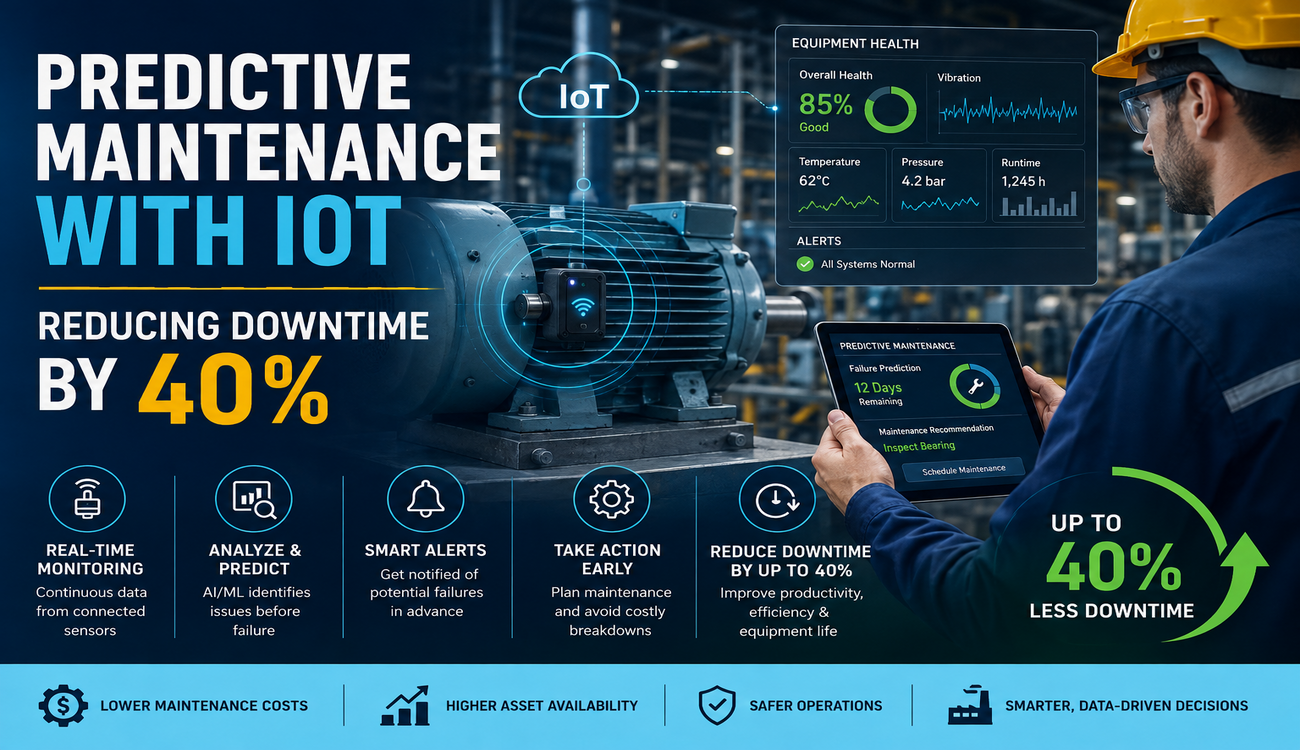
Manufacturing and industrial businesses cannot afford frequent equipment breakdowns. Unexpected failures can stop production, delay deliveries, increase repair costs, and affect customer satisfaction. Traditional maintenance methods, such as reactive maintenance and fixed maintenance schedules, often fail to identify problems before they become serious. This is where Predictive Maintenance with IoT is changing the way organizations manage equipment and production assets.
By combining IoT sensors, real-time monitoring, cloud platforms, data analytics, and machine learning, businesses can continuously track equipment conditions and identify early warning signs of failure. Instead of waiting for a machine to break down or replacing components based only on a calendar schedule, maintenance teams can act when the equipment actually shows signs of deterioration.
For organizations operating large fleets of machines, production lines, warehouses, utilities, or industrial assets, this approach can significantly reduce unplanned downtime. In well-designed implementations, predictive maintenance programs can contribute to downtime reductions of around 40% or more, depending on the equipment, baseline performance, data quality, and maintenance processes.
What is Predictive Maintenance with IoT?
Predictive Maintenance with IoT is a maintenance strategy that uses connected sensors and IoT technologies to monitor the condition and performance of equipment continuously. Sensors installed on machines collect information such as temperature, vibration, pressure, humidity, energy consumption, speed, and operating hours.
This information is transmitted through an IoT network to a centralized platform where it can be stored, analyzed, and monitored. Analytics systems can identify unusual patterns and compare current equipment behavior with historical performance.
When the system detects conditions that may indicate a developing fault, maintenance teams can receive alerts and investigate the issue before it results in a major breakdown.
How It Differs From Traditional Maintenance
Traditional reactive maintenance follows a simple approach: repair equipment after it fails. Although this method may appear straightforward, unexpected breakdowns can create significant operational disruption.
Preventive maintenance improves the situation by scheduling inspections and component replacements at predefined intervals. However, equipment does not always deteriorate according to a fixed timetable. A component may fail earlier than expected or continue working efficiently long after its scheduled replacement.
Predictive maintenance takes a condition-based approach. Instead of relying entirely on fixed schedules, organizations use actual equipment data to determine when maintenance is required. IoT makes this possible by providing continuous visibility into machine conditions.
How IoT Enables Predictive Maintenance
IoT acts as the connection layer between physical equipment and digital maintenance systems. Sensors capture operational information from machines and transmit it to platforms that maintenance teams can access in real time.
IoT Sensors Capture Equipment Conditions
The process begins with sensors installed on critical equipment. Different machines require different types of sensors depending on the potential failure modes being monitored.
Vibration sensors can identify unusual movement in motors, pumps, bearings, and rotating machinery. Temperature sensors can detect overheating, while pressure sensors can identify abnormal pressure levels in hydraulic and pneumatic systems.
Energy monitoring sensors can also provide valuable information. A sudden increase in power consumption may indicate that a machine is operating under excessive load or that a component is becoming less efficient.
Real-Time Data Transmission
Once the sensors collect information, IoT gateways or communication networks transmit the data to an IoT platform. Depending on the industrial environment, organizations may use technologies such as Wi-Fi, cellular networks, Ethernet, LoRaWAN, Bluetooth Low Energy, or industrial communication protocols.
Real-time connectivity allows maintenance teams to monitor equipment without physically inspecting every machine continuously. This becomes particularly valuable for large facilities where hundreds or thousands of assets may be operating simultaneously.
Data Analytics Identifies Abnormal Patterns
Collecting data is only the beginning. The real value comes from analyzing it.
IoT platforms can compare current sensor readings against historical operating conditions and predefined thresholds. More advanced systems can use machine learning models to identify patterns associated with equipment degradation.
For example, a motor may normally operate within a particular vibration range. If vibration gradually increases over several weeks, the system can recognize the trend and alert maintenance teams before the motor reaches a critical failure condition.
How Predictive Maintenance Can Reduce Downtime by 40%
Reducing downtime by 40% is not achieved simply by installing sensors. The result comes from combining continuous monitoring, accurate analytics, timely alerts, and effective maintenance processes.
Detecting Problems Before Equipment Failure
One of the biggest advantages of predictive maintenance is early fault detection. Equipment rarely fails without any preceding changes. Temperature may gradually increase, vibration may become abnormal, or energy consumption may rise.
IoT monitoring makes these changes visible. Maintenance teams can investigate the underlying problem while the equipment is still operational.
This can prevent minor issues from developing into expensive failures that require emergency repairs and extended production shutdowns.
Improving Maintenance Scheduling
Predictive maintenance also allows companies to plan maintenance activities more effectively. Instead of responding to unexpected breakdowns, maintenance teams can schedule repairs during planned production interruptions.
This minimizes the operational impact of maintenance work.
For example, if an IoT system identifies that a bearing is showing signs of deterioration, the maintenance team can arrange a replacement during the next planned service window. Without predictive monitoring, the same bearing could fail during production and cause an unplanned shutdown.
Reducing Secondary Equipment Damage
A failing component can sometimes damage other parts of a machine. A worn bearing, for example, may create additional vibration that affects connected components.
Early detection can prevent this chain reaction. Addressing the original problem before it becomes severe can reduce repair requirements and help keep the wider system operational.
Increasing Equipment Availability
Equipment availability is closely connected to production efficiency. When machines remain operational for longer periods, production teams can achieve more consistent output.
Predictive maintenance helps improve availability by reducing unexpected interruptions and ensuring that maintenance resources are focused on equipment that actually requires attention.
Key Components of an IoT Predictive Maintenance System
A successful implementation requires more than sensors. Several interconnected technologies work together to create a complete predictive maintenance environment.
Sensors and Connected Devices
Sensors collect physical information from equipment. The type and number of sensors depend on the machinery and the failure conditions the organization wants to detect.
Selecting the right sensors is important because poor-quality or irrelevant data can reduce the accuracy of maintenance predictions.
IoT Gateway
The IoT gateway collects information from connected sensors and transfers it to the appropriate platform. It can also perform initial data processing before information is sent to the cloud or an on-premises system.
In industrial environments, gateways can help connect modern IoT devices with existing machinery and communication systems.
Cloud and Data Platforms
Cloud platforms provide scalable infrastructure for storing and processing large amounts of equipment data. Maintenance teams can access dashboards from different locations and monitor multiple facilities through a centralized environment.
Organizations with strict operational or security requirements can also combine cloud infrastructure with edge computing or on-premises systems.
Analytics and Machine Learning
Analytics tools convert raw sensor readings into useful maintenance information. Basic analytics can identify threshold violations, while advanced models can identify complex patterns that may indicate future failures.
Machine learning becomes especially useful when an organization has sufficient historical equipment data to train and improve predictive models.
Industries Using IoT-Based Predictive Maintenance
Predictive maintenance is applicable across industries where equipment reliability directly affects operational performance.
Manufacturing
Manufacturing plants can monitor motors, conveyors, pumps, compressors, CNC machines, robotic systems, and production equipment. Predictive monitoring can help identify developing mechanical or electrical problems before they stop production lines.
Energy and Utilities
Power plants, renewable energy facilities, and utility providers depend on equipment that must operate continuously. Monitoring turbines, generators, transformers, pumps, and other critical assets can help reduce unexpected service interruptions.
Transportation and Logistics
Fleet operators can use connected sensors to monitor vehicles and identify potential issues related to engines, brakes, tires, batteries, and other components. Predictive maintenance can help reduce vehicle downtime and improve fleet availability.
Oil and Gas
Oil and gas facilities operate complex equipment under demanding conditions. Monitoring pressure, temperature, vibration, flow, and other operational parameters can help maintenance teams identify equipment problems before they become major operational risks.
Challenges in Implementing Predictive Maintenance
Despite its benefits, implementing an IoT-based predictive maintenance strategy requires careful planning.
Data Quality and Integration
Predictive models depend heavily on accurate data. Missing readings, faulty sensors, inconsistent measurements, and disconnected systems can reduce the reliability of maintenance insights.
Organizations also need to integrate IoT platforms with existing enterprise systems, maintenance management software, ERP platforms, and operational technology.
Cybersecurity
Connected equipment creates additional digital entry points that organizations need to protect. Industrial IoT systems should use appropriate authentication, encryption, network segmentation, access controls, and monitoring practices.
Cybersecurity should be considered from the beginning rather than added after the system has already been deployed.
Initial Investment
Installing sensors, gateways, connectivity infrastructure, analytics platforms, and integration systems requires investment. However, organizations should evaluate the project based on long-term operational value rather than focusing only on initial costs.
The reduction in downtime, emergency repairs, production losses, and unnecessary maintenance can provide measurable returns over time.
Best Practices for Successful Implementation
Companies should begin with critical assets rather than attempting to connect every machine immediately. Identifying equipment that causes the highest downtime or generates the greatest maintenance cost provides a practical starting point.
Organizations should then define measurable goals, such as reducing unplanned downtime, improving equipment availability, lowering maintenance costs, or increasing mean time between failures.
Sensor selection should be based on actual failure modes. Installing large numbers of sensors without a clear monitoring strategy can create unnecessary data without delivering useful insights.
Maintenance teams should also be involved throughout the implementation. Predictive maintenance is not purely a technology project. The insights generated by the system must lead to appropriate maintenance actions.
The Future of Predictive Maintenance with IoT
The future of predictive maintenance will involve greater integration between IoT, artificial intelligence, digital twins, edge computing, and automated workflows.
Instead of simply notifying maintenance teams that an abnormal condition has been detected, future systems will increasingly provide context about the likely cause, severity, and expected time to failure.
Digital twins can create virtual representations of physical equipment and help organizations simulate operational conditions. Edge computing can process critical information closer to machines, reducing latency and allowing certain decisions to be made without depending entirely on cloud connectivity.
These developments will make predictive maintenance more proactive and increasingly connected to broader industrial automation strategies.
Conclusion
Predictive Maintenance with IoT provides organizations with a practical way to move from reactive equipment repairs toward proactive asset management. By continuously monitoring machine conditions, analyzing operational data, identifying early warning signs, and scheduling maintenance at the right time, businesses can reduce unexpected failures and improve equipment availability.
A potential 40% reduction in downtime should be viewed as a business outcome rather than a guaranteed result. Actual improvements depend on equipment type, implementation quality, data availability, maintenance maturity, and how effectively teams respond to predictive insights.
For organizations with critical machinery and high downtime costs, IoT-based predictive maintenance can become an important part of a broader digital transformation strategy. When sensors, connectivity, analytics, and maintenance workflows work together, companies can keep equipment running more reliably while reducing unnecessary maintenance and improving overall operational efficiency.
Frequently Asked Questions
Q1. What is Predictive Maintenance with IoT?
Predictive Maintenance with IoT uses connected sensors, real-time monitoring, and data analytics to identify equipment problems before they cause unexpected failures or downtime.
Q2. How does IoT help reduce equipment downtime?
IoT continuously monitors equipment conditions such as temperature, vibration, pressure, and energy consumption. Early alerts allow maintenance teams to address potential problems before they become major failures.
Q3. Can Predictive Maintenance with IoT reduce downtime by 40%?
It can potentially reduce downtime significantly, including by around 40% in suitable implementations. Actual results depend on equipment, data quality, maintenance processes, and implementation.
Q4. Which industries can benefit from IoT-based predictive maintenance?
Manufacturing, logistics, transportation, energy, utilities, oil and gas, healthcare, and other industries that depend on critical equipment can benefit from IoT-based predictive maintenance.
Q5. What technologies are required for IoT predictive maintenance?
A typical solution uses IoT sensors, gateways, connectivity, cloud or edge computing, data storage, analytics, dashboards, and machine learning to monitor equipment and identify potential failures.
