
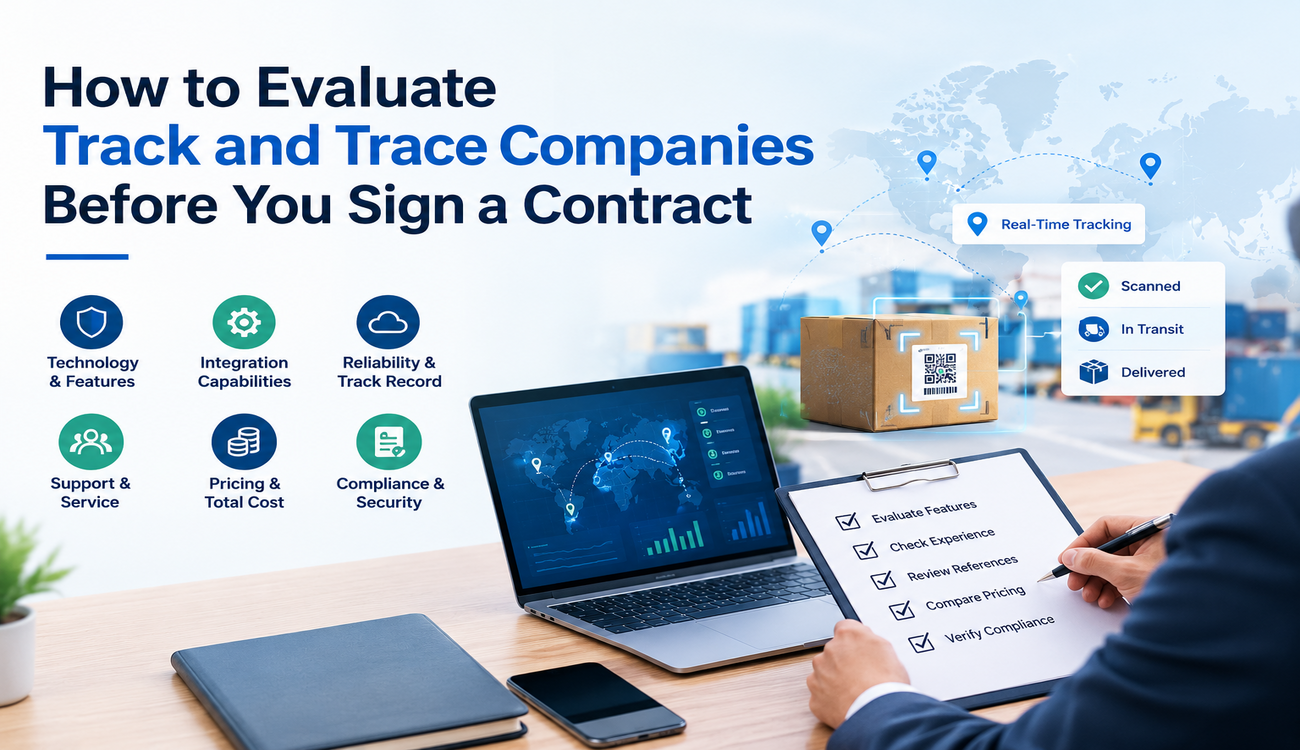
Choosing the right technology partner for product visibility, asset monitoring, shipment tracking, or supply chain traceability is an important business decision. A track and trace solution can influence how accurately organizations capture movement data, monitor inventory, manage shipments, identify operational issues, and respond to customer requirements. However, selecting a provider should involve more than comparing software features or choosing the lowest quotation. Businesses need to understand whether a provider can support their operational requirements today while remaining capable of adapting to future needs. When evaluating track and trace companies, organizations should look beyond demonstrations and marketing claims.
The right evaluation process should consider technology capabilities, integration requirements, scalability, implementation expertise, security, support, customization, and the provider’s understanding of the industry. A detailed assessment before signing a contract can reduce implementation risks and help ensure that the selected solution delivers measurable operational value.
Understand Your Track and Trace Requirements First
Before approaching vendors, businesses should clearly define what they expect from a track and trace platform. Different industries have different visibility requirements. A manufacturer may need to monitor raw materials and finished goods, while a logistics company may prioritize shipment visibility and location tracking. Retailers may focus on inventory movement, and healthcare organizations may require traceability for medical equipment, medicines, or critical assets.
Define the Operational Problems
Start by identifying the specific problems the technology needs to solve before evaluating track and trace companies. These could include limited shipment visibility, manual tracking, inventory discrepancies, delayed updates, poor asset utilization, or difficulty tracing products across multiple locations. Defining these problems creates a practical basis for evaluating vendors instead of judging solutions only by their feature lists.
Identify Required Tracking Technologies
The technology behind the solution should match the operational environment. Depending on the use case, businesses may require RFID, barcodes, GPS, IoT sensors, BLE, mobile applications, or a combination of technologies. Understanding these requirements helps organizations determine whether a provider has the technical capabilities needed to build and maintain the expected tracking environment.
Evaluate the Provider’s Technology Capabilities
Technology capabilities should be one of the central evaluation criteria. A reliable solution needs to collect accurate data, process it efficiently, and present useful information to operational teams.
Assess Real-Time Visibility
Ask how frequently location and status information is updated and whether the system can provide real-time or near-real-time visibility where required. Businesses should also understand how the platform handles connectivity limitations, delayed data, duplicate records, and missing tracking events.
Examine Analytics and Reporting
Tracking data becomes more valuable when organizations can convert it into actionable insights. When evaluating track and trace companies, review the platform’s dashboards, reporting capabilities, alerts, historical analysis, and analytics features. The solution should help teams understand movement patterns, identify delays, monitor performance, and make informed operational decisions.
Check Integration With Existing Systems
Track and trace technology rarely operates independently. It often needs to exchange information with ERP, warehouse management systems, transportation management systems, CRM platforms, e-commerce systems, or other enterprise applications.
Review APIs and Integration Architecture
Ask vendors how their platform integrates with existing software. API availability, data formats, authentication methods, integration documentation, and middleware support can significantly influence implementation complexity. A provider that understands enterprise integration can help reduce data silos and create a more connected operational environment.
Consider Data Synchronization
Integration should not only focus on sending information into the tracking platform. Data may also need to flow back into existing systems. When evaluating track and trace companies, confirm how frequently information is synchronized and how the solution handles conflicts, errors, incomplete records, and system downtime.
Examine Scalability Before Signing
A solution that works for a small deployment may not necessarily support a large enterprise environment. Businesses should evaluate scalability before committing to a long-term contract.
Consider Future Locations and Assets
Think about how the system will perform if the number of warehouses, vehicles, products, users, devices, or tracked assets increases. The provider should explain how infrastructure, databases, applications, and licensing will scale as operational requirements expand.
Evaluate Multi-Site Operations
For organizations operating across multiple warehouses, factories, stores, or distribution centers, multi-site management can become critical. Review whether the platform supports centralized visibility while allowing individual locations to maintain appropriate operational control.
Investigate Security and Data Protection
Tracking platforms can process sensitive operational and business information. Security should therefore be evaluated as part of the technology selection process rather than treated as an afterthought.
Review Access Controls
Ask how users are authenticated and how permissions are managed. Role-based access can help ensure that employees only see or modify the information relevant to their responsibilities. This is an important consideration when evaluating track and trace companies, particularly for organizations handling sensitive operational data.
Understand Data Protection Measures
Discuss encryption, backup procedures, monitoring, vulnerability management, incident response, and data retention policies. Businesses should also understand where information is hosted and what security responsibilities belong to the provider versus the customer.
Evaluate Implementation and Customization Expertise
Technology alone does not guarantee a successful deployment. Implementation requires planning, configuration, testing, training, integration, and change management.
Ask About the Implementation Process
Request a clear explanation of how the provider approaches implementation. This should cover requirements gathering, system configuration, integration, testing, pilot deployment, user training, production launch, and post-launch support. A structured process can make responsibilities and timelines easier to understand.
Understand Customization Limits
Every organization has unique workflows, but excessive customization can increase complexity and long-term maintenance costs. When evaluating track and trace companies, ask which capabilities are available as standard features and which require custom development. The goal should be to achieve the required business outcomes without creating unnecessary technical complexity.
Review Industry Experience and References
Experience in the relevant industry can be valuable because tracking requirements often depend on operational processes, regulatory expectations, and supply chain structures.
Ask for Relevant Case Studies
Review case studies involving organizations with similar operational challenges. Pay attention to the type of tracking technology used, integration complexity, deployment scale, and measurable outcomes. References can provide more realistic insight than a sales presentation alone.
Speak With Existing Customers
When possible, request customer references and ask about implementation quality, responsiveness, system reliability, support, and the provider’s ability to resolve problems. Existing customers can reveal practical experiences that may not appear during the initial evaluation process.
Examine Support and Service-Level Commitments
A tracking platform becomes part of daily operations, so technical support can be as important as the software itself. Downtime, device issues, integration failures, or data problems can affect visibility across the organization.
Review the SLA
The service-level agreement should clearly define uptime commitments, response times, resolution targets, escalation procedures, and support availability. Businesses should understand what happens when service commitments are not met and whether different support levels are available.
Assess Post-Implementation Support
Ask what happens after the implementation team completes the project. Determine whether the provider offers ongoing monitoring, maintenance, upgrades, troubleshooting, training, and account management. Long-term support can influence the overall value of the technology investment.
Compare Total Cost Instead of Only the Initial Price
Cost comparison should include more than the initial software or implementation quotation. Organizations should evaluate the total cost of ownership throughout the expected contract period.
Consider All Cost Components
Review software licensing, hardware, implementation, integration, customization, maintenance, support, training, upgrades, data storage, and additional users or locations. Hidden or variable costs can significantly change the overall investment.
Evaluate Expected Business Value
Cost should be considered alongside expected operational improvements. Better visibility may help reduce inventory discrepancies, improve asset utilization, minimize delays, strengthen customer communication, and reduce manual work. The evaluation should therefore consider both investment requirements and measurable business outcomes.
Read the Contract Carefully
Even after selecting a preferred provider, the contract requires detailed review. Businesses should ensure that commercial and technical expectations are clearly documented.
Check Ownership and Exit Terms
Understand who owns the collected data, how data can be exported, and what happens if the contract ends. A clear exit process can reduce the risk of becoming unnecessarily dependent on a particular provider.
Clarify Deliverables and Responsibilities
The contract should clearly define implementation scope, integrations, customization, timelines, training, support, service levels, and responsibilities for both parties. Ambiguity at this stage can lead to disagreements during implementation.
Conduct a Practical Proof of Concept
A proof of concept can provide valuable evidence before committing to a large-scale deployment. Instead of relying entirely on a presentation, businesses can test the solution against a realistic operational scenario.
Test Real Workflows
Use representative products, assets, locations, devices, and business processes where possible. Evaluate tracking accuracy, data synchronization, alerts, dashboards, reporting, integrations, and user experience. The objective is to determine whether the system works effectively within the actual operating environment.
Measure Defined Success Criteria
A proof of concept should have measurable success criteria. These could include tracking accuracy, response time, integration performance, reporting quality, user adoption, or reduction in manual processes. Clear measurements make vendor comparison more objective.
Make the Decision Based on Long-Term Fit
Selecting track and trace companies should ultimately be treated as a strategic technology decision rather than a simple software purchase. The provider needs to demonstrate technical capability, implementation expertise, security practices, scalability, integration experience, customer support, and a clear understanding of the organization’s operational requirements.
The most suitable solution is not necessarily the one with the largest feature list or the lowest initial price. Businesses should focus on whether the provider can deliver reliable visibility, integrate effectively with existing systems, support future growth, and maintain the solution throughout its lifecycle.
A structured evaluation also helps organizations avoid common procurement mistakes. By defining requirements, testing technology, reviewing contracts, validating support commitments, and examining the total cost of ownership, businesses can enter negotiations with clearer expectations and stronger decision-making criteria.
Conclusion
Evaluating track and trace companies before signing a contract requires a balance between technical assessment and business planning. Organizations should examine the provider’s technology, integration capabilities, scalability, security, implementation approach, industry experience, support structure, pricing model, and contractual terms. A practical proof of concept can further validate whether the proposed solution performs effectively in the intended environment.
The goal is to establish a long-term technology relationship that supports accurate visibility and efficient operations. When businesses evaluate providers against clearly defined requirements and measurable outcomes, they can reduce implementation risks and build a stronger foundation for connected, transparent, and data-driven operations.
Frequently Asked Questions
Q1. What should businesses consider when evaluating track and trace companies?
Businesses should evaluate technology capabilities, integration options, scalability, security, implementation expertise, customer support, industry experience, pricing, and contract terms. It is also important to test the solution through a proof of concept before making a long-term commitment.
Q2. Why is integration important in a track and trace solution?
Integration allows tracking data to flow between the tracking platform and existing systems such as ERP, warehouse management, transportation management, CRM, and e-commerce platforms. Effective integration can reduce data silos and provide more consistent operational visibility.
Q3. How can businesses compare the cost of track and trace solutions?
Businesses should compare total cost of ownership rather than only the initial quotation. Software licensing, hardware, implementation, customization, integrations, maintenance, support, training, upgrades, and additional users or locations should all be considered before signing a contract.
Q4. Should a business conduct a proof of concept before selecting a provider?
A proof of concept can help businesses validate whether the proposed technology works effectively in a real operational environment. It can be used to assess tracking accuracy, integrations, dashboards, alerts, reporting, system performance, and user experience before a wider deployment.
Q5. What should be included in a track and trace technology contract?
A contract should clearly define implementation scope, deliverables, integrations, customization, timelines, service-level commitments, support responsibilities, pricing, data ownership, security requirements, and termination or data-exit procedures. Clear contractual terms can help prevent misunderstandings during the partnership.
