
The logistics industry is changing rapidly as companies manage larger fleets, tighter delivery timelines, rising fuel costs, stricter customer expectations, and increasingly complex transportation operations. Fleet tracking has become an essential part of this transformation, but many logistics companies are discovering that standard subscription-based tracking platforms do not always provide the flexibility or control they need. As operations become more specialized, businesses are increasingly evaluating a Fleet GPS Tracking System India approach that can be customized around their exact workflows, fleet structure, reporting requirements, and technology ecosystem.
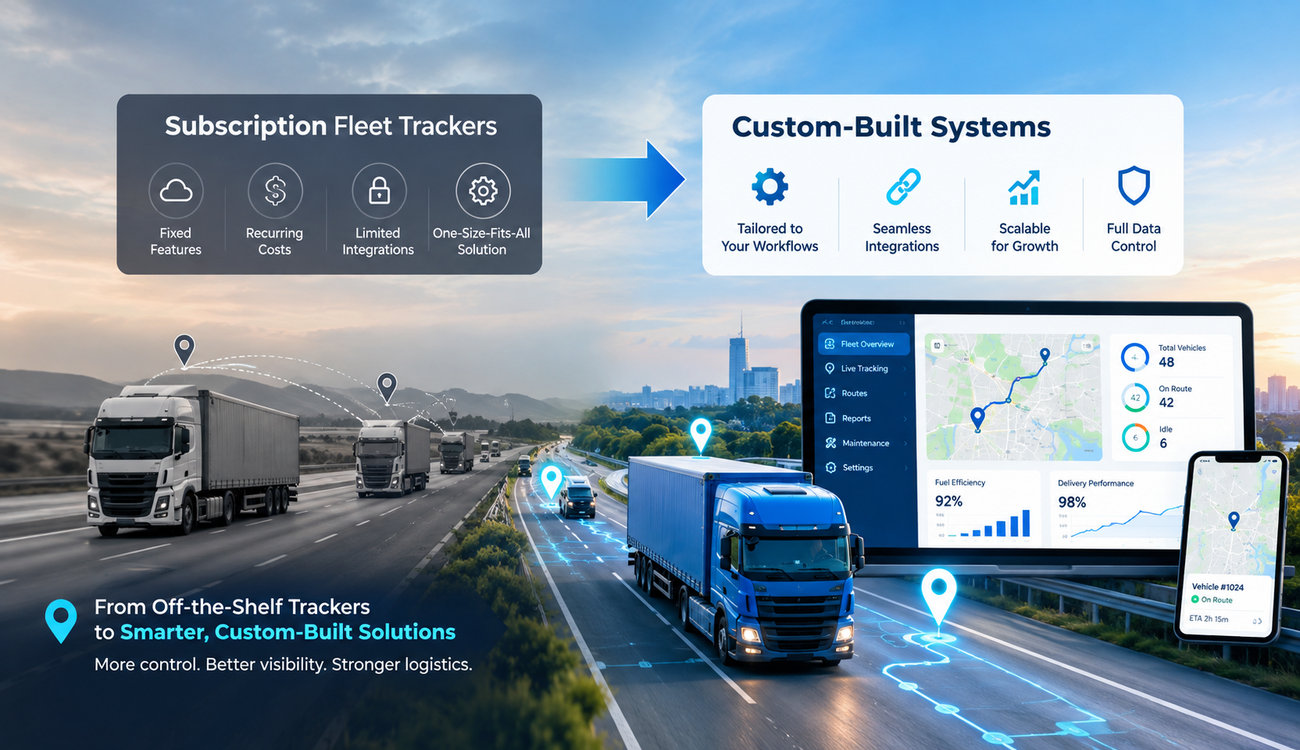
Subscription fleet trackers were initially attractive because they offered quick deployment, predictable pricing, and ready-made features. However, as logistics companies scale, they often encounter limitations related to customization, integrations, data ownership, scalability, and long-term costs. Custom-built fleet management systems are emerging as an alternative because they allow businesses to design tracking capabilities around their operational requirements instead of adjusting their processes to fit a generic platform.
The Limitations of Subscription Fleet Tracking Platforms
Subscription fleet tracking platforms are designed to serve a broad range of businesses, which makes them convenient but also limits how deeply they can adapt to specific logistics operations. A transport company may need specialized workflows for route planning, driver monitoring, fuel management, vehicle maintenance, customer notifications, proof of delivery, or temperature-sensitive shipments, while a standard platform may only provide generalized functionality.
For smaller fleets, these limitations may not create major problems, but growing logistics companies often require deeper operational visibility. When multiple branches, vehicle categories, delivery models, and customer requirements are involved, a generic tracker can become difficult to adapt. This is one reason businesses evaluating a Fleet GPS Tracking System India solution are increasingly considering platforms developed specifically around their operational environment.
Growing Demand for Operational Flexibility
Logistics companies rarely operate in exactly the same way. A regional delivery company may prioritize route optimization, while a long-haul transporter may focus more heavily on driver behavior, fuel consumption, and vehicle utilization. A cold-chain logistics provider may require continuous temperature monitoring alongside GPS tracking, while an e-commerce logistics company may need integration with order management and customer communication systems.
Custom-built systems can bring these requirements together within one platform. Instead of forcing operations teams to work around predefined features, the technology can be designed to support existing workflows and future operational changes.
Why Custom-Built Fleet Systems are Gaining Attention
The growing interest in custom fleet technology is closely connected to digital transformation across logistics. Companies are no longer looking at GPS tracking simply as a way to identify the location of vehicles. They increasingly view fleet data as a source of operational intelligence that can improve planning, resource utilization, customer service, and decision-making.
A modern Fleet GPS Tracking System India solution can be designed to collect location information and connect it with other business data, allowing companies to build a broader view of transportation performance. GPS information can be combined with fuel data, vehicle maintenance records, driver behavior, delivery status, warehouse information, and customer orders to create a more connected logistics environment.
Customization Around Business Workflows
One of the biggest advantages of custom development is the ability to create features around actual business processes. A logistics company can define how vehicles are assigned, how routes are monitored, how exceptions are escalated, and how reports are generated.
For example, a company managing hundreds of commercial vehicles may want automatic alerts when a vehicle deviates from a predefined route or remains stationary beyond a specific threshold. Another business may need automated notifications when vehicles approach customer locations. These requirements can be incorporated directly into a customized system rather than depending on the fixed configuration of a subscription product.
Better Integration With Existing Business Systems
Modern logistics operations rarely depend on one application. Companies may already use ERP platforms, warehouse management systems, transportation management systems, CRM applications, accounting software, driver applications, IoT devices, and customer portals.
A standard subscription tracker may provide limited integration options or charge additional fees for advanced integrations. A custom-built Fleet GPS Tracking System India can instead be developed with integration requirements in mind from the beginning.
Connecting GPS Data With Enterprise Applications
When GPS data is connected with enterprise applications, businesses can create more automated workflows. Vehicle location can influence delivery updates, customer notifications, route planning, dispatch decisions, and operational dashboards.
This integration can reduce manual data entry and minimize the need for employees to switch between multiple applications. It can also create a more consistent flow of information across departments, helping dispatch teams, managers, customer service teams, and finance departments work from connected operational data.
Long-Term Cost Considerations
Subscription pricing can appear affordable when a fleet is small, but costs can increase as the number of vehicles, users, locations, integrations, and advanced features grows. Businesses may also face recurring charges for premium modules, historical data storage, APIs, analytics, or additional users.
This does not mean custom software is automatically cheaper from the beginning. Custom development requires an initial investment in planning, development, testing, deployment, and maintenance. However, companies with large or growing fleets may find that ownership and greater control provide stronger long-term value.
A customized Fleet GPS Tracking System India can be developed around the features a company actually needs instead of paying continuously for a large package of generic functionality. Businesses can also prioritize development based on operational importance and gradually introduce advanced capabilities as requirements evolve.
Greater Control Over Data
Data has become one of the most important assets in logistics operations. Vehicle movements, route histories, delivery patterns, driver performance, fuel consumption, and customer information can provide valuable insights into operational efficiency.
With a customized platform, organizations can have greater control over how this information is stored, accessed, analyzed, and integrated. This can be particularly important for enterprises that have internal security policies, compliance requirements, or specific data governance standards.
Scalability for Growing Logistics Operations
A fleet management platform should not only support the current number of vehicles but also accommodate future growth. Logistics companies may expand into new regions, add different vehicle types, acquire other transportation businesses, or introduce new delivery models.
A Fleet GPS Tracking System India solution developed with scalability in mind can evolve alongside the organization. New dashboards, integrations, user roles, workflows, APIs, and analytics capabilities can be introduced as operational requirements change.
Supporting Multiple Fleet Types
Large logistics organizations may manage trucks, vans, delivery vehicles, refrigerated vehicles, trailers, or specialized transportation assets. Each category can have different monitoring requirements.
Custom software can provide configurable tracking and reporting structures for different vehicle types while maintaining centralized visibility. This can help management understand fleet performance without requiring multiple disconnected tracking platforms.
Advanced Analytics and Predictive Capabilities
Traditional GPS tracking focuses primarily on where vehicles are located. Modern logistics technology can go much further by turning historical and real-time fleet information into actionable insights.
A customized Fleet GPS Tracking System India can incorporate analytics that help organizations identify inefficient routes, excessive idling, unusual driving patterns, recurring delays, underutilized vehicles, and maintenance-related trends.
Moving From Tracking to Prediction
The next stage of fleet management is predictive decision-making. Historical data can be analyzed to identify patterns that may indicate future operational problems.
For example, repeated maintenance issues associated with particular vehicle conditions can help organizations plan preventive maintenance. Similarly, historical route and traffic patterns can contribute to better delivery planning. These capabilities can transform fleet tracking from a monitoring tool into a broader operational intelligence platform.
Improving Driver and Vehicle Performance
Driver behavior has a direct impact on fuel consumption, vehicle wear, safety, and delivery performance.
A customized Fleet GPS Tracking System India can monitor events such as harsh braking, rapid acceleration, excessive idling, unauthorized vehicle usage, route deviations, and extended stops. Management can then use these insights to identify operational patterns and improve driver training.
This creates an opportunity to combine location data with vehicle health information and maintenance records.
Better Customer Visibility
Customer expectations have changed significantly because people increasingly expect accurate delivery updates and greater transparency. Logistics companies therefore need systems that can provide reliable information about shipment movement and estimated arrival times.
A custom fleet platform can connect vehicle tracking with customer-facing applications and notification systems. Customers can receive relevant updates without logistics teams having to manually provide information.
This level of visibility can become a competitive advantage because customers are more likely to trust logistics providers that offer accurate and timely delivery information.
Security and Compliance Considerations
As fleet management platforms become connected to multiple business applications and IoT devices, cybersecurity becomes increasingly important. Organizations need appropriate controls around authentication, user permissions, data access, APIs, and system monitoring.
Custom development provides an opportunity to incorporate security requirements directly into the platform architecture. Companies can define user roles, access permissions, audit mechanisms, and integration policies based on their internal governance requirements.
For logistics organizations handling sensitive customer and operational information, this level of control can make a significant difference when evaluating a Fleet GPS Tracking System India strategy.
The Future of Fleet Management Is More Connected
The shift from subscription trackers to custom-built systems does not mean that ready-made platforms have no value. Subscription solutions can still be effective for smaller companies that need basic tracking without complex customization.
However, larger logistics businesses increasingly require technology that can adapt to their workflows, integrate with their existing systems, support operational intelligence, and scale with business growth. This is where custom fleet management becomes increasingly relevant.
A modern Fleet GPS Tracking System India can become part of a broader connected logistics ecosystem that combines GPS, IoT, analytics, automation, telematics, enterprise applications, and customer-facing technology.
Making the Right Technology Decision
The decision between subscription software and custom development should depend on business complexity, fleet size, growth plans, integration requirements, data needs, and operational priorities. Companies should evaluate not only the immediate subscription price but also the long-term value of flexibility, scalability, integration, and data control.
For logistics organizations with increasingly complex transportation operations, investing in a customized Fleet GPS Tracking System India can provide a foundation for smarter fleet management and more connected logistics processes.
Conclusion
The logistics industry is moving beyond basic vehicle tracking toward intelligent and integrated fleet management. Subscription trackers remain useful for businesses with straightforward requirements, but growing logistics organizations often need greater customization, integration, scalability, and control.
A custom-built Fleet GPS Tracking System India gives businesses the opportunity to design technology around their operations rather than redesigning operations around generic software. As logistics becomes more data-driven, connected, and automated, customized fleet platforms can help companies improve visibility, optimize resources, strengthen customer service, and prepare for future growth.
Frequently Asked Questions
Q1. Why are logistics companies moving away from subscription-based fleet trackers?
Logistics companies are moving toward custom-built systems because standard subscription platforms may not provide enough flexibility for complex fleet operations.
Q2. What are the benefits of a custom Fleet GPS Tracking System India?
A custom Fleet GPS Tracking System India can provide greater flexibility, integration capabilities, scalability, data control, and operational visibility. It can connect GPS information with ERP, CRM, TMS, IoT devices, fuel systems, maintenance platforms, and customer applications.
Q3. Is custom fleet tracking more expensive than subscription software?
Custom fleet tracking usually requires a higher initial investment because it involves development and implementation. However, for growing logistics businesses, it can provide better long-term value by reducing dependence on recurring per-vehicle charges and allowing companies to develop only the capabilities they actually need.
Q4. Can custom fleet tracking software integrate with existing logistics systems?
Yes, custom fleet tracking software can be developed to integrate with existing ERP, TMS, WMS, CRM, IoT, telematics, accounting, and customer-facing applications. These integrations can help create a connected flow of transportation data and reduce manual processes.
Q5. Can a custom Fleet GPS Tracking System India support future fleet growth?
Yes, scalability can be incorporated into the system architecture from the beginning. A Fleet GPS Tracking System India can be designed to support additional vehicles, users, locations, vehicle categories, integrations, dashboards, analytics, and automation as the logistics business expands.
