

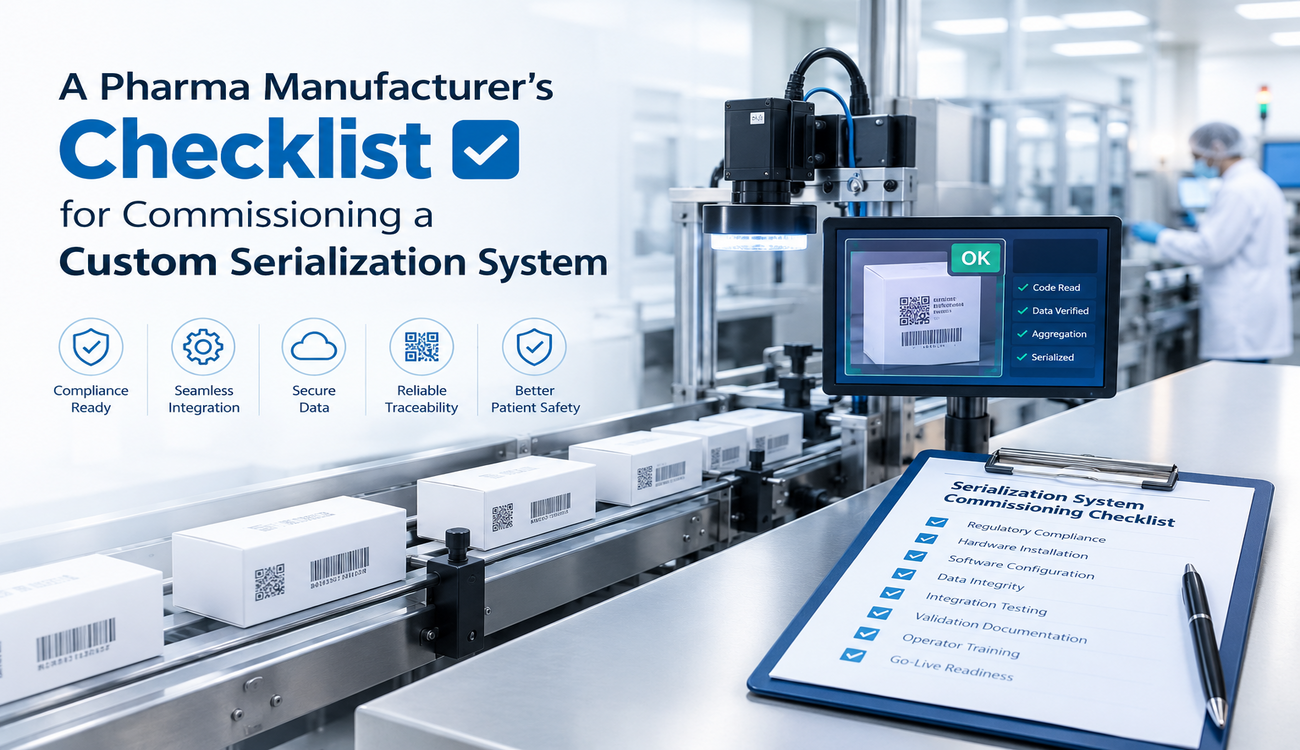
Pharmaceutical manufacturers operate in a highly regulated environment where product safety, packaging accuracy, and supply chain transparency are essential for maintaining quality and protecting patients. As regulatory requirements for pharmaceutical traceability continue to evolve, manufacturers need reliable systems that can identify individual saleable units, connect packaging levels, and maintain accurate product movement records. Commissioning a serialization system is therefore an important step toward building a secure and compliant pharmaceutical supply chain.
A Custom Pharmaceutical Serialization System helps manufacturers assign unique product identifiers, capture packaging data, manage aggregation, and exchange serialization information with internal and external systems. However, implementing the technology is only one part of the process. Before the system becomes operational, manufacturers must verify that hardware, software, packaging equipment, databases, and reporting workflows function together as expected.
A structured commissioning process helps identify technical issues before commercial production begins. It also provides documented evidence that the system meets predefined operational, quality, and regulatory requirements. By preparing a detailed checklist, pharmaceutical companies can reduce implementation risks, minimize production interruptions, and establish a dependable serialization workflow.
Understanding Serialization System Commissioning
Serialization commissioning is the process of verifying that the installed serialization infrastructure performs according to its approved specifications. It typically covers equipment installation, software configuration, data exchange, packaging line integration, security controls, and operational readiness.
For pharmaceutical manufacturers, commissioning must address more than whether a system can print a unique code on a package. The complete process should confirm that each identifier is generated correctly, applied accurately, verified by inspection equipment, recorded in the appropriate database, and associated with the correct product and packaging hierarchy.
A properly commissioned Custom Pharmaceutical Serialization System should also support exception handling, rejected-product management, data reconciliation, and the retrieval of relevant records during quality investigations or regulatory inspections.
The commissioning strategy should be established before installation begins. Quality assurance, engineering, IT, production, validation, and regulatory affairs teams should agree on acceptance criteria, documentation requirements, responsibilities, and approval procedures.
1. Define Regulatory and Business Requirements
The first step is to identify the regulations and business requirements that the serialization solution must support. Pharmaceutical traceability obligations differ between markets, products, and distribution channels, making it important to evaluate the requirements applicable to every intended market.
Manufacturers should determine whether their products require unique identifiers, machine-readable codes, human-readable information, aggregation records, verification procedures, or reporting to a national or regional traceability platform. They should also assess requirements for product verification, decommissioning, shipment reporting, and data retention wherever applicable.
Regulatory teams should translate these obligations into clear system requirements. Each requirement should have an identifiable verification method, an assigned owner, and a documented acceptance criterion.
A Custom Pharmaceutical Serialization System must be configured around the manufacturer’s actual compliance obligations rather than relying on a generic implementation template. This approach helps prevent costly changes after installation and ensures that the system supports the intended product portfolio and distribution markets.
Manufacturers should also distinguish mandatory regulatory requirements from internal operational objectives. For example, faster changeovers, fewer manual entries, improved production visibility, and easier reconciliation may be important business goals even when they are not explicit regulatory requirements.
2. Verify Packaging Line and Hardware Readiness
Serialization performance depends heavily on the packaging line where the technology will operate. Before commissioning, engineering teams should confirm that the required equipment is installed correctly and suitable for the intended production environment.
The inspection should cover printers, cameras, code readers, rejection mechanisms, sensors, industrial computers, network connections, and line controllers. Teams should verify that each component is compatible with the packaging materials, line speed, environmental conditions, and product presentation.
Print quality is particularly important because poorly positioned, damaged, or unreadable codes can lead to product rejection and production delays. Commissioning tests should therefore evaluate code placement, readability, contrast, and verification performance under representative operating conditions.
The rejection mechanism must also be tested to confirm that defective or incorrectly serialized packages are removed from the accepted product flow. Manufacturers should verify that rejected units cannot accidentally re-enter production without the required investigation and authorization.
When a Custom Pharmaceutical Serialization System is connected to multiple packaging lines, each line should be assessed individually. Differences in equipment, packaging formats, and operating speeds may require different configurations and acceptance tests.
3. Validate Software Configuration and Master Data
Serialization software relies on accurate master data to create and manage product identifiers. Incorrect product codes, packaging descriptions, market assignments, or line configurations can compromise the entire process, even when the hardware functions correctly.
Before commissioning, the responsible teams should verify product master records, identifier formats, packaging hierarchies, user permissions, and line-specific parameters. They should confirm that the correct product information is selected during production setup and that unauthorized changes cannot affect approved configurations.
The software should also be tested for duplicate identifier prevention, identifier allocation, status management, and exception handling. Where applicable, teams should confirm that unused, rejected, damaged, or otherwise invalid identifiers are managed according to approved procedures.
Data migration requires special attention when manufacturers replace an existing platform. Historical records, product references, and relevant configuration information must be transferred and reconciled according to a documented migration plan.
A Custom Pharmaceutical Serialization System should provide clear relationships between product master data, serial numbers, packaging events, and aggregation records. These relationships support traceability and make it easier to investigate discrepancies throughout the product lifecycle.
4. Test Serialization and Aggregation Workflows
Serialization and aggregation should be tested together because both processes contribute to end-to-end traceability.
Serialization assigns a unique identifier to each applicable saleable unit. Aggregation connects individual units to higher packaging levels, such as bundles, cases, and pallets, where required by the manufacturer’s process and applicable regulations.
Commissioning should confirm that identifiers are generated, printed, inspected, and recorded correctly. The system should also be tested for packaging hierarchy accuracy, including the relationship between individual products and their parent containers.
Manufacturers should simulate routine production as well as exceptions. Examples include unreadable codes, duplicate serial numbers, damaged packages, rejected units, interrupted aggregation, and packaging hierarchy changes.
The system must maintain accurate records when a case is opened, repacked, or rebuilt. If the packaging structure changes, the relevant parent-child relationships should be updated according to the approved workflow.
Testing a Custom Pharmaceutical Serialization System under realistic operating conditions helps reveal problems that may not appear during basic software demonstrations. It also provides evidence that the complete packaging process works reliably rather than simply confirming that individual components are functional.
5. Confirm Integration With Enterprise Systems
Serialization data often needs to move between multiple applications, including enterprise resource planning systems, manufacturing execution systems, warehouse management systems, laboratory information systems, and external traceability platforms.
Commissioning teams should verify the interfaces required for the intended implementation. They should confirm that product information, production orders, serial number requests, packaging events, and shipment-related data are exchanged accurately wherever these integrations are required.
Integration tests should cover successful transactions, incomplete messages, communication failures, duplicate submissions, and recovery after service interruptions. The system should handle failed transactions without silently losing records or creating inconsistent product statuses.
Manufacturers should also establish reconciliation procedures to compare relevant records across connected systems. Differences between production quantities, accepted serial numbers, rejected units, and reported packaging events must be identifiable and investigated.
A Custom Pharmaceutical Serialization System should integrate with existing business applications without creating unnecessary manual work or introducing uncontrolled data transfers. Interface ownership, monitoring responsibilities, and escalation procedures should be clearly documented before production approval.
6. Establish Data Integrity and Cybersecurity Controls
Serialization records can support product verification, recalls, quality investigations, and regulatory inspections. Their accuracy, completeness, and availability are therefore essential.
Data integrity controls should ensure that records are attributable to authorized users, recorded consistently, protected against unauthorized alteration, and retained according to applicable requirements. Where required, electronic signatures, audit trails, and controlled record changes should be tested as part of the commissioning process.
Cybersecurity testing should examine user authentication, role-based access, password policies, network segmentation, backup protection, and system recovery arrangements. Access should be limited according to job responsibilities, particularly for administrative functions and changes to critical configuration settings.
Manufacturers should verify that the system records important events, including failed login attempts, configuration changes, and other security-relevant activities where required by the approved design.
Backup and recovery testing is equally important. Teams should demonstrate that relevant data and configurations can be restored within approved recovery objectives and that restored records remain consistent.
A Custom Pharmaceutical Serialization System should be commissioned with security and data integrity built into its operating procedures. Treating these controls as final-stage additions can introduce avoidable compliance gaps and operational risks.
7. Prepare Validation Documentation and Acceptance Tests
Commissioning activities should generate objective evidence that the system meets approved requirements. The documentation package should be defined before testing starts so that critical records are not overlooked.
Installation qualification, operational qualification, and performance qualification may be required under the manufacturer’s validation strategy and applicable regulatory framework. The exact approach should reflect the system’s intended use, complexity, risk, and organizational quality procedures.
Testing should establish that the equipment has been installed correctly, configured functions operate as intended, and representative production activities meet predefined acceptance criteria.
For a Custom Pharmaceutical Serialization System, validation evidence should connect user requirements to test cases and recorded results. This traceability helps reviewers determine whether every critical requirement has been verified.
Any deviation discovered during commissioning should be documented, assessed, investigated, and resolved or formally managed under the approved quality process. Retesting should be performed where necessary, and unresolved issues should be evaluated before the system is released for commercial use.
8. Train Operators and Define Standard Operating Procedures
Even a technically sound serialization system can fail when employees do not understand how to operate it correctly. Training should therefore be completed before the system enters routine production.
Operators should learn how to initiate production orders, verify product and packaging settings, respond to code inspection failures, manage rejected packages, and escalate technical issues. Supervisors should understand production monitoring, reconciliation, and exception approval procedures.
IT and maintenance personnel need separate training on troubleshooting, access management, backups, interface monitoring, and system recovery. Quality assurance teams should understand how to review records, investigate discrepancies, and assess deviations.
Standard operating procedures should cover routine production, line clearance, product changeovers, rework, aggregation corrections, downtime, and recovery after system interruptions.
The manufacturer should retain training records and verify that personnel are qualified for their assigned responsibilities. Refresher training should be provided when significant system changes or recurring operational issues make it necessary.
9. Conduct End-to-End Performance Testing
Before final release, the serialization system should be evaluated during representative production conditions. The purpose is to confirm that the complete workflow remains reliable when equipment, software, people, and connected systems operate together.
Testing should assess code readability, serialization accuracy, rejection performance, data transmission, aggregation consistency, and reconciliation. Throughput should also be evaluated against the approved production requirements.
Where practical, performance tests should include normal production runs, product changeovers, communication interruptions, and recovery scenarios. Results should be compared with predefined acceptance criteria rather than subjective expectations.
Manufacturers should examine recurring failures, unexpected downtime, excessive rejection rates, and delays in data exchange. These issues may indicate configuration problems, equipment limitations, or integration weaknesses that require correction.
A Custom Pharmaceutical Serialization System should demonstrate that it can support the intended production workload while maintaining the required quality and traceability controls.
Key Commissioning Checks Before Production Release
The following single-sentence checks provide a concise final review of commissioning readiness.
Regulatory and Documentation Readiness
Confirm that applicable regulatory requirements, approved specifications, risk assessments, validation records, and acceptance criteria have been reviewed and approved.
Equipment and Software Readiness
Verify that printers, vision systems, rejection mechanisms, serialization software, product master data, and line configurations perform according to approved specifications.
Data and Integration Readiness
Demonstrate that serial numbers, packaging hierarchies, production records, and required external reports remain accurate and consistent across connected systems.
Quality and Security Readiness
Confirm that access controls, audit trails, backup procedures, deviation management, and data retention arrangements meet applicable requirements.
Operational Readiness
Ensure that operators are trained, standard operating procedures are approved, support responsibilities are assigned, and critical defects have been resolved or formally assessed.
Final Approval
Obtain documented approval from the responsible quality, engineering, production, IT, and validation stakeholders before authorizing commercial operation.
10. Plan Post-Commissioning Monitoring and Continuous Improvement
Commissioning does not eliminate the need for ongoing system oversight. Once the system enters production, manufacturers should monitor its performance to identify emerging problems and maintain compliance.
Useful indicators include serialization success rates, rejected package rates, code readability, system availability, interface failures, reconciliation discrepancies, and average recovery time. Monitoring thresholds should be defined according to the system’s operational requirements and risk profile.
Change control should apply to software updates, hardware replacements, product configuration changes, and interface modifications. Changes affecting validated functions should undergo appropriate assessment, testing, and approval before implementation.
Manufacturers should also schedule periodic reviews of user access, backup restoration, cybersecurity controls, and relevant system documentation. Internal audits can help identify gaps before they affect production or regulatory readiness.
A Custom Pharmaceutical Serialization System should evolve alongside changes in packaging operations, product portfolios, and applicable regulations. Continuous monitoring allows manufacturers to maintain system reliability while identifying opportunities to improve production efficiency and traceability.
Conclusion
Commissioning a pharmaceutical serialization system requires coordinated planning, technical verification, validation, and operational preparation. Manufacturers must assess regulatory obligations, confirm hardware readiness, validate software configurations, test serialization and aggregation, verify enterprise integrations, and establish effective data integrity controls.
A detailed commissioning checklist helps ensure that every critical component is evaluated before commercial production begins. It also supports clearer accountability, stronger documentation, and faster identification of problems that could affect product quality or supply chain visibility.
Selecting and commissioning a Custom Pharmaceutical Serialization System should be treated as a long-term investment in pharmaceutical traceability rather than a standalone packaging technology project. When the system is properly tested, documented, and supported by trained personnel, manufacturers can strengthen operational reliability and improve their ability to meet changing compliance expectations.
FAQs
Q1. What is a Custom Pharmaceutical Serialization System?
A Custom Pharmaceutical Serialization System is a software and hardware solution that assigns unique identifiers to pharmaceutical products, captures packaging information, and supports traceability throughout the supply chain. It can integrate with packaging lines, enterprise systems, and relevant regulatory platforms to improve product verification, data accuracy, and compliance management.
Q2. Why is commissioning important for pharmaceutical serialization systems?
Commissioning verifies that serialization equipment, software, data exchange, and packaging workflows operate according to approved specifications. It helps identify technical issues before commercial production, reduces operational risks, supports validation activities, and ensures that the system is prepared for reliable pharmaceutical manufacturing operations.
Q3. What should a pharmaceutical serialization commissioning checklist include?
A commissioning checklist should cover regulatory requirements, hardware installation, software configuration, master data accuracy, serialization and aggregation workflows, system integrations, cybersecurity, data integrity, validation documentation, operator training, and performance testing. Each activity should have defined acceptance criteria and documented results.
Q4. How does a Custom Pharmaceutical Serialization System support regulatory compliance?
A Custom Pharmaceutical Serialization System supports compliance by generating unique product identifiers, maintaining packaging hierarchy records, recording relevant product events, and exchanging traceability information with connected systems where required. Its configuration must reflect the applicable regulations, product requirements, and reporting obligations in each target market.
Q5. How can manufacturers ensure successful serialization system commissioning?
Manufacturers can improve commissioning outcomes by involving quality, engineering, IT, production, and regulatory teams from the beginning. They should conduct risk-based testing, verify integrations, resolve critical deviations, train employees, document validation evidence, and establish ongoing performance monitoring before approving the system for commercial production.
