
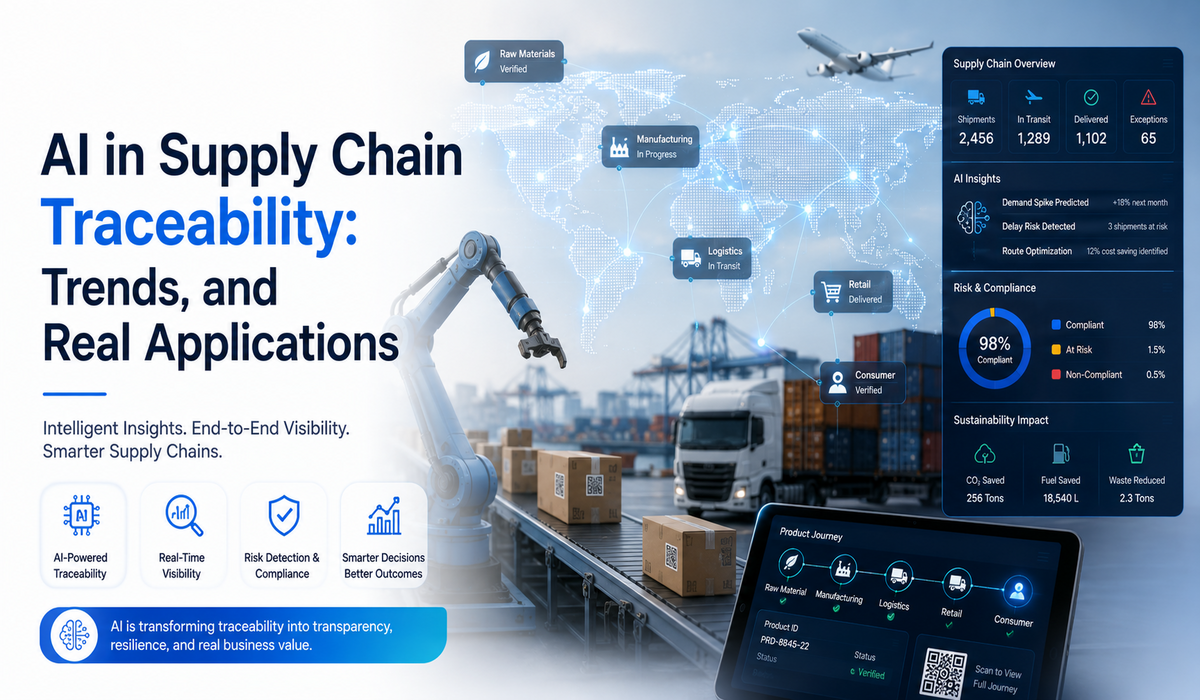
Modern supply chains generate enormous volumes of data every second—from manufacturing records and shipment updates to warehouse movements, supplier transactions, and product delivery confirmations. Despite this, many organizations still struggle with limited visibility, delayed responses, inaccurate inventory tracking, and compliance challenges. This is where AI in Supply Chain Traceability is becoming one of the most influential technologies transforming global operations. Businesses are increasingly using artificial intelligence to improve transparency, predict disruptions, automate tracking processes, and create smarter decision-making systems across supply networks.
In 2026, supply chain traceability is no longer only about knowing where a product is. Organizations want to know why delays occur, when risks might emerge, whether supplier performance is declining, and how operational issues can be prevented before they happen. AI enables this shift from reactive tracking to predictive and intelligent traceability. As industries move toward automation, AI-driven traceability solutions are becoming essential for manufacturers, logistics providers, retailers, healthcare organizations, and enterprises managing complex supplier ecosystems.
Understanding how artificial intelligence supports traceability, the technologies involved, emerging trends, and practical applications is increasingly important for companies seeking resilient and future-ready supply chains.
What Is AI in Supply Chain Traceability?
Artificial intelligence in supply chain traceability refers to the use of machine learning, predictive analytics, computer vision, natural language processing, and automation technologies to monitor, analyze, and optimize product movement throughout supply chain networks. Rather than simply recording events, AI interprets large volumes of operational data and identifies patterns, risks, anomalies, and opportunities for improvement.
Traditional traceability systems often depend heavily on manual monitoring and historical reporting. AI expands capabilities by delivering intelligent insights in real time. For example, instead of identifying shipment delays after they occur, AI models may predict disruptions days earlier based on weather conditions, supplier behavior, transportation performance, or inventory fluctuations.
The objective extends beyond visibility. AI helps organizations transform traceability into a proactive business intelligence capability.
Why AI-Driven Traceability Matters More Than Ever
Global supply chains have become increasingly interconnected and vulnerable to disruption. Geopolitical changes, climate events, raw material shortages, transportation delays, and rising customer expectations have created pressure for faster and more accurate decision-making.
Businesses now require traceability systems capable of answering complex operational questions:
Which supplier poses future risk?
Which shipments are likely to be delayed?
Where are inefficiencies affecting delivery performance?
Which production batches may fail quality standards?
Conventional systems often struggle to provide these insights quickly. AI improves responsiveness by processing massive datasets and generating predictive recommendations.
The growing emphasis on sustainability reporting, compliance requirements, and ethical sourcing has also increased demand for intelligent traceability capabilities. Organizations increasingly recognize that transparency supported by predictive analytics strengthens resilience.
AI in Supply Chain Traceability: Why Enterprises Are Investing in It
Companies are investing in AI-powered traceability because operational complexity continues to increase. Enterprises managing thousands of suppliers and millions of product movements require smarter systems capable of continuous monitoring.
Artificial intelligence helps reduce uncertainty in areas such as inventory planning, supplier performance evaluation, fraud detection, logistics optimization, and quality assurance. Instead of relying entirely on historical records, businesses gain forward-looking visibility.
In highly regulated sectors including pharmaceuticals, food manufacturing, electronics, and automotive production, predictive traceability provides stronger compliance readiness and risk management.
The value increasingly comes from anticipation rather than documentation.
Core Technologies Powering Intelligent Traceability Systems
Artificial intelligence works alongside multiple digital technologies to create connected traceability ecosystems.
Machine learning algorithms analyze historical and real-time supply chain data to identify patterns and predict outcomes. These models improve continuously as additional data becomes available.
Computer vision technologies support automated inspection processes. Cameras combined with AI detect packaging defects, damaged products, incorrect labeling, or quality issues during production and distribution.
Internet of Things sensors collect environmental information such as temperature, humidity, movement, and location. AI interprets this data to identify unusual conditions or operational risks.
Natural language processing assists organizations in analyzing supplier documents, compliance reports, contracts, and communications.
Cloud computing enables scalable data processing while enterprise software integration connects AI systems with ERP platforms, warehouse systems, and logistics applications.
The effectiveness of intelligent traceability often depends on how well these technologies function together.
How AI Improves Supply Chain Traceability Step by Step
Understanding practical workflows helps explain where artificial intelligence creates measurable value.
Step 1: Collecting Data From Multiple Sources
AI systems gather information from sensors, RFID tags, warehouse platforms, supplier databases, transportation systems, and production environments.
The broader the dataset, the stronger the analytical capability.
Step 2: Organizing and Cleaning Data
Raw operational information frequently contains inconsistencies and duplication. AI improves accuracy through automated data cleansing and normalization.
Reliable insights depend on reliable input.
Step 3: Identifying Patterns and Anomalies
Algorithms detect unusual behavior including shipment deviations, supplier delays, inventory discrepancies, or unexpected environmental changes.
Early detection reduces risk.
Step 4: Predicting Future Disruptions
Predictive models estimate potential delays, shortages, maintenance requirements, or quality issues before they impact operations.
This shifts organizations toward proactive management.
Step 5: Automating Responses
Advanced systems trigger alerts, recommend corrective actions, or initiate workflows automatically.
Decision speed improves significantly.
Step 6: Continuous Learning and Optimization
AI models evolve through ongoing data analysis, gradually improving prediction accuracy and operational recommendations.
Major Trends Defining AI Traceability in 2026
The role of artificial intelligence in supply chains continues evolving rapidly. Several trends are shaping adoption patterns.
One important development involves predictive risk intelligence. Businesses increasingly prefer systems capable of forecasting disruptions rather than only reporting historical events.
Another emerging trend is autonomous supply chain monitoring. AI continuously evaluates operations without requiring extensive manual oversight.
Digital twins are gaining popularity as organizations create virtual replicas of supply networks to simulate risks and optimize decisions.
Generative AI is beginning to support supplier communication analysis, documentation processing, and operational reporting.
Sustainability intelligence is becoming another priority. Enterprises increasingly use AI to track carbon emissions, sourcing practices, and environmental performance throughout supply chains.
The future appears centered on intelligent ecosystems rather than isolated software solutions.
Real Applications of AI Across Different Industries
Artificial intelligence delivers value differently depending on industry requirements.
In food supply chains, AI helps detect spoilage risks, monitor storage conditions, and improve recall efficiency. Faster identification reduces waste and strengthens safety compliance.
Pharmaceutical companies use intelligent traceability to monitor temperature-sensitive medicines and identify counterfeit risks. Predictive analytics support regulatory compliance and product integrity.
Manufacturing organizations apply AI for supplier evaluation, defect detection, production optimization, and maintenance forecasting.
Retail businesses improve inventory visibility and demand forecasting through AI-supported analysis.
Logistics providers use predictive systems to optimize delivery routes, anticipate delays, and improve shipment reliability.
These examples illustrate how AI transforms traceability into operational intelligence.
AI Tools Supporting Supply Chain Traceability in 2026
The market increasingly offers platforms integrating artificial intelligence with traceability capabilities. Enterprise software providers continue expanding intelligent features.
Predictive analytics platforms support demand forecasting and risk identification.
Computer vision solutions automate quality inspection processes.
AI-enhanced warehouse management systems optimize inventory movement.
Supply chain visibility platforms consolidate operational information into centralized dashboards.
Digital twin platforms simulate operational scenarios and test response strategies.
IoT monitoring systems provide real-time environmental tracking supported by intelligent analytics.
Organizations typically achieve stronger results when selecting tools aligned with specific operational objectives rather than pursuing broad technology adoption.
Benefits Businesses Gain Through Intelligent Traceability
Companies implementing AI-supported traceability often experience measurable improvements in visibility, efficiency, and responsiveness.
Predictive insights reduce unexpected disruptions because risks become identifiable earlier.
Inventory accuracy improves through continuous monitoring and anomaly detection.
Supplier performance becomes easier to evaluate using data-driven analysis.
Compliance reporting processes become more efficient due to automated monitoring capabilities.
Operational costs may decline through reduced waste, improved planning, and optimized logistics.
Customer trust increases when organizations provide transparent and reliable product information.
Perhaps the greatest advantage is decision-making speed. Businesses move faster when supported by intelligent insights.
Challenges Organizations Must Overcome
Although adoption continues increasing, implementation remains complex.
Data quality remains one of the largest obstacles. AI models depend heavily on accurate and consistent information.
Legacy systems frequently limit integration capability.
Skill shortages create additional challenges because organizations need expertise across AI, analytics, and supply chain operations.
Implementation costs may discourage smaller enterprises.
Trust in automated recommendations also requires organizational change management.
Successful deployment often depends as much on governance and culture as on technology.
Common Mistakes During AI Adoption
Many organizations expect artificial intelligence to solve operational problems immediately without addressing underlying process inefficiencies.
Some companies deploy AI without clear business objectives.
Others underestimate training requirements and stakeholder adoption challenges.
Incomplete datasets frequently produce weak outcomes.
Organizations also risk over-automation, where human oversight becomes insufficient.
AI performs most effectively when combined with operational expertise rather than replacing it entirely.
Best Practices for Implementing AI-Based Traceability Systems
Enterprises pursuing stronger outcomes generally begin with targeted use cases rather than large-scale transformation programs.
High-risk operational areas often provide suitable starting points because measurable ROI becomes easier to demonstrate.
Organizations benefit from establishing data governance frameworks before deployment.
Cross-functional collaboration between supply chain teams, IT departments, and leadership improves adoption success.
Continuous model monitoring remains essential because AI accuracy evolves over time.
Most importantly, businesses should prioritize solving operational challenges instead of implementing AI solely for innovation positioning.
The Future of AI in Supply Chain Traceability Beyond 2026
The next stage of development will likely involve more autonomous decision-making systems. AI may increasingly recommend actions, coordinate workflows, and optimize supply chain responses with minimal manual intervention.
Integration between blockchain, IoT, digital twins, and artificial intelligence is expected to strengthen traceability accuracy further.
Regulatory requirements surrounding sustainability and ethical sourcing may accelerate intelligent monitoring adoption.
Consumer expectations are also changing. Buyers increasingly expect proof of authenticity, sourcing transparency, and environmental responsibility.
Future traceability systems will probably become more predictive, automated, and interconnected than today’s models.
The competitive advantage may belong to organizations capable of converting operational data into intelligent action.
Conclusion
Supply chains are moving beyond traditional tracking methods toward intelligent ecosystems capable of predicting risks, improving visibility, and accelerating decision-making. AI in Supply Chain Traceability is becoming increasingly valuable for organizations seeking stronger resilience, transparency, compliance readiness, and operational efficiency. The greatest impact comes when artificial intelligence supports practical business goals rather than functioning as a standalone innovation initiative.
