
Manufacturing companies are under constant pressure to improve product quality, reduce defects, and maintain complete visibility across production processes. Traditional quality inspection methods often depend on manual checks, sampling, and separate production records, making it difficult to identify defects quickly or trace them back to their source. AI Vision for Traceability is changing this approach by combining computer vision, artificial intelligence, and production data to automate visual quality control while creating a more connected traceability system.
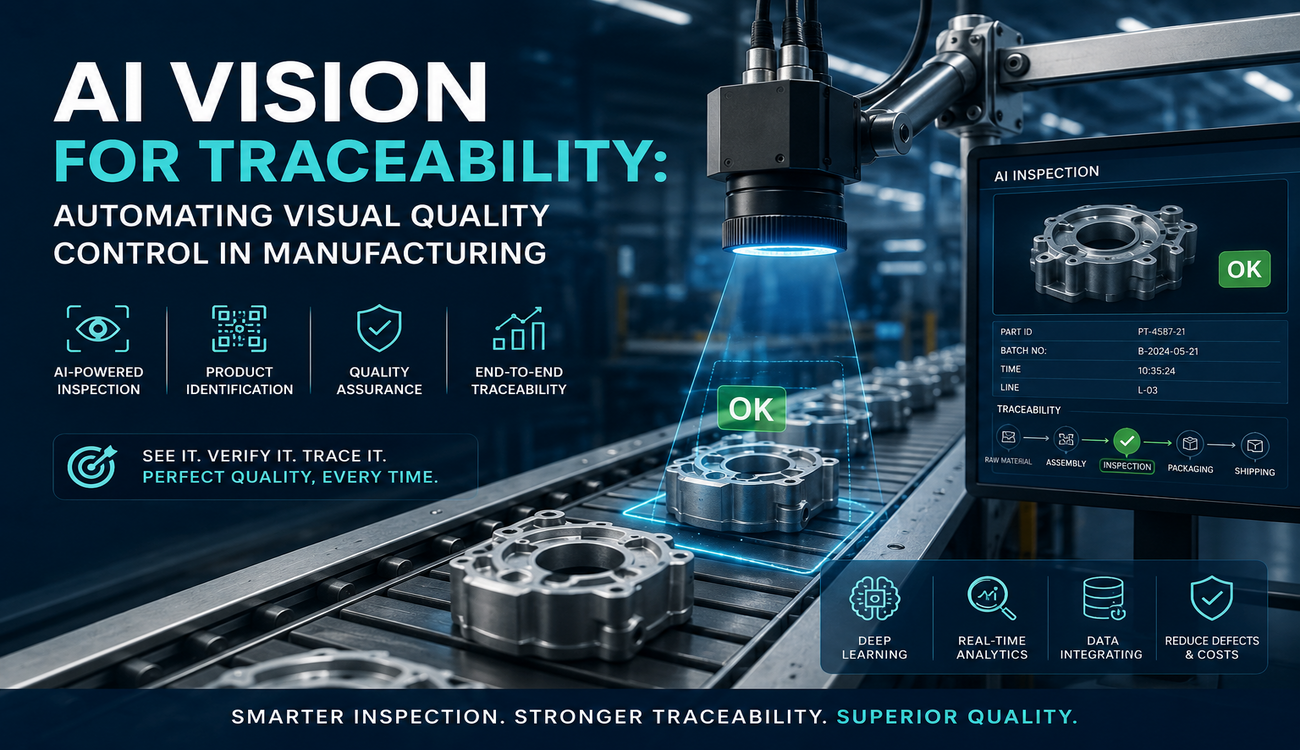
AI-powered vision systems can inspect products as they move through production lines, identify visual defects, verify components, read labels and codes, and connect inspection results with specific products, batches, machines, or production stages. This allows manufacturers to move beyond simple defect detection toward intelligent quality management where every inspection can become part of a complete digital production history.
What is AI Vision for Traceability?
AI Vision for Traceability refers to the use of artificial intelligence-powered computer vision systems to inspect, identify, verify, and track products throughout manufacturing operations. Unlike conventional machine vision systems that primarily follow predefined rules, AI vision can use trained models to recognize complex patterns, variations, and defects that may be difficult to detect through traditional inspection techniques.
The system uses industrial cameras and imaging equipment to capture product images during different stages of production. AI models then analyze those images to determine whether a product meets predefined quality requirements. The inspection result can be connected with information such as product identification, batch number, serial number, manufacturing timestamp, machine ID, or production line.
How AI Vision Connects Inspection With Traceability
Visual inspection and traceability have traditionally been treated as separate processes. Quality teams may inspect a product visually while another system records production information. This separation can create gaps when manufacturers need to determine exactly when, where, and why a defect occurred.
AI vision helps connect these processes. A product can be identified through barcode recognition, QR code reading, OCR, RFID integration, or other identification technologies. The vision system can then associate its inspection results with the corresponding production record.
This creates a digital inspection history that can follow the product through its manufacturing journey. If a defect is identified later, manufacturers can investigate related inspection images, production conditions, equipment information, and batch details instead of relying entirely on manual records.
How AI Vision Automates Visual Quality Control
Automated visual inspection begins when cameras capture images of products, components, packaging, or production areas. These images are processed by an AI vision system that has been trained to understand acceptable and unacceptable conditions.
AI-Based Defect Detection
AI models can identify defects such as scratches, cracks, dents, missing components, incorrect assembly, surface irregularities, color variations, contamination, and dimensional inconsistencies. The exact capabilities depend on the camera configuration, training data, product characteristics, and inspection requirements.
Unlike manual inspection, automated systems can maintain consistent inspection criteria throughout production. This is particularly useful for high-volume manufacturing environments where inspecting every product manually may be difficult, expensive, or inconsistent.
Automated Product and Component Verification
AI vision can also verify whether the correct component has been installed or whether a product has been assembled according to specifications. Cameras can examine the position, shape, orientation, and presence of components before the product moves to the next manufacturing stage.
For example, an electronics manufacturer can use AI vision to check whether components are positioned correctly on a circuit board. An automotive manufacturer can inspect whether specific parts are present and correctly assembled before final production.
OCR and Code Recognition
Traceability depends heavily on reliable product identification. AI vision systems can use optical character recognition to read printed text, serial numbers, batch codes, dates, and other markings directly from products and packaging.
The system can also recognize barcodes and QR codes and connect the captured information with production records. This reduces the dependence on manual data entry and helps prevent identification errors that could compromise traceability.
Why AI Vision for Traceability Matters in Manufacturing
Manufacturers need more than a system that simply identifies defective products. They need to understand how defects occur and determine whether a problem is isolated or affects an entire production batch.
AI Vision for Traceability provides the foundation for connecting visual inspection results with production data. This can improve visibility across manufacturing operations and help quality teams respond faster to problems.
Improving Product Quality
Automated inspection can identify quality issues earlier in the production process. Instead of discovering a defect after products have already moved through multiple stages, manufacturers can detect problems close to where they occur.
Early detection can reduce rework, scrap, customer complaints, and the risk of defective products reaching the market. It can also help production teams understand whether a particular process requires adjustment.
Creating Consistent Inspection
Manual inspection can vary depending on operator experience, fatigue, workload, and environmental conditions. AI vision provides a standardized inspection process that can operate continuously across production shifts.
This consistency becomes particularly valuable when manufacturers need to inspect large quantities of products or maintain strict quality requirements.
Strengthening Root Cause Analysis
When inspection results are connected to traceability records, quality teams can investigate defects with greater context. They can compare defective products with production information and identify patterns associated with specific machines, batches, materials, suppliers, shifts, or production stages.
This moves quality management from reactive inspection toward more data-driven root cause analysis.
Applications of AI Vision for Traceability Across Manufacturing
The technology can be applied across many manufacturing environments because visual inspection and traceability requirements exist at different stages of production.
Automotive Manufacturing
Automotive manufacturers can use AI vision to inspect components, verify assembly, detect surface defects, read identification codes, and confirm the presence of critical parts. Inspection results can be associated with vehicle components or production batches to support quality investigations and compliance requirements.
Electronics Manufacturing
Electronics production often requires highly detailed inspection because small defects can affect product performance. AI vision can inspect circuit boards, connectors, soldering areas, component placement, and product markings.
Connecting these inspection results with serial numbers and production records can provide manufacturers with a detailed history for individual units.
Food and Beverage Manufacturing
In food and beverage production, computer vision can inspect packaging, labels, seals, fill levels, product appearance, and date codes. AI vision can help identify packaging inconsistencies while connecting inspection information with batch-level traceability data.
This can support faster investigation when quality issues or recalls occur.
Pharmaceutical Manufacturing
Pharmaceutical production requires strict quality control and traceability. AI vision can assist with packaging inspection, label verification, container inspection, and code recognition.
By connecting visual inspection results with batch and production information, manufacturers can strengthen documentation and improve visibility across quality processes.
Building an AI Vision Traceability System
Successful implementation requires more than installing cameras on a production line. Manufacturers need to determine what should be inspected, what information needs to be captured, and how inspection results should connect with existing systems.
Selecting the Right Inspection Points
The first step is identifying production stages where visual inspection can provide the greatest value. Some manufacturers may benefit from inspecting incoming materials, while others may focus on assembly, packaging, or final quality control.
The inspection environment should also be considered. Lighting, camera position, product speed, surface characteristics, and image resolution can significantly influence system performance.
Connecting AI Vision With Manufacturing Systems
An AI vision system becomes more valuable when it can exchange information with existing manufacturing technologies. Integration with Manufacturing Execution Systems, Enterprise Resource Planning platforms, quality management systems, barcode systems, RFID infrastructure, and industrial equipment can create a connected quality ecosystem.
When inspection results and production information are connected, manufacturers can build a more complete digital record of each product or batch.
Training AI Models With Relevant Data
AI models need representative training data to identify defects accurately. Images should cover normal products as well as different types and levels of defects that the system is expected to detect.
As production changes, models may also need to be updated. New products, materials, packaging designs, or manufacturing conditions can introduce visual variations that were not present in the original training data.
Challenges in Implementing AI Vision for Traceability
Although AI vision offers significant benefits, manufacturers need to address several practical challenges during implementation. Poor lighting, inconsistent camera positioning, reflective surfaces, product variations, insufficient training data, and high production speeds can affect inspection performance.
Integration can also be challenging when manufacturing environments contain legacy systems that were not designed to exchange real-time data. Organizations may need to modernize parts of their technology infrastructure to establish reliable communication between vision systems and production platforms.
Another important consideration is validation. Manufacturers should establish clear inspection criteria and continuously monitor system performance. AI should complement quality teams rather than operate as an isolated technology without appropriate oversight.
The Future of AI Vision in Manufacturing Traceability
The role of AI vision is expected to expand as manufacturers adopt more connected and intelligent production environments. Future systems will increasingly combine visual inspection with real-time production data, predictive analytics, digital twins, IoT sensors, and automated decision-making.
From Defect Detection to Predictive Quality
Traditional visual inspection primarily answers whether a product is acceptable or defective. Advanced AI vision systems can move toward identifying patterns that indicate a potential quality problem before a large number of defects occur.
For example, repeated changes in surface appearance or assembly patterns could indicate equipment wear, material variation, or process instability. When combined with other production data, these signals can support predictive quality management.
Real-Time Quality Intelligence
Manufacturers are also moving toward real-time quality dashboards where inspection results can be monitored across production lines. Quality teams can see defect trends, identify recurring issues, and investigate production anomalies without waiting for manual inspection reports.
This creates a more responsive manufacturing environment in which quality information becomes available while production is still taking place.
Conclusion
AI Vision for Traceability is transforming visual quality control by connecting automated inspection with product identification and manufacturing data. Instead of treating inspection as a separate quality activity, manufacturers can create a connected process where every visual inspection contributes to a broader traceability record.
From defect detection and component verification to OCR, barcode recognition, batch tracking, and root cause analysis, AI-powered vision can improve both manufacturing visibility and quality consistency. When integrated with existing production systems, it can help manufacturers reduce defects, respond faster to quality issues, and build stronger digital records across the production lifecycle.
The future of manufacturing quality is moving toward continuous, intelligent, and data-driven inspection. For organizations looking to modernize their quality operations, AI Vision for Traceability provides an important pathway toward smarter visual inspection and more reliable end-to-end manufacturing traceability.
FAQs
Q1. What is AI Vision for Traceability in manufacturing?
AI Vision for Traceability combines computer vision and artificial intelligence to inspect products, detect defects, verify components, read identification codes, and connect inspection results with production and traceability data.
Q2. How does AI vision improve manufacturing quality control?
AI vision automates visual inspections and helps identify defects consistently and in real time. This can reduce manual inspection errors, improve product quality, and allow manufacturers to detect issues earlier in the production process.
Q3. Can AI Vision for Traceability integrate with existing manufacturing systems?
Yes. AI vision systems can be integrated with MES, ERP, quality management systems, barcode and QR code systems, RFID infrastructure, and other manufacturing technologies to connect inspection data with production records.
Q4. What types of defects can AI vision detect?
AI vision can detect various visual defects, including scratches, cracks, dents, missing or incorrectly positioned components, surface irregularities, incorrect labels, packaging defects, and other product-specific quality issues.
Q5. What are the benefits of using AI Vision for Traceability?
Key benefits include automated inspection, consistent quality control, improved product traceability, faster defect detection, better root cause analysis, reduced rework and scrap, and greater visibility into manufacturing processes.
