
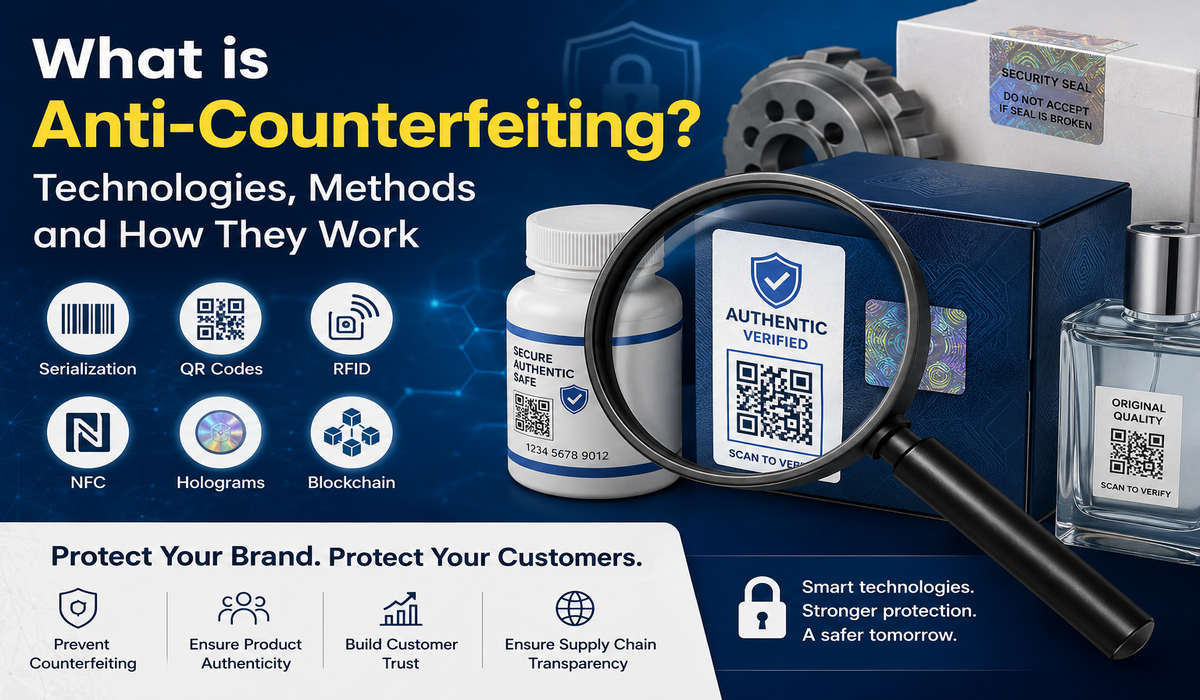
Counterfeit products have become a serious challenge for manufacturers, retailers, brands, and consumers across industries. From pharmaceuticals and electronics to automotive parts, luxury goods, food products, and industrial equipment, fake products can enter legitimate supply chains and create financial, safety, and reputational risks. As counterfeiting methods become more sophisticated, businesses are increasingly relying on Anti-Counterfeiting Technologies to protect products and verify their authenticity.
Anti-counterfeiting is not limited to placing a security label on a product. Modern solutions combine physical security features, digital identification, serialization, traceability, authentication systems, and data-driven technologies to make products more difficult to copy and easier to verify. These technologies help businesses identify genuine products, detect suspicious items, track products through the supply chain, and protect customers from counterfeit goods.
What Is Anti-Counterfeiting?
Anti-counterfeiting refers to the technologies, processes, security features, and strategies used to prevent, identify, and control the production and distribution of fake products. The primary objective is to make counterfeit products difficult to manufacture, difficult to distribute, and easier to detect.
Counterfeiters often attempt to replicate product packaging, labels, barcodes, trademarks, serial numbers, or other visible characteristics. Traditional security methods can therefore become less effective when criminals gain access to better printing equipment and digital tools. Modern Anti-Counterfeiting Technologies address this problem by combining multiple layers of protection.
These technologies can provide authentication at different stages of the product lifecycle. A manufacturer can verify an item during production, a distributor can confirm its identity during shipment, a retailer can authenticate it before selling, and consumers can sometimes verify the product using a smartphone or other connected device.
Why Is Anti-Counterfeiting Important?
Counterfeit products can affect almost every part of a business. When customers unknowingly purchase fake products, the original brand may lose revenue and customer trust. Counterfeiting can also create serious safety concerns when the products involved are medicines, medical devices, automotive components, electrical equipment, or food products.
Protecting Brand Reputation
A brand’s reputation depends heavily on product quality and customer experience. When counterfeit products fail or cause harm, customers may associate the poor experience with the genuine manufacturer. Anti-counterfeiting measures help brands establish a stronger connection between their products and verified authenticity.
Improving Consumer Safety
Some counterfeit products can create direct health and safety risks. Fake medicines may contain incorrect ingredients, while counterfeit electrical components may fail to meet safety standards. Authentication technologies help organizations reduce the possibility of unsafe products reaching customers.
Reducing Revenue Loss
Counterfeiting can divert sales away from legitimate manufacturers and retailers. Product serialization, traceability, and authentication can make it more difficult for counterfeit goods to enter legitimate distribution channels.
Strengthening Supply Chain Visibility
Modern authentication solutions can also provide information about where a product was manufactured, shipped, distributed, and sold. This additional visibility can help businesses identify unusual movement patterns and investigate potential diversion or counterfeit activity.
How Do Anti-Counterfeiting Technologies Work?
Modern anti-counterfeiting systems usually work by assigning a unique identity or security characteristic to a product, package, label, or component. That identity can then be checked against trusted information stored in a database or digital system.
For example, a manufacturer may assign a unique serialized code to every product during production. When the product moves through the supply chain, the code can be scanned and recorded. At the point of sale, the code can be checked again. If the same unique identifier appears in unexpected locations or is scanned multiple times, the system can flag the product for investigation.
The effectiveness of the solution depends on how difficult the authentication feature is to reproduce and how reliably the information can be verified.
Major Anti-Counterfeiting Technologies
Different industries use different combinations of authentication technologies depending on product value, regulatory requirements, supply chain complexity, and risk level.
Serialization and Unique Identification
Serialization assigns a unique identification number or code to individual products. Unlike a simple product barcode that identifies a product type, serialization can distinguish one physical unit from another.
Each serialized product can be associated with information such as manufacturing details, batch information, production date, distribution records, and authentication events. When the code is scanned, the system can determine whether the product identity is valid.
Serialization is particularly useful for industries where individual product-level traceability is important. It can also make large-scale counterfeiting more difficult because creating a realistic package is not enough; the counterfeit product must also have a valid and verifiable identity.
QR Codes and Secure Digital Codes
QR codes are widely used for product authentication because smartphones can scan them quickly. A business can connect a QR code to a secure digital platform that verifies whether the associated product record is genuine.
However, simply printing an ordinary QR code does not automatically make a product counterfeit-proof. Counterfeiters can copy visible codes from genuine products. For this reason, secure QR-based systems may use unique codes, dynamic authentication, encrypted information, scan-history analysis, or backend verification.
When implemented correctly, QR-based authentication can also allow consumers to access product information and confirm authenticity before making a purchase.
RFID Technology
Radio Frequency Identification, or RFID, uses radio waves to identify and track products through electronically readable tags. An RFID tag can contain a unique identifier that can be associated with a product record in a centralized system.
Unlike visible labels, RFID tags can often be read without direct line-of-sight scanning. This makes the technology useful for warehouses, manufacturing facilities, logistics operations, and retail environments.
RFID can support anti-counterfeiting by helping organizations verify product identity and monitor movement across the supply chain. When integrated with inventory and traceability systems, it can provide additional visibility into where products are located and whether their movement matches expected patterns.
NFC Authentication
Near Field Communication, or NFC, enables short-range communication between compatible devices. NFC-enabled authentication tags can be embedded into product packaging, labels, or individual products.
A customer or authorized employee can use an NFC-enabled smartphone to interact with the tag and verify information associated with the product. Depending on the implementation, the system can provide authentication results, product information, manufacturing details, or verification history.
NFC is especially useful for premium products where brands want to combine authenticity verification with a digital customer experience.
Holograms and Optical Security Features
Holograms are physical security features that use complex visual effects to make replication more difficult. They are commonly found on certificates, packaging, identification documents, currency, and high-value products.
Modern optical security solutions can go beyond conventional holograms by incorporating microtext, hidden images, color-shifting elements, special printing techniques, and machine-readable characteristics.
These features provide a visible or semi-visible layer of protection. However, sophisticated counterfeiters can sometimes reproduce basic holographic effects, which is why holograms are often combined with digital authentication methods.
Tamper-Evident Packaging
Tamper-evident technologies are designed to show whether a package has been opened, altered, or interfered with after manufacturing.
Security seals, destructible labels, special closures, and tamper-evident packaging can provide immediate physical evidence of unauthorized access. These methods are particularly important for pharmaceuticals, food products, cosmetics, and other products where package integrity is critical.
Tamper evidence does not necessarily prove that the product itself is genuine, but it can provide an important additional layer of protection when combined with authentication technologies.
Blockchain-Based Product Traceability
Blockchain can be used to create a shared and tamper-resistant record of product-related transactions. Instead of relying only on physical labels, organizations can associate product identities with digital records maintained across a distributed system.
For example, a product can receive a digital identity at the manufacturing stage. Events such as shipment, distribution, ownership transfer, and verification can then be recorded throughout its lifecycle.
Blockchain does not automatically prevent counterfeiting. Its value comes from creating a more difficult-to-alter record of product history. The technology becomes more effective when combined with secure physical or digital product identities.
Digital Watermarks
Digital watermarks can be incorporated into images, labels, packaging designs, or other digital and physical content. Some watermarks are visible, while others are designed to remain hidden from ordinary users.
Specialized scanners or software can detect hidden characteristics and compare them against authorized information. This can help brands verify packaging, documents, labels, and other materials.
Digital watermarking is particularly valuable when companies want authentication features that are difficult for consumers or counterfeiters to identify easily.
How Multiple Anti-Counterfeiting Methods Work Together
The strongest protection usually comes from a layered approach rather than relying on a single technology. A manufacturer may combine serialization with QR codes, RFID, tamper-evident packaging, and centralized product tracking.
For example, a pharmaceutical company could assign a unique serial number to every package, print a secure QR code, apply a tamper-evident seal, and record product movement through the distribution network. A distributor could scan the product during shipment, while a pharmacy could verify the product before selling it.
If a counterfeit product enters the system, its identity may fail during verification. Similarly, if a genuine code is copied and repeatedly scanned from different locations, the system can identify suspicious activity.
This layered approach makes it harder for counterfeiters to reproduce every authentication element and gives businesses more information for detecting potential fraud.
Applications of Anti-Counterfeiting Technologies
Anti-counterfeiting solutions are used across many industries because counterfeit risks vary from one product category to another.
Pharmaceuticals and Healthcare
The pharmaceutical industry uses serialization, secure labels, track-and-trace systems, tamper-evident packaging, and digital authentication to help protect medicines and healthcare products. Authentication is especially important because counterfeit medicines can create severe consequences for patients.
Automotive Industry
Counterfeit automotive components can affect vehicle safety and performance. Manufacturers can use serialized labels, RFID tags, secure packaging, and digital verification systems to authenticate spare parts and track their distribution.
Electronics and Consumer Products
Electronic components and consumer devices are frequently targeted by counterfeiters. Product identification and authentication technologies can help manufacturers and distributors distinguish genuine products from unauthorized copies.
Luxury Goods and Fashion
Luxury brands use authentication technologies to protect high-value products and maintain customer trust. NFC tags, RFID, holographic features, serialized identities, and digital certificates can be integrated into products and packaging.
Food and Beverage
Food producers can use traceability systems, secure labels, QR codes, and tamper-evident packaging to improve product authenticity and supply chain visibility. These technologies can help customers and businesses verify product information.
Benefits of Using Anti-Counterfeiting Technologies
The adoption of Anti-Counterfeiting Technologies can provide benefits beyond simply identifying fake products. Businesses can gain greater visibility into their supply chains, improve customer confidence, reduce unauthorized distribution, and strengthen brand protection.
Digital authentication can also generate valuable data. Companies can analyze verification activity, geographic scan patterns, product movement, and unusual authentication attempts. These insights can help security teams identify potential counterfeit networks or distribution anomalies.
Another important advantage is scalability. Once a digital authentication platform is established, businesses can potentially extend it across product categories, markets, and distribution channels without relying entirely on manual inspection.
Challenges in Implementing Anti-Counterfeiting Technologies
Although modern technologies provide stronger protection, implementation can involve several challenges. Businesses need to consider technology costs, infrastructure requirements, supply chain integration, employee training, consumer adoption, and data security.
A security feature must also remain effective as counterfeiters develop new techniques. A technology that is difficult to replicate today may become easier to copy as equipment and techniques improve.
Another challenge is ensuring that authentication data remains accurate. If product records are incomplete or poorly managed, even advanced authentication systems may produce unreliable results. Therefore, technology selection should be combined with strong processes, secure data management, and regular monitoring.
How Businesses Can Choose the Right Anti-Counterfeiting Technology
The right solution depends on the nature of the product, the level of counterfeit risk, supply chain complexity, and the people who need to perform authentication.
Businesses should first understand where counterfeit products are entering the supply chain and which stages require verification. They can then select technologies that provide appropriate protection without creating unnecessary operational complexity.
A combination of visible security features and digital authentication is often more effective than using one method alone. The system should also be easy enough for authorized employees, distributors, retailers, or customers to use consistently.
The Future of Anti-Counterfeiting Technologies
The future of anti-counterfeiting is moving toward connected and intelligent authentication systems. Products are increasingly receiving digital identities that can be connected to supply chain platforms, mobile applications, IoT systems, and centralized databases.
Artificial intelligence can also support counterfeit detection by analyzing unusual scanning patterns, transaction behavior, geographic anomalies, and other signals. Computer vision may help identify differences between genuine and counterfeit packaging, while connected technologies can provide more detailed product traceability.
As supply chains become more digital, the combination of physical security and digital identity is likely to become increasingly important. Rather than treating authentication as a final inspection step, businesses can build product verification into the entire product lifecycle.
Conclusion
Counterfeiting is no longer a problem that can be addressed through packaging design or manual inspection alone. As counterfeit products become increasingly sophisticated, businesses need stronger and more connected methods for protecting products and customers.
Anti-Counterfeiting Technologies such as serialization, QR codes, RFID, NFC, holograms, tamper-evident packaging, digital watermarks, and blockchain-based traceability provide different layers of protection. When these technologies are integrated into a broader product authentication and supply chain strategy, organizations can make counterfeit products harder to produce, easier to detect, and less profitable to distribute.
The most effective approach is not simply choosing the newest technology. It is creating a reliable authentication ecosystem that connects product identity, supply chain visibility, security features, and verification data. For businesses operating in industries where authenticity, safety, and brand trust matter, investing in the right anti-counterfeiting strategy can become an important part of long-term business protection.
