

Indoor location technology has become an essential part of modern asset management. Organizations across manufacturing, healthcare, logistics, retail, and warehousing rely on accurate location data to improve operational efficiency, reduce asset loss, and optimize workflows. Among the available technologies, Bluetooth Low Energy (BLE) and Ultra-Wideband (UWB) have emerged as two of the most popular options for indoor positioning.
Selecting the right solution depends on several factors, including accuracy requirements, infrastructure costs, scalability, and business objectives. While both technologies enable real-time visibility of assets and equipment, they differ significantly in performance and implementation. Businesses considering a BLE Asset Tracking System should understand how it compares with UWB before making an investment.
Understanding Indoor Location Technology
Indoor positioning systems allow organizations to locate, monitor, and manage assets inside buildings where GPS signals are unreliable or unavailable. These systems use wireless communication technologies to determine the location of tagged assets, equipment, or personnel.
Industries such as healthcare track medical devices across hospitals, manufacturers monitor production tools, warehouses manage inventory movement, and airports keep track of baggage handling equipment. Accurate indoor visibility helps reduce search times, prevent losses, improve utilization, and support data-driven decision-making.
What is Bluetooth Low Energy (BLE)?
Bluetooth Low Energy is a wireless communication technology designed to provide reliable connectivity while consuming minimal power. BLE devices continuously transmit signals through small battery-powered beacons or tags that communicate with nearby gateways, smartphones, or dedicated receivers.
A BLE Asset Tracking System uses these signals to estimate the location of tagged assets throughout a facility. Because BLE tags have low power consumption, they often operate for several years without requiring battery replacement, making them suitable for large-scale deployments.
BLE technology has become popular because it combines affordability, scalability, and compatibility with existing Bluetooth-enabled devices.
How BLE Works
BLE tags periodically broadcast unique identification signals. Nearby receivers capture these signals and send the collected information to a centralized software platform. The software estimates the asset’s location using signal strength, multiple gateway readings, or advanced positioning algorithms.
Depending on the infrastructure, BLE can provide room-level, zone-level, or meter-level positioning accuracy suitable for numerous business applications.
Advantages of BLE Technology
BLE offers low deployment costs compared to many indoor positioning technologies. Since the hardware is relatively inexpensive and consumes little energy, organizations can deploy thousands of tags without significant operational expenses.
Its compatibility with smartphones, tablets, and existing Bluetooth infrastructure further simplifies implementation. Businesses can often integrate BLE into their current IT environment without extensive modifications.
The long battery life of BLE tags also reduces maintenance requirements and lowers the total cost of ownership.
Limitations of BLE
Although BLE provides reliable tracking, its positioning accuracy depends on gateway placement, environmental conditions, and signal interference. Metal structures, machinery, walls, and moving equipment may affect signal quality.
Applications requiring centimeter-level precision may find BLE insufficient compared to technologies specifically designed for high-accuracy positioning.
What is Ultra-Wideband (UWB)?
Ultra-Wideband is a high-precision wireless communication technology that measures the time required for radio signals to travel between devices. Instead of estimating location based on signal strength, UWB calculates distance using highly accurate timing measurements.
This approach enables precise real-time positioning, often achieving accuracy within a few centimeters.
UWB has become increasingly popular in industries where exact positioning is essential, including advanced manufacturing, robotics, autonomous vehicles, and high-security facilities.
How UWB Works
UWB tags communicate with multiple fixed anchors installed throughout a building. The anchors precisely measure the time taken for radio signals to travel between devices. Using trilateration algorithms, the system calculates the exact location of the tagged asset.
Because the measurements rely on timing rather than signal strength, UWB delivers significantly higher positioning accuracy.
Advantages of UWB Technology
UWB provides extremely accurate indoor positioning even in challenging environments. It performs well in facilities containing dense machinery, complex layouts, or high-value assets requiring precise tracking.
Its ability to support real-time movement tracking makes it suitable for applications involving automation, robotics, and worker safety.
Limitations of UWB
The higher level of accuracy comes with increased infrastructure costs. UWB deployments typically require more specialized hardware, carefully planned anchor placement, and greater installation complexity.
For organizations managing thousands of lower-value assets, the additional investment may not always provide proportional business value.
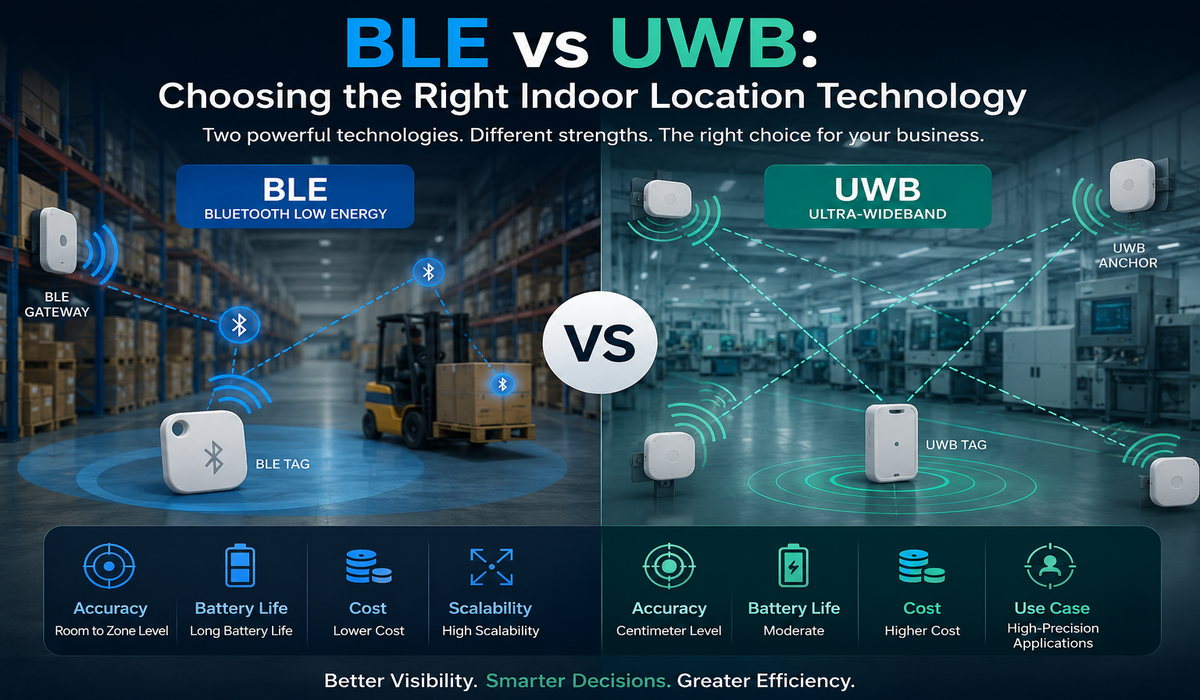
BLE vs UWB: Key Differences
Although both technologies support indoor tracking, they address different business requirements.
Positioning Accuracy
Accuracy is the most noticeable difference between BLE and UWB. BLE generally provides room-level or meter-level positioning depending on infrastructure and environmental conditions. UWB, on the other hand, delivers centimeter-level accuracy, making it suitable for applications where precise positioning directly impacts operations.
Infrastructure Requirements
BLE installations are generally simpler because many buildings already contain Bluetooth-compatible devices. Additional gateways can be installed gradually as tracking needs expand.
UWB requires dedicated anchors positioned throughout the facility to achieve its high accuracy. This often increases deployment time and infrastructure investment.
Battery Performance
BLE tags are well known for their exceptional battery efficiency. Many devices continue operating for several years before requiring battery replacement.
UWB tags typically consume more power due to the frequency and precision of their communication, resulting in comparatively shorter battery life.
Scalability
Organizations planning to track thousands of assets often find BLE easier to scale because of its lower hardware costs and simplified deployment.
UWB deployments can also scale successfully but usually involve higher capital investment as infrastructure grows.
Cost Considerations
A BLE Asset Tracking System generally offers a lower total cost of ownership. Both hardware and maintenance costs remain relatively low, making BLE attractive for enterprises seeking broad asset visibility without substantial infrastructure expenses.
UWB delivers superior accuracy but usually requires a larger initial investment in anchors, tags, and installation.
When Should You Choose a BLE Asset Tracking System?
BLE is an excellent choice for organizations focused on operational efficiency rather than centimeter-level positioning.
Warehouses can monitor pallets, forklifts, and inventory movement efficiently. Hospitals can locate wheelchairs, infusion pumps, and medical equipment more quickly. Manufacturing facilities can improve tool management, while offices can monitor shared assets across departments.
Businesses that prioritize affordability, long battery life, easy deployment, and scalable asset visibility often find BLE to be the most practical solution.
When is UWB the Better Choice?
UWB becomes the preferred option when precise positioning directly affects productivity, automation, or safety.
Manufacturing environments using autonomous mobile robots require exact navigation. High-security facilities may need accurate personnel tracking. Industrial automation systems often depend on centimeter-level positioning to coordinate machinery and equipment.
In these scenarios, the higher investment is justified by the operational benefits delivered through exceptional accuracy.
Factors to Consider Before Selecting an Indoor Location Technology
Every organization has unique operational requirements, making technology selection a strategic decision rather than simply choosing the most advanced option.
Businesses should evaluate the value of the assets being tracked, required positioning accuracy, deployment budget, facility size, maintenance expectations, scalability requirements, and future expansion plans. Existing IT infrastructure and integration with enterprise systems should also influence the decision.
A thorough assessment ensures that the selected technology aligns with both current operations and long-term business objectives.
Future of Indoor Asset Tracking
Indoor positioning technologies continue to evolve alongside Industry 4.0, Industrial IoT, and artificial intelligence. Modern asset tracking platforms increasingly combine location data with predictive analytics, workflow automation, digital twins, and real-time operational dashboards.
Hybrid solutions that integrate BLE, UWB, Wi-Fi, RFID, and IoT sensors are becoming more common, allowing organizations to balance accuracy, coverage, and cost according to specific use cases.
As businesses continue their digital transformation journeys, indoor location technologies will play an increasingly important role in improving operational visibility and resource utilization.
Conclusion
Both BLE and UWB offer significant advantages for indoor location tracking, but the right choice depends on your operational requirements. Organizations seeking an affordable, scalable, and energy-efficient solution for monitoring equipment, inventory, and business assets often benefit from implementing a BLE Asset Tracking System. Its low deployment cost, long battery life, and flexible infrastructure make it well suited for a wide range of industries.
UWB, meanwhile, delivers unmatched positioning accuracy for environments where every centimeter matters. By carefully evaluating business goals, accuracy needs, and total ownership costs, organizations can choose the indoor location technology that delivers the greatest long-term value and supports more efficient, data-driven operations.
