
Supply chains have become more complex than ever. Products may pass through manufacturers, suppliers, warehouses, distributors, logistics providers, retailers, and customers before reaching their final destination. With every stage, more data is generated, including information about product origin, ownership, transportation, storage, quality, and delivery. When this information is stored across disconnected systems, businesses can struggle to establish what actually happened at each stage. This lack of visibility can create delays, compliance problems, counterfeit risks, and disputes between supply chain partners. Blockchain Track and Trace is emerging as a powerful approach to solving these challenges.
By creating a shared and tamper-resistant record of transactions and product movements, blockchain can help organizations establish greater visibility across complex supply networks. Instead of relying entirely on isolated databases and manual records, businesses can create a connected chain of information that allows authorized participants to verify where products came from, how they moved, and what happened along the way.
As businesses increasingly prioritize transparency, resilience, compliance, and customer trust, Blockchain Track and Trace is becoming an important technology for building more accountable and intelligent supply chains.
What is Blockchain Track and Trace?
Blockchain Track and Trace combines blockchain technology with supply chain tracking processes to create a transparent and verifiable record of product movement. Traditional tracking systems usually depend on centralized databases maintained by individual organizations. While these systems can be effective within a specific company, information may become difficult to verify once products move between multiple independent organizations.
Blockchain changes this model by allowing authorized participants to record and access relevant transactions through a shared digital ledger. Each transaction is connected to previous records, creating a chronological history of the product or asset. Once information has been recorded and validated, changing historical data becomes significantly more difficult without detection.
How Blockchain Creates Supply Chain Visibility
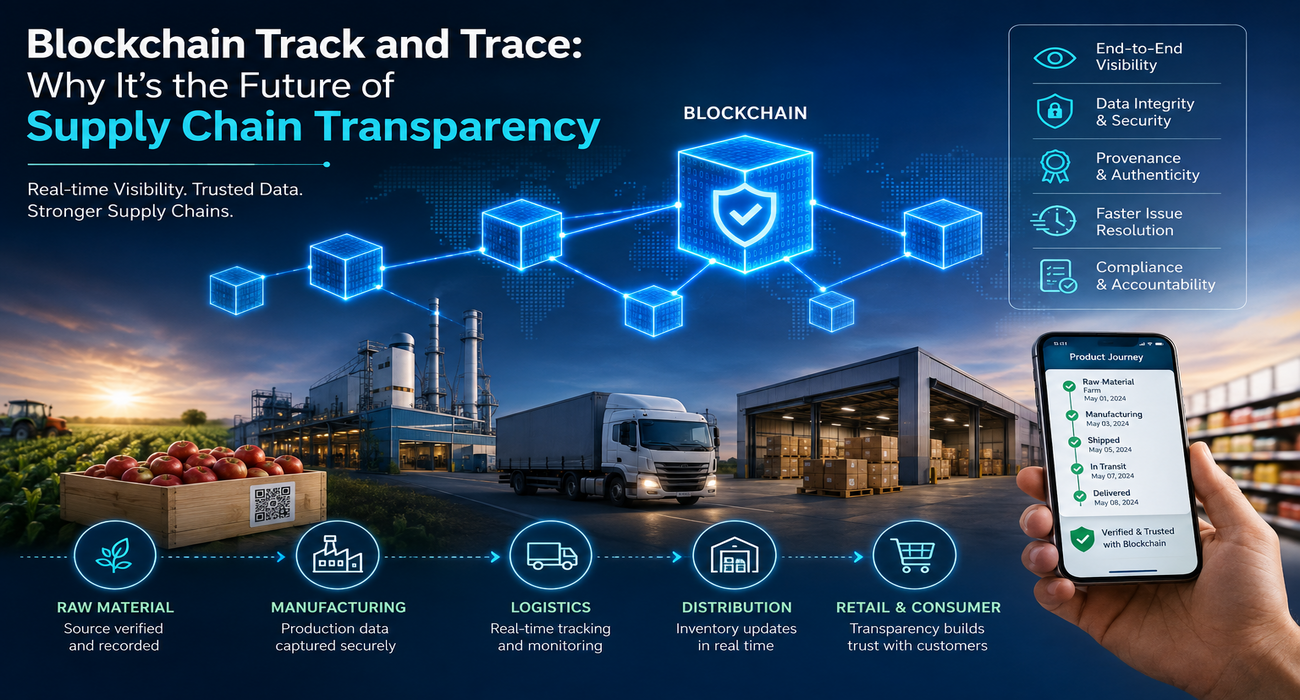
The core value of blockchain comes from creating a shared source of trusted information. A manufacturer can record when a product is produced, while a logistics provider can record its shipment details and a distributor can add information when the product reaches a warehouse. Depending on the implementation, additional data such as inspection results, certifications, temperature conditions, or delivery confirmation can also be connected to the product record.
This creates a more complete digital history. Instead of asking multiple organizations to reconcile different versions of the same information, authorized participants can work from a shared record. The result is improved visibility and a stronger foundation for supply chain decision-making.
Why Supply Chain Transparency Matters
Transparency is becoming a strategic requirement rather than simply an operational advantage. Customers increasingly want to know where products originate and whether businesses follow responsible sourcing and manufacturing practices. Regulators are also demanding stronger traceability in industries where product safety, authenticity, and environmental compliance are important.
For businesses, poor visibility can create significant financial and operational risks. When a problem occurs, organizations may spend considerable time identifying the affected products, locating their source, and determining which supply chain partners were involved.
Faster Identification of Supply Chain Problems
A transparent tracking system can help organizations identify where an issue originated. If a defective component is discovered, businesses can use the available product history to trace relevant shipments and transactions instead of manually checking records across multiple systems.
This can make recalls more targeted and potentially reduce their operational and financial impact. It can also help organizations investigate recurring problems and improve supplier management.
Building Greater Customer Trust
Customers are more likely to trust businesses when they can demonstrate the origin and journey of their products. Blockchain can support this transparency by providing verifiable records that can potentially be shared with customers through digital interfaces, QR codes, or other technologies.
For industries such as food, pharmaceuticals, luxury goods, and electronics, the ability to demonstrate authenticity and provenance can become a meaningful competitive advantage.
How Blockchain Track and Trace Works Across the Supply Chain
The implementation of Blockchain Track and Trace typically involves connecting physical products and supply chain events with digital records. Technologies such as RFID, QR codes, IoT sensors, GPS systems, and enterprise applications can capture information about products and their movement.
From Manufacturing to Distribution
At the manufacturing stage, a product or batch can receive a unique digital identity. Relevant production information can then be recorded on the blockchain or connected through associated systems. When the product is transferred to a logistics provider, another transaction can establish the next stage of its journey.
As the product moves through warehouses, distribution centers, and retailers, additional events can be recorded. This creates a continuous chain of information that represents the product’s movement through the supply network.
Combining Blockchain With IoT
The value of blockchain becomes even greater when it is combined with IoT technology. Sensors can collect real-time information about environmental conditions such as temperature, humidity, location, and movement. That information can then be connected to blockchain-based records.
For temperature-sensitive products, for example, businesses can monitor whether required conditions were maintained during transportation. This combination of IoT data and blockchain records can provide stronger evidence of how products were handled throughout their journey.
Key Benefits of Blockchain Track and Trace
The growing interest in Blockchain Track and Trace is driven by its ability to address several persistent supply chain challenges. One of its most important advantages is improved data integrity. Because blockchain records are distributed and linked through cryptographic mechanisms, unauthorized changes to historical transactions become more difficult.
Improved Traceability
Organizations can establish a clearer history of products, materials, and transactions. This can help businesses understand where products originated and how they moved through the supply chain.
Improved traceability is particularly valuable when organizations need to investigate quality problems, conduct recalls, verify suppliers, or demonstrate compliance with industry requirements.
Reduced Counterfeit Risk
Counterfeit products can create serious financial, legal, and reputational problems. Blockchain can support product authentication by creating verifiable records associated with products or batches.
When combined with unique identifiers and technologies such as RFID or QR codes, businesses can make it easier for authorized participants to validate product information and identify inconsistencies.
Greater Operational Efficiency
Supply chain organizations often spend substantial time reconciling data between partners. A shared and verifiable ledger can reduce some of this administrative burden by improving access to consistent transaction information.
This can support faster verification, reduce disputes, and improve coordination between supply chain participants.
Blockchain Track and Trace Across Different Industries
The applications of Blockchain Track and Trace extend across industries because almost every complex supply chain depends on accurate information about products and transactions.
Food and Agriculture
Food companies need to track products from farms and processing facilities through distribution and retail. Blockchain can help record information about sourcing, processing, transportation, and distribution.
If contamination occurs, traceability information can help organizations identify affected batches more efficiently. It can also support transparency around sourcing and quality.
Pharmaceuticals and Healthcare
Pharmaceutical supply chains require strict controls because counterfeit or improperly handled medicines can create serious risks. Blockchain can support tracking throughout manufacturing, distribution, and delivery.
When combined with authentication technologies and appropriate regulatory systems, it can help organizations strengthen visibility and establish more reliable product histories.
Manufacturing
Manufacturers often depend on complex networks of suppliers and components. Tracking materials across these networks can be challenging when each organization maintains separate systems.
Blockchain can provide a connected record of relevant transactions, helping manufacturers improve component traceability, supplier visibility, and quality management.
Retail and Consumer Goods
Retailers increasingly want to demonstrate product authenticity and responsible sourcing. Blockchain can help connect products with information about their origin and supply chain journey.
For premium products, this can be especially valuable because customers may want greater confidence that a product is genuine and sourced through legitimate channels.
Challenges of Implementing Blockchain Track and Trace
Despite its potential, Blockchain Track and Trace is not a simple technology that can solve supply chain problems automatically. Successful implementation requires careful planning, integration, governance, and collaboration between participating organizations.
Data Quality Remains Critical
Blockchain can help protect recorded information from unauthorized modification, but it cannot guarantee that the information entered initially is accurate. If incorrect data is introduced into the system, the blockchain may preserve that incorrect information.
Organizations therefore need reliable data capture processes, appropriate validation mechanisms, and connected technologies that can reduce manual errors.
Integration With Existing Systems
Most enterprises already use ERP, warehouse management, transportation management, CRM, IoT, RFID, and other systems. A blockchain solution must work with this existing technology environment rather than creating another isolated platform.
API integration, standardized data models, identity management, and interoperability therefore become important considerations during implementation.
Collaboration Across Supply Chain Partners
Blockchain delivers greater value when multiple participants contribute and verify information. This means businesses may need to establish common standards around data sharing, permissions, responsibilities, and governance.
Without sufficient participation, a blockchain network may provide only limited visibility.
The Future of Blockchain Track and Trace
The future of supply chain transparency will likely involve the convergence of blockchain with AI, IoT, digital twins, RFID, cloud platforms, and advanced analytics. Blockchain can provide trusted transaction histories, while other technologies can provide real-time data collection and intelligent analysis.
AI and Blockchain Working Together
Artificial intelligence can analyze large volumes of supply chain data to identify patterns, predict disruptions, detect anomalies, and improve forecasting. Blockchain can provide a more trusted data foundation for these analytical processes.
Together, these technologies can help organizations move from simply recording supply chain events to actively predicting and managing supply chain risks.
Digital Supply Chain Records
As organizations continue to digitize operations, physical products are increasingly being represented through digital identities and connected records. Blockchain can support these digital records by maintaining a verifiable history of ownership, movement, and relevant events.
This could make supply chains more transparent, accountable, and responsive over time.
Conclusion
Supply chain transparency is becoming essential for businesses that want to improve resilience, customer trust, compliance, and operational control. Traditional tracking systems can provide valuable information, but fragmented data and limited visibility across organizational boundaries continue to create challenges.
Blockchain Track and Trace offers a way to create a more connected and verifiable record of product and transaction histories. When combined with technologies such as IoT, RFID, AI, cloud computing, and digital supply chain platforms, blockchain can help organizations establish deeper visibility across complex networks.
The technology is not a replacement for strong processes, accurate data, or effective collaboration. Instead, it can serve as an important foundation for creating trusted digital supply chains. As businesses continue to demand greater accountability and real-time visibility, Blockchain Track and Trace is positioned to play an increasingly important role in the future of supply chain transparency.
Frequently Asked Questions
Q1. What is Blockchain Track and Trace in supply chain management?
Blockchain Track and Trace is a technology approach that uses blockchain to create a secure, transparent, and verifiable record of products as they move through different stages of the supply chain.
Q2. How does Blockchain Track and Trace improve supply chain transparency?
It creates a shared record of supply chain transactions and product movements, helping authorized participants verify product origin, ownership, location, and other relevant events.
Q3. Can Blockchain Track and Trace help prevent counterfeit products?
Yes. By connecting products with unique digital identities and verifiable blockchain records, businesses can make it easier to authenticate products and identify inconsistencies in their supply chain history.
Q4. Can blockchain work with IoT and RFID tracking systems?
Yes. Blockchain can be integrated with IoT sensors, RFID systems, GPS, and other tracking technologies to connect real-world product movements and sensor data with digital supply chain records.
Q5. What industries can benefit from Blockchain Track and Trace?
Industries such as food and agriculture, pharmaceuticals, manufacturing, retail, logistics, automotive, and consumer goods can use Blockchain Track and Trace to improve product visibility, traceability, authentication, and supply chain accountability.
