

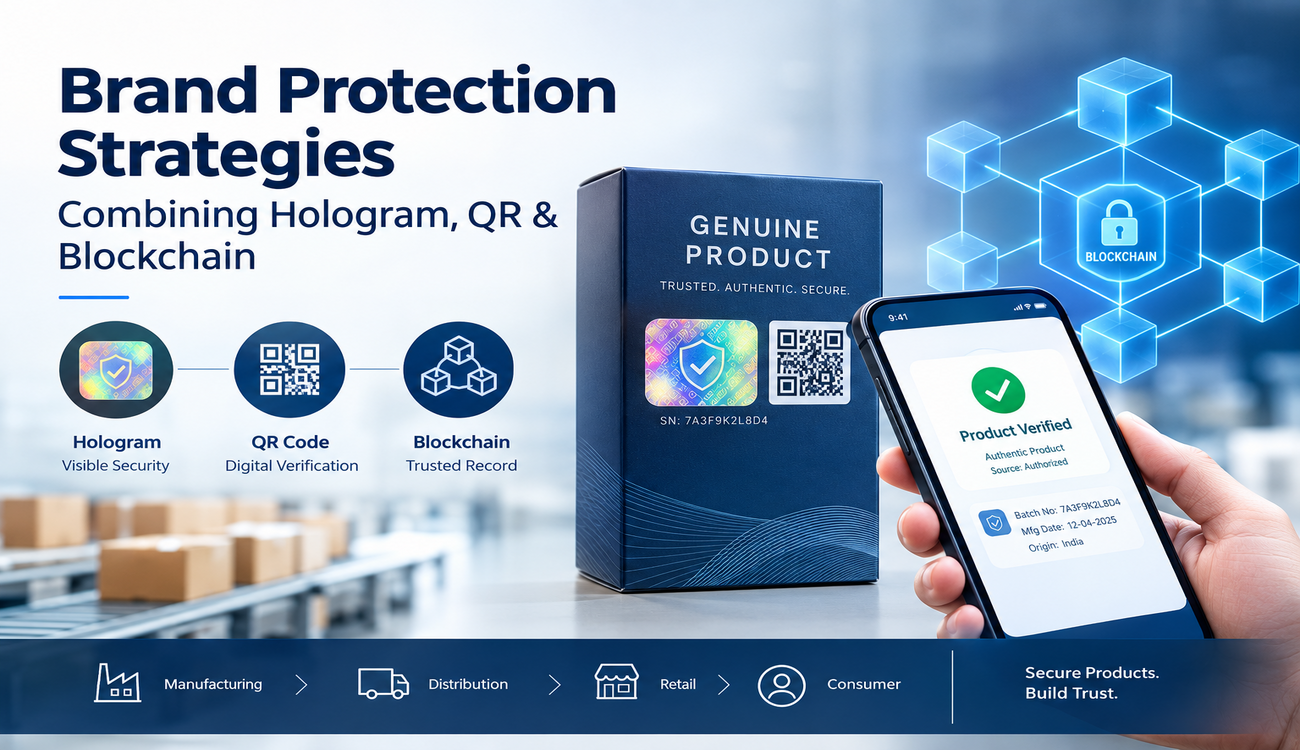
Counterfeit products, unauthorized distribution, and product tampering have become serious challenges for businesses across industries. As supply chains become more complex and consumers increasingly purchase products through online and offline channels, protecting a brand requires more than traditional packaging and security labels. Businesses now need technology-driven solutions that can verify products, strengthen supply chain visibility, and help customers identify genuine products with confidence. This is where modern Brand Protection Strategies combining holograms, QR codes, and blockchain technology can create a stronger and more connected layer of product security.
Holograms have been used for years as a visible security feature because they are difficult to reproduce accurately. QR codes add another layer by allowing customers, distributors, retailers, and inspectors to digitally verify product information. Blockchain takes this approach further by creating a trusted and tamper-resistant record of product identity and movement. When these technologies are integrated rather than used independently, companies can build a more comprehensive brand protection framework that addresses both physical and digital counterfeiting risks.
Understanding Modern Brand Protection Strategies
Modern Brand Protection Strategies focus on preventing unauthorized copying, detecting counterfeit products, protecting intellectual property, and maintaining customer trust. Traditional approaches often relied on printed labels, packaging designs, serial numbers, or basic authentication marks. While these methods still have value, counterfeiters have become more sophisticated and can reproduce many visual elements of legitimate products.
A technology-based protection strategy connects a physical product with a digital identity. This means that a product can carry visible security features while also having a unique digital record that can be verified through a smartphone or other connected system. Holograms, QR codes, and blockchain can work together to establish this connection.
Why Traditional Brand Protection Is No Longer Enough
Counterfeiting is no longer limited to physical markets. Fake products can be promoted through e-commerce platforms, social media, unauthorized distributors, and international marketplaces. A consumer may purchase what appears to be a genuine product without knowing whether it originated from the authorized manufacturer.
A simple label may not provide enough evidence of authenticity. Even a copied QR code can create problems if the verification system does not analyze whether the code is being used in the correct location or whether the product has already been scanned multiple times. Effective protection therefore requires multiple layers of authentication and monitoring.
The Role of Holograms in Brand Protection
Holograms remain one of the most recognizable physical security features used for product authentication. A properly designed security hologram can contain complex visual elements, microtext, patterns, optical effects, and other characteristics that make unauthorized reproduction more difficult.
For consumers, holograms provide an immediate visual indicator that can help distinguish an authentic product from an obvious counterfeit. For manufacturers, they can become part of a broader authentication system when each holographic label is associated with a unique product identifier.
Advanced Holographic Security Features
Modern security holograms can incorporate multiple layers of protection rather than relying on a simple reflective image. Specialized patterns, hidden elements, microtext, dynamic optical effects, and customized designs can make duplication significantly more challenging.
The real value comes when the hologram is connected with digital authentication. Instead of treating the hologram as the complete security solution, businesses can use it as the physical layer of a wider authentication ecosystem.
Holograms and Consumer Confidence
Consumers often make quick decisions when purchasing products, particularly in industries such as pharmaceuticals, cosmetics, electronics, luxury goods, and packaged consumer products. A visible security feature can provide an initial indication of authenticity.
However, consumers increasingly expect digital verification as well. Combining a holographic identifier with a QR code allows customers to move from visual inspection to digital confirmation, making authentication more convenient and transparent.
How QR Codes Strengthen Product Authentication
QR codes have become an important component of digital product authentication because smartphones can scan them without requiring specialized equipment. Businesses can assign unique QR codes to individual products, packaging units, batches, or shipments depending on their operational requirements.
When scanned, the QR code can connect the user to a verification platform containing relevant product information. The system may confirm whether the product is registered, identify the manufacturing batch, display authentication information, or provide other approved product details.
Unique QR Codes for Individual Products
A major advantage of QR-based authentication is the ability to create unique digital identities. Instead of assigning one code to an entire product category, manufacturers can generate unique identifiers for individual units.
This makes it easier to identify suspicious scanning patterns. For example, if the same product code is scanned repeatedly from geographically distant locations within a short period, the system may flag the activity for investigation.
QR Codes Across the Supply Chain
QR codes can also support authentication beyond the consumer. Manufacturers, distributors, warehouses, retailers, and logistics teams can use product identifiers to record important supply chain events.
This creates a connected authentication process in which a product can be monitored from production to distribution and eventually to the customer. Such visibility can help organizations identify unauthorized movement and investigate potential diversion or counterfeit activity.
Blockchain as a Trust Layer for Brand Protection
Blockchain can add another layer of trust by providing a distributed and tamper-resistant method for recording product information and transactions. Instead of relying only on a centralized database, blockchain-based systems can maintain records that are difficult to alter retrospectively without detection.
For brand protection, this can be valuable when multiple parties participate in the supply chain. Manufacturers, logistics providers, distributors, retailers, and other authorized stakeholders can interact with a shared record of relevant product events.
Creating a Digital Product Identity
A blockchain-based system can associate a product with a unique digital identity. Important events, such as manufacturing, packaging, shipment, distribution, and authentication, can be recorded against that identity.
When a customer scans a QR code, the verification platform can use the associated product identity to confirm whether the product’s information is consistent with the recorded history. This provides a stronger foundation for authentication than a QR code that simply redirects users to a static webpage.
Preventing Unauthorized Data Manipulation
One of the challenges in conventional authentication systems is maintaining confidence in historical records. If product information can be changed without proper controls, stakeholders may question the reliability of the data.
Blockchain can help address this issue by creating an auditable record of transactions. While blockchain does not automatically make every piece of information accurate, it can provide a stronger mechanism for preserving and auditing records once they are entered into the system.
Combining Hologram, QR Codes and Blockchain
The strongest approach is not to treat holograms, QR codes, and blockchain as separate technologies. Instead, businesses can combine them into a multi-layered authentication model.
The hologram provides a physical security feature that consumers can inspect. The QR code creates a bridge between the physical product and its digital identity. Blockchain can provide the underlying trusted record for important product events and authentication data.
Physical Authentication Meets Digital Verification
A customer can first inspect the hologram on a product package and then scan the QR code using a smartphone. The authentication platform can verify the unique product identifier and retrieve relevant information from the connected system.
If the product record is valid and the scanning behavior appears normal, the system can provide an authentication confirmation. If the identifier does not exist, has already been deactivated, or displays suspicious activity, the system can trigger an appropriate warning or investigation workflow.
Building a Connected Authentication Ecosystem
This integrated model can also provide value beyond counterfeit detection. Businesses can use the same infrastructure to improve traceability, monitor distribution, understand product interactions, and gather useful information about authentication activity.
The system can become part of a broader digital supply chain environment rather than functioning only as a security mechanism.
Industries That Can Benefit From These Brand Protection Strategies
Different industries face different counterfeit risks, but the combination of physical and digital authentication can be useful across many sectors. Pharmaceutical companies can use these technologies to help authenticate medicines and improve traceability. Luxury brands can connect individual products with unique digital identities to protect against unauthorized replicas.
Electronics manufacturers can use QR-based authentication to verify devices and accessories, while automotive companies can apply similar systems to spare parts and components. Food and beverage companies can use product identities to strengthen traceability and help consumers verify product information.
Cosmetics, apparel, industrial equipment, agricultural products, and high-value consumer goods can also benefit from multi-layered authentication systems where counterfeit activity creates financial, operational, or reputational risks.
Benefits of Integrated Brand Protection
An integrated approach can improve protection because it does not depend on a single security mechanism. If a counterfeit product successfully copies the appearance of packaging, the digital verification layer can still provide another method of detection.
Stronger Counterfeit Detection
Unique product identities and digital verification can make it more difficult for counterfeiters to replicate legitimate products at scale. Suspicious scans and inconsistent product records can provide signals that help organizations identify potential counterfeit activity.
Greater Supply Chain Visibility
When product events are recorded throughout the supply chain, businesses can gain greater visibility into where products originate and how they move between authorized participants. This can support investigations into diversion, unauthorized distribution, and other supply chain issues.
Improved Customer Trust
Customers are more likely to trust brands that provide convenient ways to verify authenticity. A simple smartphone scan can make authentication more accessible while demonstrating that the company is actively investing in product security.
Better Brand Reputation
Counterfeit products can damage a company’s reputation even when the manufacturer is not responsible for them. Customers who unknowingly purchase fake products may associate poor quality or safety issues with the original brand. Strong authentication and traceability can help reduce this risk.
Challenges in Implementing Integrated Authentication
Although these technologies offer significant potential, successful implementation requires careful planning. Businesses need to determine which products require individual-level identification and which can use batch-level tracking. They also need to protect QR codes from unauthorized duplication and ensure that the authentication platform can handle large volumes of scans.
Data quality is equally important. Blockchain can preserve records, but inaccurate information entered into the system remains inaccurate. Organizations therefore need clear processes for product registration, supply chain updates, access control, and exception handling.
Consumer adoption is another consideration. Authentication must be simple enough for customers to understand and use. If scanning a product requires too many steps, customers may ignore the feature. The experience should therefore be fast, mobile-friendly, and easy to interpret.
Best Approach for Implementing Brand Protection Strategies
Businesses should begin by assessing their most significant counterfeiting and supply chain risks rather than implementing technology without a defined objective. The organization can then determine where physical security features, digital authentication, and distributed records can provide the greatest value.
The next stage involves designing a unique product identification system. Holograms, QR codes, serial numbers, and blockchain records should be connected through a clearly defined architecture. Authentication rules should also be established so that unusual scans, duplicate identifiers, or unexpected locations can be investigated.
Making Authentication Simple for Customers
Technology should remain invisible where possible. Customers should not need technical knowledge to determine whether a product is genuine. A clear scan experience with understandable authentication results can significantly improve adoption.
Continuously Monitoring the System
Brand protection is not a one-time implementation. Counterfeiters continuously change their methods, which means authentication systems must evolve as well. Businesses should monitor scan behavior, investigate suspicious activity, update security features, and improve authentication processes over time.
The Future of Brand Protection
The future of Brand Protection Strategies will increasingly involve the integration of physical security, digital identity, data analytics, and connected supply chains. Holograms can continue to provide visible protection, while QR codes can make authentication accessible through everyday smartphones. Blockchain can provide a trusted foundation for recording important product events and verification histories.
As businesses move toward more connected supply chains, product authentication can become part of a larger digital ecosystem. Artificial intelligence and analytics may further help organizations identify unusual scanning behavior, detect potential counterfeit networks, and prioritize investigations.
Conclusion
Counterfeit products are becoming more sophisticated, making traditional brand protection methods alone less effective. Businesses need layered strategies that combine physical security with digital verification and trusted data.
By combining holograms, QR codes, and blockchain, organizations can create a connected authentication framework that helps verify products, improve supply chain visibility, detect suspicious activity, and strengthen customer confidence. Holograms provide a visible physical security layer, QR codes connect products to digital verification, and blockchain can provide a reliable record of important product events.
The most effective Brand Protection Strategies are therefore not built around one technology. They combine multiple layers of protection into a system designed around the company’s products, supply chain, customers, and specific counterfeit risks. As digital authentication continues to evolve, this integrated approach can become an important part of protecting brand value and maintaining trust in an increasingly complex marketplace.
Frequently Asked Questions
Q1. What are Brand Protection Strategies?
Brand Protection Strategies are methods businesses use to protect their products, intellectual property, reputation, and customers from counterfeiting, unauthorized distribution, and product tampering. Technologies such as holograms, QR codes, and blockchain can strengthen these strategies.
Q2. How do holograms help protect brands from counterfeit products?
Holograms provide a visible security feature that can be difficult to reproduce accurately. Advanced holograms can include customized patterns, microtext, and optical effects that help consumers and businesses identify authentic products.
Q3. How do QR codes support product authentication?
QR codes can connect a physical product to a unique digital identity. When customers or supply chain partners scan the code, they can access an authentication platform that verifies product information and can identify suspicious or duplicate scans.
Q4. What role does blockchain play in brand protection?
Blockchain can provide a tamper-resistant record of product information and supply chain events. By connecting product identities with blockchain records, businesses can improve traceability and create a more trustworthy authentication process.
Q5. Can holograms, QR codes, and blockchain be used together?
Yes. Combining these technologies creates multiple layers of protection. The hologram provides physical authentication, the QR code connects the product to its digital identity, and blockchain can provide a trusted record of relevant product and supply chain information.
