

Modern supply chains operate in an environment where customer expectations are higher than ever, product lifecycles are shorter, and disruptions can occur at any stage of the movement of goods. Businesses today are expected to maintain optimal stock levels, fulfill orders quickly, and respond to changing market conditions without delays. In this landscape, understanding the true value of Inventory Visibility Benefits has become essential for organizations seeking operational efficiency and competitive advantage.
Inventory management is no longer limited to counting products stored in warehouses. It has evolved into a strategic business function that influences procurement, production planning, logistics, customer satisfaction, and profitability. Organizations that can accurately track inventory across warehouses, distribution centers, stores, and transit locations gain greater control over their supply chain operations.
Whether a company operates in manufacturing, retail, healthcare, logistics, or e-commerce, having real-time insight into inventory enables smarter decisions and reduces costly inefficiencies. As supply chains become increasingly interconnected, visibility into stock movement and availability plays a critical role in maintaining resilience and business continuity.
What is Inventory Visibility?
Inventory visibility refers to the ability of an organization to track, monitor, and access accurate inventory information across the entire supply chain in real time. It provides a unified view of inventory levels, locations, movements, and status from procurement to final delivery.
Instead of relying on periodic inventory checks or disconnected systems, businesses gain continuous access to inventory data across multiple facilities and channels. This visibility allows managers to know exactly what inventory is available, where it is located, and when it is expected to arrive or move.
Modern inventory visibility solutions integrate data from warehouses, transportation systems, enterprise resource planning platforms, suppliers, and distribution networks. This creates a centralized source of truth that supports informed decision-making throughout the organization.
As supply chains become more complex, organizations increasingly rely on technologies such as RFID, barcode systems, IoT sensors, cloud platforms, and analytics tools to achieve comprehensive inventory visibility.
Why Inventory Visibility Matters in Modern Supply Chains
Supply chain operations involve numerous stakeholders, processes, and locations working together to move products efficiently. Without accurate visibility, businesses often struggle with stock discrepancies, delayed shipments, inaccurate forecasting, and poor customer experiences.
Inventory visibility enables organizations to identify problems before they escalate. When managers have access to real-time inventory information, they can proactively address shortages, excess stock, supplier delays, and transportation bottlenecks.
In addition, visibility creates alignment across departments. Procurement teams can make informed purchasing decisions, warehouse managers can optimize storage utilization, sales teams can provide accurate availability information, and executives can make strategic decisions based on reliable data.
The growing demand for faster deliveries and omnichannel fulfillment has further increased the importance of inventory visibility. Customers expect accurate inventory information and timely order fulfillment regardless of how or where they purchase products. Organizations that lack visibility often struggle to meet these expectations.
The Core Components of Effective Inventory Visibility
Achieving comprehensive visibility requires a combination of technology, processes, and data management practices. Several foundational components contribute to successful implementation.
Real-Time Data Collection
Real-time inventory data serves as the backbone of visibility. Organizations must continuously capture inventory information through automated systems rather than relying on manual updates. This ensures accuracy and minimizes delays in decision-making.
Centralized Inventory Management
Data from multiple locations and systems should be consolidated into a single platform. Centralized management eliminates information silos and provides a unified view of inventory across the supply chain.
Asset Tracking Technologies
Technologies such as RFID, barcode scanning, GPS tracking, and IoT devices help organizations monitor inventory movement and location throughout the supply chain journey.
Data Analytics and Reporting
Analytics tools transform inventory data into actionable insights. Businesses can identify trends, forecast demand, monitor performance, and improve operational planning through advanced reporting capabilities.
Integration Across Systems
Inventory visibility depends on seamless communication between enterprise applications, warehouse management systems, transportation platforms, supplier portals, and customer-facing systems.
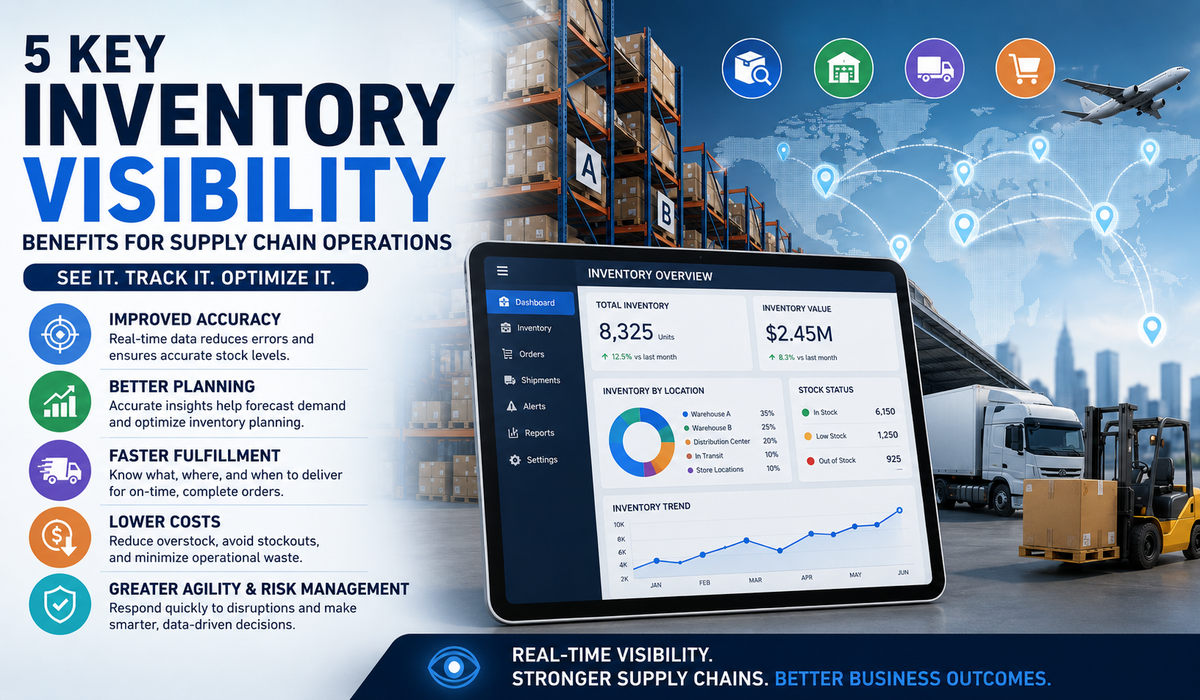
5 Key Inventory Visibility Benefits for Supply Chain Operations
1. Improved Inventory Accuracy and Stock Control
One of the most significant Inventory Visibility Benefits is improved inventory accuracy. Many organizations experience discrepancies between recorded inventory and actual stock levels due to manual errors, delayed updates, or system inconsistencies.
With real-time visibility, inventory records remain synchronized across all locations and channels. This reduces inaccuracies and ensures that decision-makers have access to reliable information.
Accurate inventory data helps organizations maintain optimal stock levels while minimizing waste. Businesses can reduce overstocking, prevent stockouts, and allocate resources more effectively. As a result, inventory carrying costs decrease while service levels improve.
Greater stock control also supports compliance and audit requirements by providing traceable inventory records and transaction histories.
2. Enhanced Demand Forecasting and Planning
Another important aspect of Inventory Visibility Benefits is the ability to improve forecasting accuracy. Demand forecasting relies heavily on access to accurate and timely inventory information.
When organizations have visibility into inventory movements, sales trends, and consumption patterns, they can develop more precise forecasts. Better forecasting enables companies to anticipate customer demand and adjust procurement and production schedules accordingly.
This proactive approach reduces the likelihood of inventory shortages during periods of high demand while preventing excess stock accumulation during slower periods.
Improved planning also strengthens supplier relationships because businesses can communicate requirements more accurately and collaborate more effectively on replenishment strategies.
3. Faster Order Fulfillment and Better Customer Satisfaction
Customer expectations continue to evolve, with speed and reliability becoming critical differentiators. Visibility into inventory availability allows organizations to fulfill orders more efficiently and accurately.
When businesses know exactly where inventory is located, they can select the most appropriate fulfillment source and reduce delivery times. This improves operational efficiency and enhances customer experiences.
Customers receive accurate information regarding product availability and shipment status, reducing frustration and increasing trust. Businesses can also respond quickly to changes in demand and unexpected disruptions.
Faster fulfillment contributes directly to customer retention and brand reputation, making it a valuable competitive advantage in today’s marketplace.
4. Reduced Operational Costs and Waste
Reducing costs is a major objective for supply chain leaders. Among the most impactful Inventory Visibility Benefits is the ability to identify inefficiencies and eliminate unnecessary expenses.
Organizations often incur significant costs due to excess inventory, emergency replenishment orders, warehouse congestion, and obsolete stock. Enhanced visibility enables businesses to detect these issues early and take corrective action.
Inventory optimization becomes easier when decision-makers can monitor stock levels continuously and adjust inventory strategies based on actual demand patterns.
Improved visibility also reduces labor costs associated with manual inventory checks, reconciliation activities, and error correction processes.
As operational waste decreases, organizations can allocate resources more effectively and improve overall profitability.
5. Greater Supply Chain Agility and Risk Management
Modern supply chains face numerous risks, including supplier disruptions, transportation delays, geopolitical events, and unexpected demand fluctuations.
One of the most strategic Inventory Visibility Benefits is increased agility. Organizations with real-time inventory insight can identify disruptions quickly and implement contingency plans before significant operational impacts occur.
Visibility enables companies to monitor inventory across multiple locations and redistribute stock when necessary. Businesses can respond more effectively to changing market conditions and customer requirements.
Risk management improves because organizations gain earlier warning of potential shortages, delays, or supply chain bottlenecks. This proactive capability strengthens resilience and supports business continuity.
Step-by-Step Approach to Implement Inventory Visibility
Step 1: Assess Existing Inventory Processes
Organizations should begin by evaluating current inventory management practices, systems, and workflows. Identifying gaps in visibility helps establish implementation priorities and objectives.
Step 2: Define Business Goals
Clear goals ensure alignment between inventory visibility initiatives and broader business objectives. Organizations may focus on reducing stockouts, improving order fulfillment, enhancing forecasting, or lowering inventory costs.
Step 3: Select Appropriate Technologies
Technology selection should align with operational requirements and scalability needs. Businesses may implement RFID systems, barcode solutions, IoT sensors, cloud-based inventory platforms, or integrated warehouse management systems.
Step 4: Integrate Data Sources
Visibility depends on seamless data flow across the supply chain ecosystem. Organizations should integrate inventory systems with ERP platforms, supplier networks, logistics systems, and analytics tools.
Step 5: Establish Real-Time Monitoring
Continuous monitoring provides accurate inventory updates and enables proactive decision-making. Automated alerts and dashboards help managers respond quickly to inventory-related issues.
Step 6: Train Employees and Stakeholders
Successful implementation requires user adoption. Employees should understand how to use visibility tools effectively and how inventory data supports operational goals.
Step 7: Measure and Optimize Performance
Organizations should continuously evaluate performance metrics, identify improvement opportunities, and refine inventory strategies to maximize business value.
Real-World Use Cases of Inventory Visibility
Retail Supply Chains
Large retailers often manage inventory across distribution centers, warehouses, and physical stores. Visibility allows them to maintain accurate stock information and support omnichannel fulfillment strategies.
Retailers can quickly transfer inventory between locations, improve replenishment decisions, and ensure products remain available for customers.
Manufacturing Operations
Manufacturers depend on consistent access to raw materials and components. Visibility helps production teams monitor inventory levels and avoid disruptions caused by material shortages.
Real-time tracking also improves production planning and supports lean manufacturing initiatives.
Healthcare Organizations
Hospitals and healthcare providers require accurate inventory tracking for medical supplies, pharmaceuticals, and critical equipment. Visibility improves patient care by ensuring essential items remain available when needed.
Logistics and Distribution
Logistics companies benefit from tracking inventory in transit and across distribution networks. This enhances shipment accuracy, reduces delays, and improves customer communication.
Technologies Driving Inventory Visibility
Advancements in digital technologies continue to transform inventory management capabilities across industries.
RFID technology enables automated identification and tracking of inventory without requiring direct line-of-sight scanning. This significantly improves accuracy and operational efficiency.
Barcode systems remain widely used because they provide a cost-effective method for inventory tracking and data capture.
IoT sensors deliver real-time monitoring capabilities by collecting information about inventory location, condition, and movement.
Cloud-based inventory management platforms provide centralized access to inventory data from any location while supporting scalability and collaboration.
Artificial intelligence and machine learning enhance visibility by analyzing large volumes of inventory data, identifying patterns, and generating predictive insights.
Digital twins and advanced analytics are also emerging as valuable tools for supply chain optimization and inventory planning.
Common Challenges in Achieving Inventory Visibility
Despite its benefits, implementing visibility initiatives can present challenges.
Data quality issues often create inconsistencies that undermine decision-making. Organizations must establish strong data governance practices to maintain accuracy.
System integration can be complex when businesses operate multiple legacy applications across different departments and locations.
Resistance to change may slow adoption efforts. Employees accustomed to traditional processes may require training and support during implementation.
Scalability considerations become increasingly important as organizations expand operations and add new inventory locations.
Cybersecurity risks also require attention because inventory visibility systems frequently rely on interconnected digital platforms.
Addressing these challenges proactively improves implementation success and long-term value realization.
Best Practices for Maximizing Results
Organizations seeking successful inventory visibility initiatives should prioritize data accuracy and process standardization across all locations.
Automation should be leveraged wherever possible to reduce manual intervention and improve consistency.
Regular performance reviews help identify emerging issues and opportunities for optimization.
Cross-functional collaboration ensures that inventory data supports decision-making across procurement, production, logistics, sales, and customer service teams.
Businesses should also invest in scalable technology solutions that can adapt to future growth and evolving operational requirements.
Future Trends Shaping Inventory Visibility
The future of inventory visibility is closely connected to digital transformation and intelligent supply chain technologies.
Artificial intelligence will continue enhancing forecasting accuracy and inventory optimization through predictive analytics.
IoT adoption is expected to increase, providing more granular tracking capabilities and real-time monitoring across supply networks.
Blockchain technology may improve transparency by creating secure and verifiable inventory records shared among supply chain partners.
Autonomous warehouses and robotics will further improve inventory accuracy and operational efficiency.
As organizations pursue greater resilience, visibility platforms will increasingly incorporate risk intelligence and scenario planning capabilities.
The integration of AI-driven decision support systems will enable businesses to respond faster to disruptions while improving overall supply chain performance.
Conclusion
The growing complexity of modern supply chains makes inventory visibility a critical capability rather than an optional advantage. Organizations that invest in real-time inventory insights can improve accuracy, optimize planning, reduce costs, enhance customer experiences, and strengthen resilience against disruptions. The long-term value of Inventory Visibility Benefits extends beyond operational efficiency and directly supports strategic business growth.
As technologies such as RFID, IoT, cloud platforms, and artificial intelligence continue to evolve, businesses have more opportunities than ever to build intelligent and connected supply chains.
People Also Ask
Q1. What is inventory visibility in supply chain management?
Inventory visibility is the ability to track and monitor inventory levels, locations, movements, and status across the supply chain in real time. It provides businesses with accurate information about available stock and helps ensure efficient inventory management. By using technologies such as RFID, barcode systems, cloud platforms, and IoT devices, organizations can gain a centralized view of inventory across warehouses, stores, and distribution centers. This enables better planning, faster decision-making, and improved customer service while reducing operational inefficiencies.
Q2. Why is inventory visibility important for businesses?
Inventory visibility is important because it helps organizations maintain accurate stock information and make informed operational decisions. Without visibility, businesses may experience stock shortages, excess inventory, delayed deliveries, and inaccurate forecasting. Real-time inventory insights support better demand planning, improve customer satisfaction, and enhance supply chain performance. Visibility also allows organizations to respond quickly to disruptions and changing market conditions while reducing costs associated with inventory errors and inefficiencies.
Q3. How does inventory visibility improve customer satisfaction?
Inventory visibility improves customer satisfaction by providing accurate information regarding product availability and delivery timelines. Businesses can fulfill orders faster and minimize fulfillment errors when they know exactly where inventory is located. Customers receive reliable updates about order status, which enhances trust and confidence. Improved inventory accuracy also reduces the likelihood of canceled orders, delayed shipments, and unavailable products. These factors contribute to a better customer experience and stronger brand loyalty.
Q4. What technologies support inventory visibility?
Several technologies support inventory visibility, including RFID systems, barcode scanners, IoT sensors, cloud-based inventory platforms, warehouse management systems, and enterprise resource planning software. These technologies enable organizations to collect, process, and analyze inventory data in real time. Artificial intelligence and advanced analytics further enhance visibility by identifying trends and generating predictive insights. The combination of these technologies creates a comprehensive view of inventory throughout the supply chain.
Q5. What industries benefit most from inventory visibility?
Inventory visibility provides value across many industries, including retail, manufacturing, healthcare, logistics, automotive, and e-commerce. Retailers use visibility to support omnichannel fulfillment and stock optimization. Manufacturers rely on visibility to maintain production continuity. Healthcare organizations track critical medical supplies and equipment. Logistics providers monitor inventory movement across transportation networks. Any industry that manages physical inventory can improve efficiency, accuracy, and customer service through enhanced visibility.
Q6. What are the biggest Inventory Visibility Benefits for supply chains?
The most significant Inventory Visibility Benefits include improved inventory accuracy, enhanced forecasting, faster order fulfillment, reduced operational costs, and stronger supply chain resilience. Organizations gain greater control over inventory movement and can respond proactively to changing demand and potential disruptions. These advantages support better decision-making, higher customer satisfaction, and improved profitability. Visibility also creates a foundation for digital transformation initiatives and long-term operational excellence.
Q7. How can companies successfully implement inventory visibility solutions?
Successful implementation begins with assessing existing processes and identifying visibility gaps. Organizations should define clear objectives, select appropriate technologies, integrate data sources, and establish real-time monitoring capabilities. Employee training and stakeholder engagement are also critical for adoption. Continuous performance measurement ensures that visibility initiatives deliver measurable business value. A phased implementation approach often helps organizations manage complexity while achieving sustainable results.
