
IoT Cold Chain Monitoring has become an essential technology for industries that rely on temperature-sensitive products. Whether transporting vaccines, biologics, dairy products, frozen foods, or fresh produce, maintaining the correct environmental conditions throughout the supply chain is critical. Even minor temperature fluctuations can reduce product quality, shorten shelf life, or make products unsafe for consumption. IoT Cold Chain Monitoring addresses these challenges by combining smart sensors, connected devices, cloud platforms, and analytics to deliver complete visibility across storage facilities, warehouses, refrigerated vehicles, distribution centers, and retail locations. Instead of reacting after spoilage occurs, organizations can identify risks immediately and take corrective action before products are damaged.
Traditional cold chain management often depends on manual inspections and periodic temperature recordings. While these methods provide limited visibility, they cannot detect sudden environmental changes or equipment failures in real time. As global supply chains become more complex, businesses require continuous monitoring, instant alerts, and predictive insights to minimize losses and maintain compliance.
This article explores how IoT Cold Chain Monitoring works, why it is transforming food and pharmaceutical logistics, its benefits, implementation strategies, challenges, and future trends that are shaping intelligent cold chain operations.
Understanding IoT Cold Chain Monitoring
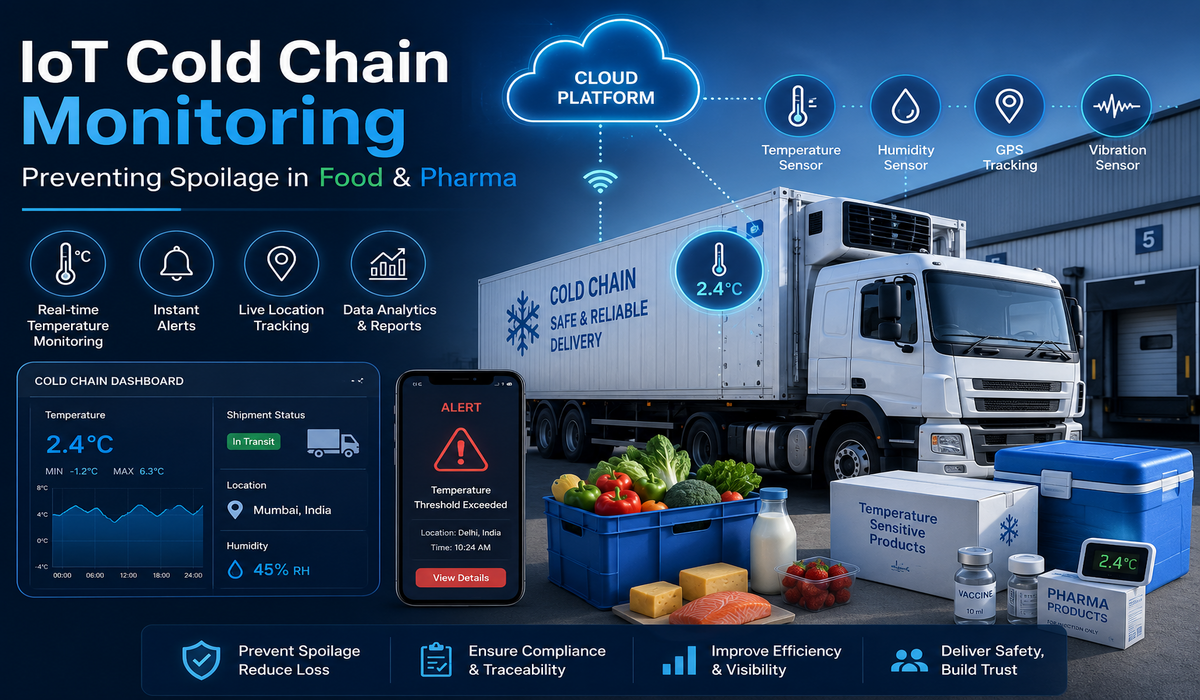
IoT Cold Chain Monitoring refers to the use of Internet of Things (IoT) devices to continuously monitor environmental conditions throughout the storage and transportation of temperature-sensitive goods. Smart sensors collect data related to temperature, humidity, location, vibration, light exposure, and equipment performance, transmitting this information to centralized cloud platforms for real-time analysis.
Unlike conventional monitoring methods that depend on periodic manual checks, IoT enables continuous tracking throughout the entire journey. Every stage of the supply chain becomes connected, allowing logistics teams to monitor product conditions remotely while receiving instant notifications whenever predefined thresholds are exceeded.
This level of visibility helps businesses maintain product quality while reducing operational risks and improving customer confidence.
Why Cold Chain Monitoring Matters?
Maintaining product integrity is one of the biggest challenges for organizations handling perishable goods. Food products can spoil quickly when exposed to incorrect temperatures, while pharmaceutical products such as vaccines and biologics may permanently lose effectiveness after even short temperature excursions.
Supply chain disruptions, equipment failures, transportation delays, and human errors increase the likelihood of temperature deviations. Without continuous monitoring, organizations often discover these issues only after products reach customers or fail regulatory inspections.
IoT Cold Chain Monitoring provides real-time visibility that significantly reduces these risks by allowing businesses to intervene immediately before irreversible damage occurs.
How IoT Cold Chain Monitoring Works
Smart Environmental Sensors
Specialized IoT sensors continuously measure temperature, humidity, pressure, vibration, and other environmental parameters. These sensors are installed inside refrigerated trucks, cold storage warehouses, shipping containers, refrigerators, freezers, and distribution centers.
The sensors collect data every few seconds or minutes depending on operational requirements, ensuring uninterrupted monitoring throughout transportation and storage.
Temperature Monitoring
Temperature is the most critical parameter within any cold chain operation. IoT sensors accurately record temperature variations throughout the transportation process, ensuring products remain within acceptable operating ranges.
Humidity Monitoring
Many food items and pharmaceutical products require controlled humidity levels to maintain quality. Smart humidity sensors help prevent excessive moisture or dehydration that could compromise product integrity.
Location Tracking
GPS-enabled IoT devices allow logistics teams to monitor shipment locations in real time. Businesses gain complete visibility into transportation routes, estimated arrival times, and delivery progress.
Equipment Health Monitoring
IoT devices also monitor refrigeration equipment performance, compressor efficiency, energy consumption, and mechanical health. Early detection of equipment issues prevents unexpected failures that could damage valuable inventory.
Cloud Connectivity
The collected sensor data is securely transmitted through cellular, Wi-Fi, LPWAN, NB-IoT, LoRaWAN, or satellite networks to cloud-based monitoring platforms. These platforms centralize information from multiple locations, making it accessible through web dashboards and mobile applications.
Supply chain managers can monitor every shipment regardless of geographical location.
Real-Time Analytics
Cloud platforms analyze incoming sensor data continuously. Intelligent algorithms compare live readings with predefined safety thresholds and identify abnormal conditions instantly.
When unusual temperature fluctuations occur, automated alerts notify responsible personnel through mobile notifications, SMS, emails, or enterprise applications.
Automated Reporting
Every environmental reading is automatically recorded, creating detailed compliance reports for regulatory inspections and quality audits. Businesses no longer rely on manual documentation, reducing administrative work while improving traceability.
Key Components of an IoT Cold Chain Monitoring System
An effective IoT Cold Chain Monitoring solution integrates several technologies into one intelligent ecosystem.
IoT Sensors
Environmental sensors continuously collect operational data throughout transportation and storage.
IoT Gateways
Gateways aggregate sensor information and securely transmit it to cloud infrastructure.
Cloud Platform
The cloud platform stores, analyzes, and visualizes operational data from thousands of connected devices.
Mobile Applications
Mobile apps enable logistics managers to monitor shipments remotely and receive instant alerts.
Analytics Engine
Advanced analytics transform raw sensor data into meaningful operational insights, enabling predictive maintenance and proactive decision-making.
Dashboard
Interactive dashboards provide real-time visualization of shipment status, temperature history, equipment health, route performance, and compliance metrics.
Benefits of IoT Cold Chain Monitoring
Reduces Product Spoilage
Continuous environmental monitoring helps organizations identify potential risks before products become unusable. Immediate corrective action significantly lowers spoilage rates and financial losses.
Ensures Regulatory Compliance
Food safety authorities and pharmaceutical regulators require detailed environmental records during storage and transportation. IoT systems automatically generate accurate compliance reports that simplify audits and inspections.
Improves Product Quality
Maintaining consistent storage conditions preserves freshness, nutritional value, effectiveness, and overall product quality throughout the supply chain.
Enhances Supply Chain Visibility
Real-time visibility allows organizations to monitor shipments at every stage, reducing uncertainty and improving operational transparency.
Enables Faster Decision Making
Instant alerts allow logistics managers to respond immediately to unexpected temperature deviations instead of discovering problems after deliveries are completed.
Supports Predictive Maintenance
Monitoring refrigeration equipment performance enables maintenance teams to identify potential failures before breakdowns occur, reducing downtime and repair costs.
Reduces Operational Costs
Lower spoilage rates, optimized maintenance schedules, reduced manual inspections, and improved logistics efficiency contribute to significant cost savings.
Improves Customer Trust
Customers gain confidence knowing that sensitive products have been monitored continuously throughout transportation and storage.
Applications of IoT Cold Chain Monitoring
Pharmaceutical Industry
The pharmaceutical industry depends heavily on strict temperature control. Vaccines, insulin, biologics, blood products, and specialty medicines require uninterrupted cold chain conditions to maintain effectiveness.
IoT Cold Chain Monitoring ensures compliance with regulatory standards while protecting patient safety.
Food and Beverage Industry
Fresh fruits, vegetables, dairy products, seafood, frozen foods, meat products, beverages, and ready-to-eat meals all require controlled storage conditions.
Continuous monitoring helps businesses reduce food waste while delivering higher-quality products.
Healthcare Logistics
Hospitals, diagnostic laboratories, and blood banks rely on connected monitoring systems to ensure critical medical supplies remain within safe environmental conditions.
Agriculture
Freshly harvested crops require proper storage and transportation before reaching processing facilities and retail markets. IoT monitoring minimizes spoilage while improving product freshness.
Chemical Industry
Temperature-sensitive industrial chemicals and specialty materials require controlled transportation to maintain stability and safety.
Challenges in Cold Chain Management
Despite technological advancements, organizations continue to face operational challenges.
Equipment failures may occur unexpectedly during transportation. Long-distance shipments often experience delays caused by weather, customs procedures, or traffic congestion. Manual processes still introduce human error into many supply chains, while fragmented data systems make centralized monitoring difficult.
IoT Cold Chain Monitoring helps address these issues by providing continuous visibility, automated alerts, centralized reporting, and predictive insights that improve operational resilience.
Best Practices for Implementing IoT Cold Chain Monitoring
Organizations should begin by identifying critical control points across their supply chain where temperature-sensitive products are stored or transported. High-quality industrial IoT sensors should be selected based on accuracy, durability, and communication capabilities.
Reliable network connectivity is equally important to ensure uninterrupted data transmission from remote locations. Businesses should establish temperature thresholds for different product categories and configure automated alerts to notify relevant personnel immediately when deviations occur.
Regular calibration of sensors maintains measurement accuracy over time, while integrating IoT platforms with ERP, Warehouse Management Systems (WMS), and Transportation Management Systems (TMS) creates a unified operational environment. Staff training is also essential to ensure rapid responses whenever alerts are triggered.
Future Trends in IoT Cold Chain Monitoring
Artificial Intelligence is making cold chain systems increasingly predictive by identifying equipment failures and environmental risks before they occur. Machine learning algorithms continuously improve forecasting accuracy based on historical operational data.
Digital twins are providing virtual representations of refrigeration systems and logistics networks, enabling businesses to simulate different operating scenarios without disrupting real operations.
Blockchain technology is improving traceability by creating secure, tamper-proof records for every shipment throughout the supply chain.
Edge computing is enabling faster local decision-making by processing sensor data closer to the source instead of relying entirely on cloud infrastructure.
Sustainability initiatives are also driving innovation, with IoT helping organizations optimize refrigeration efficiency, reduce energy consumption, and minimize food waste while lowering carbon emissions.
Choosing the Right IoT Cold Chain Monitoring Solution
Selecting the right solution requires careful consideration of business requirements. Organizations should evaluate sensor accuracy, connectivity options, cloud scalability, dashboard capabilities, integration support, cybersecurity features, reporting functionality, predictive analytics, mobile accessibility, and long-term maintenance requirements.
A scalable solution should accommodate future business growth while supporting multiple storage locations, transportation fleets, and expanding operational networks.
Conclusion
IoT Cold Chain Monitoring has transformed how food and pharmaceutical organizations protect temperature-sensitive products throughout storage and transportation. By replacing manual inspections with continuous real-time monitoring, businesses gain complete visibility into every stage of the cold chain while reducing spoilage, ensuring regulatory compliance, and improving operational efficiency.
As global supply chains become increasingly complex, intelligent monitoring systems are no longer optional—they are essential for maintaining product quality, customer trust, and business competitiveness. Organizations that invest in IoT-enabled cold chain solutions today will be better positioned to reduce losses, improve sustainability, and build more resilient supply chains for the future.
Frequently Asked Questions (FAQs)
Q1. What is IoT Cold Chain Monitoring?
IoT Cold Chain Monitoring is the use of connected sensors, IoT devices, and cloud-based platforms to continuously monitor temperature, humidity, location, and other environmental conditions during the storage and transportation of temperature-sensitive products. It helps businesses maintain product quality, reduce spoilage, and ensure regulatory compliance.
Q2. Why is IoT Cold Chain Monitoring important for the food and pharmaceutical industries?
The food and pharmaceutical industries rely on strict temperature control to preserve product quality and safety. IoT Cold Chain Monitoring provides real-time visibility and instant alerts, allowing businesses to prevent temperature excursions that could lead to spoilage, product recalls, or loss of efficacy.
Q3. How does IoT Cold Chain Monitoring help reduce product spoilage?
IoT-enabled sensors continuously track environmental conditions and send real-time alerts whenever temperature or humidity moves outside predefined limits. This enables logistics teams to take immediate corrective action before products are damaged, significantly reducing spoilage and financial losses.
Q4. What technologies are used in an IoT Cold Chain Monitoring system?
A typical IoT Cold Chain Monitoring solution includes temperature and humidity sensors, GPS tracking devices, IoT gateways, cloud-based monitoring platforms, wireless communication networks, analytics dashboards, and automated alert systems. Advanced solutions may also integrate Artificial Intelligence for predictive analytics and equipment monitoring.
Q5. What are the benefits of implementing IoT Cold Chain Monitoring?
Implementing IoT Cold Chain Monitoring helps organizations improve product quality, minimize spoilage, ensure regulatory compliance, enhance supply chain visibility, optimize equipment performance, reduce operational costs, and provide customers with greater confidence in the safety and integrity of temperature-sensitive products.
