
Modern supply chains are no longer driven only by manual processes, spreadsheets, or delayed reporting systems. Businesses today operate in highly connected environments where real-time visibility, predictive insights, and operational efficiency determine competitiveness. IoT in Supply Chain Management is transforming how organizations monitor goods, track assets, manage inventories, optimize logistics, and improve decision-making across complex supply networks. As industries face rising customer expectations, global disruptions, and increasing demand for transparency, IoT has become a practical technology rather than a future concept.
In 2026, enterprises across manufacturing, retail, healthcare, logistics, automotive, and food industries are adopting Internet of Things solutions to create smarter supply chains. Connected sensors, RFID devices, GPS trackers, and intelligent monitoring systems enable businesses to collect continuous operational data, helping reduce delays, improve forecasting, and strengthen overall supply chain performance. Understanding how IoT works and where it delivers measurable value has become essential for organizations pursuing digital transformation.
What Is IoT in Supply Chain Management?
IoT refers to interconnected physical devices capable of collecting, transmitting, and exchanging data through internet-enabled networks. In supply chain operations, these devices include sensors, RFID tags, GPS trackers, smart scanners, industrial equipment monitors, environmental sensors, and connected machines.
When applied to supply chains, IoT creates a digital ecosystem where products, vehicles, warehouses, and equipment continuously communicate real-time information. Businesses gain visibility into inventory levels, shipment conditions, asset movement, storage environments, and operational performance without depending entirely on manual updates.
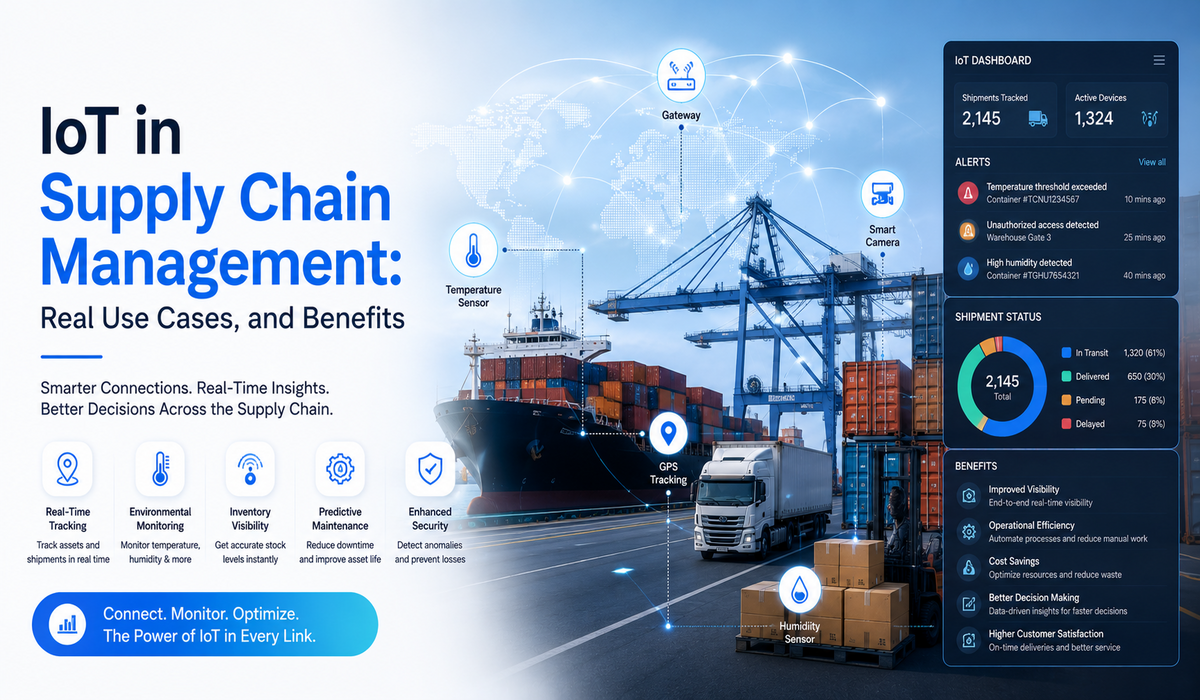
For example, a shipment carrying temperature-sensitive pharmaceuticals can automatically transmit humidity, temperature, and location data throughout transportation. If conditions exceed acceptable limits, alerts trigger immediately, allowing intervention before product damage occurs.
The core objective is simple: improve visibility, enhance control, and enable faster decisions through real-time data.
Why IoT Matters More Than Ever in Modern Supply Chains
Global supply chains have become increasingly complex. Products often move across multiple suppliers, manufacturing facilities, distribution centers, transportation partners, and retailers before reaching customers. Traditional tracking methods frequently struggle to provide accurate and timely information.
Organizations are adopting connected technologies because visibility gaps create costly consequences including inventory shortages, delayed shipments, product losses, and customer dissatisfaction.
The growing importance of IoT is driven by several business realities. Customers expect faster deliveries and accurate updates. Enterprises require predictive insights rather than reactive responses. Regulatory compliance demands better tracking and documentation. Sustainability initiatives require monitoring of resource consumption and logistics efficiency.
In this environment, real-time intelligence becomes a competitive advantage.
How IoT in Supply Chain Management Works Across Operations
The implementation process typically begins with connected devices capturing operational information at different stages of the supply chain. Sensors installed on machinery, vehicles, pallets, storage units, or products continuously collect data.
This information may include temperature, movement, pressure, humidity, location, equipment health, or inventory status. The collected data is transmitted to cloud platforms where analytics systems process information and generate insights.
Organizations then use dashboards, alerts, predictive models, and automation tools to make operational decisions.
Instead of discovering problems after they occur, businesses gain opportunities to respond proactively.
Core Technologies Supporting IoT-Based Supply Chains
Successful deployment depends on multiple technologies working together rather than isolated devices.
Connected sensors remain the foundation of IoT ecosystems. These sensors monitor environmental conditions, machine performance, and product movement in real time.
RFID technology enables automatic identification and tracking of assets without manual scanning requirements. Warehouses increasingly use RFID for inventory visibility and faster operations.
GPS tracking systems provide shipment visibility, helping logistics teams monitor transportation routes and delivery progress.
Cloud computing platforms store and process large volumes of IoT-generated information, making data accessible across departments and locations.
Artificial intelligence and machine learning convert operational data into predictive insights, enabling businesses to forecast disruptions, optimize routes, and improve planning.
Analytics platforms transform raw information into actionable intelligence for decision-makers.
Step-by-Step Process: How Businesses Implement IoT in Supply Chains
Step 1: Identify Operational Challenges
Organizations begin by defining specific pain points. These may include inventory inaccuracies, shipment delays, equipment failures, or poor visibility.
Technology selection should address business problems rather than follow trends.
Step 2: Select Data Collection Devices
Businesses determine which sensors, RFID systems, or monitoring tools align with operational needs.
Different industries require different capabilities.
Step 3: Integrate Existing Systems
IoT infrastructure must connect with ERP software, warehouse management systems, transportation platforms, and analytics tools.
Integration supports unified operations.
Step 4: Establish Real-Time Monitoring
Dashboards and alerts enable continuous visibility into supply chain performance.
Organizations gain faster awareness of disruptions.
Step 5: Analyze and Optimize
Collected information becomes useful only when converted into decisions. Analytics help improve forecasting, reduce inefficiencies, and strengthen planning.
Step 6: Scale Across Operations
Successful pilots often expand into broader enterprise deployment once measurable outcomes appear.
Real Use Cases of IoT Across Supply Chain Industries
The practical value of IoT becomes clearer through real-world applications.
Smart Inventory Management
Inventory inaccuracies remain a persistent challenge for many businesses. IoT-enabled inventory systems continuously monitor stock levels and automatically update records.
Organizations reduce stockouts while improving replenishment planning.
Warehouses become more efficient because employees spend less time on manual counting processes.
Predictive Maintenance in Manufacturing
Unexpected equipment failures create production delays and financial losses.
Connected sensors monitor machinery conditions including vibration, temperature, and operating performance. Analytics identify potential failures before breakdowns occur.
Maintenance shifts from reactive to predictive.
Cold Chain Monitoring
Industries such as pharmaceuticals, food processing, and healthcare require strict environmental control.
IoT devices track storage conditions throughout transportation.
If temperature exceeds acceptable ranges, alerts trigger instantly.
This helps reduce spoilage and compliance risks.
Fleet and Transportation Monitoring
Logistics companies increasingly use IoT systems to monitor vehicle locations, fuel usage, route efficiency, and driver behavior.
Real-time visibility improves delivery performance.
Warehouse Automation
Smart warehouses use connected devices to optimize storage conditions, track assets, and improve operational workflows.
Automation reduces manual effort.
Asset Tracking Across Supply Networks
Organizations managing expensive equipment or high-value products benefit from continuous location monitoring.
Asset visibility improves accountability.
Key Benefits of IoT in Supply Chain Management for Enterprises
The adoption of connected technologies creates measurable improvements across operational and strategic areas.
One major advantage is enhanced visibility. Businesses gain real-time insights into products, assets, and processes throughout the supply chain lifecycle. Improved visibility reduces uncertainty and supports faster decisions.
Operational efficiency also increases because automated monitoring reduces dependence on manual processes. Employees spend less time collecting information and more time acting on insights.
Predictive capabilities represent another important benefit. Organizations can identify risks earlier, forecast maintenance needs, and anticipate disruptions before they escalate.
Customer satisfaction improves as businesses provide more accurate delivery estimates and stronger service reliability.
Cost reduction becomes possible through optimized routes, lower inventory losses, reduced downtime, and improved resource utilization.
Compliance management also becomes easier because traceable records support auditing and reporting requirements.
Business Impact: How IoT Improves Supply Chain Performance
The long-term impact extends beyond operational improvements.
Organizations with connected supply chains often achieve stronger resilience during disruptions because they identify problems earlier and respond faster.
Decision-making improves because leaders rely on live operational intelligence rather than historical reports.
Supplier relationships may strengthen due to greater transparency.
Companies pursuing sustainability goals can monitor energy consumption, transportation efficiency, and environmental conditions more accurately.
Digital transformation initiatives accelerate when organizations establish connected infrastructure.
Ultimately, IoT contributes to creating agile supply chains capable of adapting to changing market conditions.
Challenges Businesses Face During IoT Adoption
Despite its advantages, implementation involves significant challenges.
Data security remains a major concern because connected devices increase potential entry points for cyber threats.
Integration complexity can slow deployment, particularly for organizations operating legacy systems.
Managing large volumes of generated data requires strong analytics capabilities.
Implementation costs may create hesitation for smaller organizations.
Another challenge involves scalability. Pilot projects often succeed, but expanding across global operations introduces complexity.
Employee training also matters. Technology adoption without operational readiness limits value creation.
Common Mistakes Organizations Should Avoid
Many businesses invest in connected technologies without clearly defining expected outcomes. This often results in expensive systems delivering limited business impact.
Another common mistake involves collecting excessive data without actionable analysis strategies.
Some organizations underestimate cybersecurity requirements.
Others ignore integration planning, creating disconnected technology ecosystems.
Successful implementation usually begins with focused objectives and measurable KPIs.
Best Practices for Successful IoT Adoption in Supply Chains
Organizations achieving stronger results typically prioritize practical deployment strategies.
They start with high-impact use cases where visibility challenges already exist.
They establish governance frameworks covering data ownership, security, and access management.
Most importantly, they align technology investments with business outcomes rather than pursuing innovation alone.
They integrate IoT initiatives with broader digital transformation goals.
Future Trends: How IoT Is Evolving Beyond 2026
The future of connected supply chains will likely involve deeper integration with artificial intelligence, blockchain, automation, and advanced analytics.
AI-driven predictive models may become more sophisticated, enabling highly accurate demand forecasting and disruption prediction.
Digital twins are expected to grow in importance by creating virtual replicas of supply chain environments for simulation and optimization.
Autonomous logistics systems may increasingly rely on IoT-generated intelligence.
Sustainability monitoring will become more significant as organizations face pressure to measure environmental impact.
The evolution of smart supply chains suggests that connected ecosystems will become increasingly essential for competitive operations.
Measuring ROI From IoT Investments
Organizations evaluating implementation success typically examine performance indicators such as reduced downtime, improved inventory accuracy, lower transportation costs, faster delivery times, improved asset utilization, and stronger customer satisfaction.
The most successful initiatives demonstrate measurable operational value rather than technology adoption metrics alone.
Business leaders increasingly prioritize outcomes over innovation narratives.
Conclusion
The growing adoption of IoT in Supply Chain Management reflects a broader shift toward intelligent, connected, and data-driven operations. Businesses no longer rely solely on historical reports or manual processes; they increasingly depend on real-time insights to improve efficiency, resilience, and decision-making. From inventory visibility to predictive maintenance and logistics optimization, IoT continues to reshape how modern supply chains operate.
People Also Ask (FAQs)
Q1. What does IoT mean in supply chain operations?
IoT refers to connected devices and sensors that collect, share, and analyze operational information throughout supply chain activities. These technologies help businesses monitor inventory, shipments, equipment, environmental conditions, and logistics performance in real time, improving visibility and efficiency.
Q2. How does IoT improve inventory management?
IoT improves inventory management by providing continuous monitoring of stock levels and movement. Connected systems reduce manual tracking errors, improve replenishment planning, and support more accurate forecasting, leading to fewer shortages and excess inventory situations.
Q3. Which industries benefit most from IoT adoption in supply chains?
Manufacturing, healthcare, logistics, retail, automotive, food processing, and pharmaceuticals often benefit significantly because these industries depend heavily on real-time monitoring, compliance, and operational visibility.
Q4. Is IoT expensive to implement for supply chains?
Implementation costs vary depending on infrastructure requirements, integration complexity, and deployment scale. Small pilot projects may require limited investment, while enterprise-wide initiatives involve greater costs. ROI analysis remains essential before expansion.
Q5. Can IoT reduce supply chain disruptions?
Yes. Real-time monitoring helps organizations detect issues earlier, respond faster, and improve planning. Predictive maintenance and operational alerts support disruption prevention.
Q6. How secure are IoT systems in supply chains?
Security depends on device protection, network controls, encryption methods, and governance practices. Cybersecurity planning is critical because connected environments increase exposure risks.
Q7. What is the future of IoT in supply chain operations?
Future development will likely include stronger integration with AI, automation, digital twins, blockchain, and predictive analytics, creating increasingly intelligent and autonomous supply chain ecosystems.
