
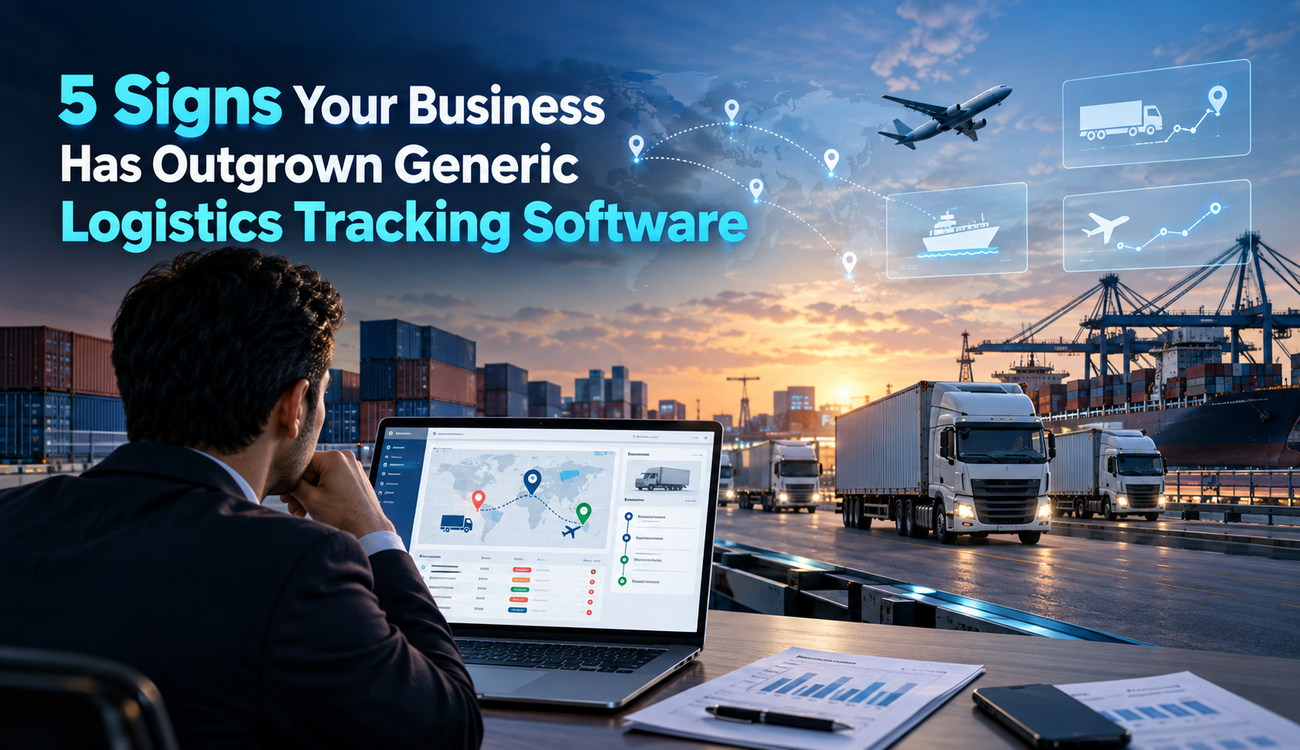
Logistics operations become increasingly difficult to manage as businesses grow. What once worked for a small fleet, limited shipments, and a handful of customers can quickly become a bottleneck when order volumes, delivery networks, carriers, and customer expectations increase. Many companies initially rely on basic tools because they are affordable and easy to implement, but these systems may eventually struggle to support more complex logistics operations. Recognizing when your existing technology is no longer sufficient can help prevent delays, rising operational costs, and poor customer experiences. Businesses often reach a point where their existing Logistics Tracking Software cannot provide the visibility, automation, integrations, or scalability required to manage modern supply chain operations.
The challenge is identifying that point before inefficiencies become expensive problems. Several warning signs can indicate that your business has moved beyond the capabilities of a generic tracking platform and needs a more flexible and intelligent solution.
1. Your Logistics Data is Scattered Across Multiple Systems
As a logistics operation expands, the amount of data generated across different processes increases rapidly. Shipment details, vehicle information, delivery schedules, warehouse records, customer orders, carrier updates, and inventory information may all be stored in separate systems. When these platforms cannot communicate effectively, employees are forced to switch between applications to understand what is happening across the logistics network.
Limited Visibility Creates Operational Delays
A generic Logistics Tracking Software platform may provide basic shipment tracking without connecting information from other critical business systems. This creates information gaps that make it difficult for logistics managers to obtain a complete picture of an order or shipment. Teams may need to manually compare records from transportation systems, ERP platforms, warehouse management systems, spreadsheets, and carrier portals.
These fragmented workflows can increase the possibility of errors while consuming valuable employee time. When a customer asks about a delayed shipment, employees may need to investigate multiple systems before providing an accurate answer. As shipment volumes increase, this approach becomes increasingly difficult to maintain.
Integrated Data Becomes Essential
Growing businesses need logistics technology that can connect operational data across the organization. Integration with ERP, CRM, warehouse management, transportation management, inventory, accounting, and carrier systems can create a unified flow of information. This allows teams to access more complete and reliable information without depending heavily on manual data entry.
If your logistics teams spend more time searching for information than acting on it, your existing technology may no longer match the complexity of your business.
2. Your Customers Are Asking for More Real-Time Visibility
Customer expectations have changed significantly across logistics and delivery operations. Customers increasingly expect accurate shipment information, estimated delivery times, status notifications, and visibility throughout the delivery journey. A simple status such as “in transit” may no longer provide enough information.
Basic Tracking Cannot Meet Modern Expectations
Generic platforms often provide limited tracking capabilities that show where a shipment was last scanned or updated. While this may have been sufficient for smaller operations, growing businesses often need more detailed visibility across every stage of transportation.
When customers repeatedly contact support teams asking where their orders are, it may indicate that your tracking system is not providing enough information. Customer service teams should not have to manually investigate shipment locations every time a customer requests an update.
Real-Time Visibility Improves Customer Experience
Modern Logistics Tracking Software can provide more detailed shipment visibility by combining GPS data, carrier information, delivery milestones, location updates, and automated notifications. Customers can receive relevant information without needing to contact support teams.
Greater transparency can also strengthen trust because customers have a clearer understanding of delivery progress. For businesses handling high-value, time-sensitive, or recurring shipments, real-time visibility can become an important part of the overall customer experience.
3. Manual Processes Are Increasing as Your Business Grows
Growth should ideally make operations more efficient through scale, but outdated technology can have the opposite effect. When logistics teams rely on spreadsheets, emails, phone calls, and manual status updates, operational complexity increases with every additional shipment, vehicle, customer, or carrier.
Manual Work Creates Hidden Costs
A generic Logistics Tracking Software platform may automate basic tracking but leave many important workflows outside the system. Employees may still need to manually update delivery information, reconcile shipment records, check carrier statuses, generate reports, or communicate exceptions.
These tasks may appear manageable when shipment volumes are low. However, repeating them hundreds or thousands of times can create significant administrative costs. Manual processes also increase the risk of incorrect information entering the system.
Automation Can Support Operational Scale
Growing logistics businesses need automation that extends beyond basic shipment tracking. Automated alerts, exception management, carrier updates, delivery notifications, reporting, and workflow triggers can reduce repetitive work while allowing employees to focus on higher-value activities.
When your team continues hiring additional employees simply to manage increasing amounts of repetitive tracking work, it may be a sign that your technology needs to become more capable.
4. Your Existing System Cannot Adapt to Your Logistics Model
Every logistics business has different operational requirements. A regional distributor may have completely different workflows from an international freight company, e-commerce business, pharmaceutical distributor, or manufacturing organization. Generic platforms are designed to serve broad requirements, which can become restrictive when a company develops specialized processes.
One-Size-Fits-All Features Become Restrictive
A basic Logistics Tracking Software solution may offer predefined workflows that cannot easily accommodate unique business rules. Your organization may need specialized shipment statuses, approval processes, carrier rules, route requirements, customer-specific workflows, or industry compliance processes.
When employees start creating workarounds to compensate for missing functionality, the technology is no longer simplifying operations. Instead, it becomes another operational constraint.
Customization Supports Business Growth
A scalable logistics platform should allow businesses to configure workflows according to their operational requirements. Custom dashboards, user permissions, alerts, business rules, integrations, reporting structures, and automated processes can make the system more relevant to the organization’s actual needs.
The right technology should adapt as your logistics model changes rather than forcing your business to change its processes around the limitations of the software.
5. Your Business Needs Predictive Insights Instead of Basic Tracking
Tracking tells logistics teams what is happening now, but growing organizations increasingly need technology that can help them understand what is likely to happen next. Delays, capacity constraints, route disruptions, demand fluctuations, and operational bottlenecks can have a significant impact on logistics performance.
Historical Data Can Reveal Future Problems
Traditional Logistics Tracking Software typically focuses on recording shipment events and displaying current statuses. While this information is useful, it may not provide the intelligence needed for proactive decision-making.
Modern logistics operations can use historical and real-time data to identify recurring delivery delays, inefficient routes, carrier performance patterns, seasonal demand changes, and potential operational risks. These insights can help managers move from reactive problem-solving toward proactive planning.
AI and Analytics Add a New Layer of Intelligence
Advanced analytics and AI can analyze large volumes of logistics data and identify patterns that may not be immediately visible to human teams. Predictive capabilities can support estimated arrival times, route optimization, demand planning, risk detection, and performance forecasting.
For organizations managing complex transportation networks, this intelligence can become a major competitive advantage. Instead of waiting for a problem to occur, logistics teams can identify potential issues earlier and take corrective action.
What Should You Look for in a More Advanced Logistics Platform?
Once a business recognizes these warning signs, the next step is determining what capabilities a replacement system should provide. Moving from a generic platform to a more advanced solution should not simply mean purchasing software with more features. The objective should be to create a technology environment that supports operational visibility, scalability, automation, and informed decision-making.
Scalability Should Be a Core Requirement
Your logistics technology should be able to support increasing shipment volumes, users, locations, vehicles, carriers, and customers without creating unnecessary complexity. Scalability ensures that technology remains useful as the organization expands into new markets or develops new logistics models.
Integration Should Connect the Entire Workflow
A modern logistics platform should connect with the systems your business already depends on. ERP, CRM, WMS, TMS, inventory platforms, carrier APIs, GPS devices, IoT systems, and customer-facing applications can work together to create a more connected operational environment.
Analytics Should Support Better Decisions
Reporting should go beyond basic shipment histories. Decision-makers need dashboards and analytics that reveal delivery performance, carrier efficiency, route effectiveness, operational costs, exceptions, and emerging trends.
Automation Should Reduce Repetitive Work
Automation should be applied to repetitive processes such as notifications, status updates, alerts, reporting, exception handling, and workflow approvals. This allows employees to spend more time managing strategic logistics activities rather than administrative tasks.
When is It Time to Replace Your Current System?
There is no single shipment volume or company size that determines when a logistics platform should be replaced. The more important question is whether the current system is helping your business grow or creating friction that slows it down.
If teams regularly work around system limitations, customers lack timely visibility, data remains fragmented, manual processes continue increasing, or managers cannot access actionable insights, your organization may have already reached that point.
The transition to a more advanced Logistics Tracking Software platform should be viewed as an operational improvement rather than simply a technology upgrade. The right solution can connect data, automate workflows, improve visibility, support predictive decision-making, and provide the flexibility required for long-term growth.
Conclusion
Logistics technology needs to evolve as business operations become more complex. A system that was perfectly adequate during the early stages of a company’s growth may eventually become restrictive when shipment volumes, customers, carriers, locations, and operational requirements increase.
The warning signs are usually visible before the consequences become serious. Fragmented data, limited customer visibility, increasing manual work, inflexible workflows, and a lack of predictive intelligence can all indicate that a business has outgrown its existing Logistics Tracking Software.
The goal should not simply be to find a platform with more features. Businesses should look for technology that connects their operations, supports automation, integrates with existing systems, provides meaningful insights, and scales with future growth. When logistics technology becomes an enabler rather than a limitation, organizations can build faster, more transparent, and more resilient supply chain operations.
FAQs
Q1. What is Logistics Tracking Software?
Logistics Tracking Software helps businesses monitor shipments, vehicles, deliveries, and transportation activities in real time. It can centralize logistics data, automate status updates, improve visibility, and provide insights that help teams manage deliveries more efficiently.
Q2. How do I know if my business has outgrown its current logistics software?
Signs include increasing manual work, fragmented logistics data, limited shipment visibility, frequent customer tracking requests, difficulty integrating other systems, and a lack of advanced reporting or predictive insights. These challenges often indicate that the existing platform can no longer support operational growth.
Q3. What features should businesses look for in logistics tracking software?
Businesses should consider real-time shipment visibility, GPS tracking, automated notifications, carrier integrations, analytics, reporting, workflow automation, API connectivity, scalability, and customizable dashboards. The right features depend on the company’s logistics model and future operational requirements.
Q4. Can logistics tracking software integrate with ERP and other business systems?
Yes, modern logistics platforms can integrate with ERP, CRM, warehouse management, transportation management, inventory, carrier, GPS, and IoT systems. These integrations help create a connected flow of operational data and reduce the need for manual data entry across multiple platforms.
Q5. How can advanced logistics tracking software improve business operations?
Advanced platforms can improve operational visibility, reduce repetitive manual tasks, support faster decision-making, improve customer communication, identify delivery risks, and provide analytics for optimizing routes and carrier performance. This can help businesses manage growing logistics operations more efficiently.
