
Manufacturing companies are under constant pressure to produce more while maintaining consistent quality, controlling costs, and reducing downtime. Traditional production monitoring methods often depend on manual data collection, spreadsheets, operator observations, and periodic reports. While these approaches can provide basic information, they make it difficult to understand what is happening on the production floor in real time. A modern Production Line Monitoring System addresses this challenge by connecting machines, sensors, industrial equipment, and production processes to a centralized digital environment.
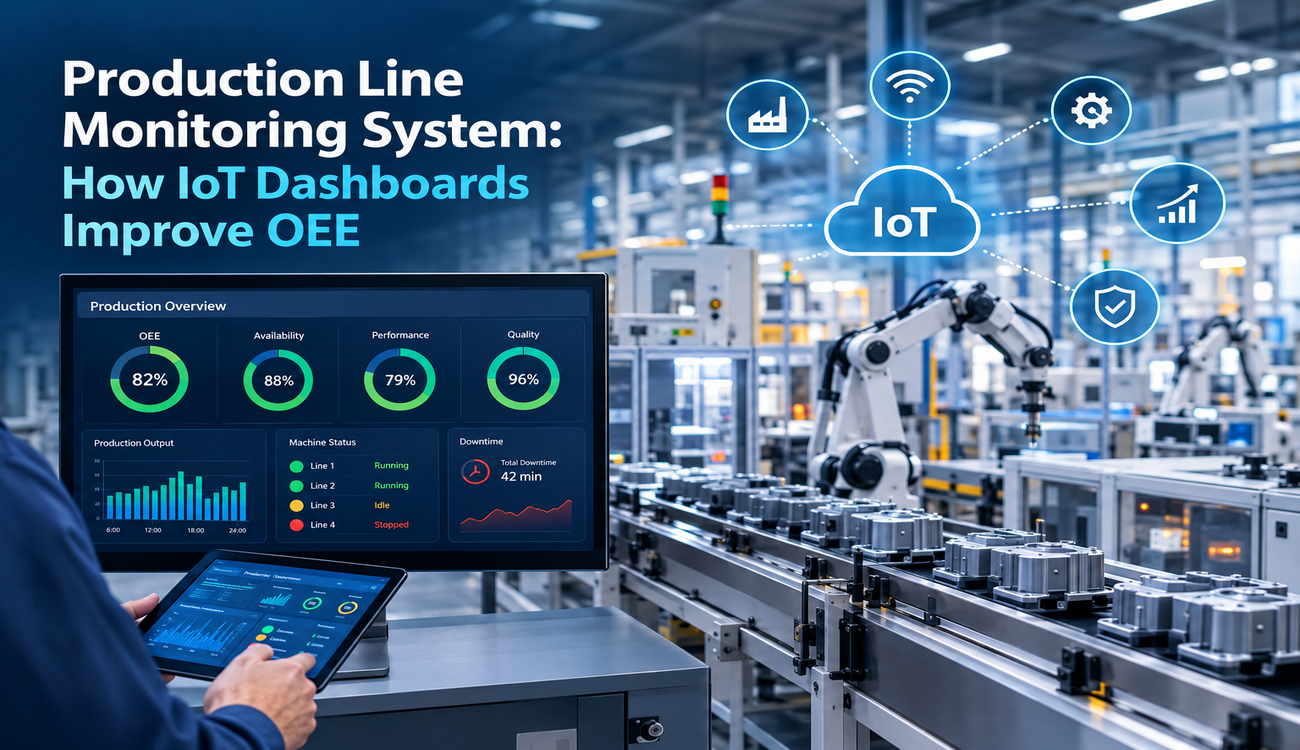
IoT dashboards play an important role in this transformation. They collect data from connected machines and convert it into meaningful production insights that managers, engineers, and operators can use. Instead of waiting until the end of a shift to identify production losses, teams can monitor equipment performance, downtime, cycle times, production output, and quality indicators as events occur. When this information is connected with Overall Equipment Effectiveness (OEE), manufacturers can gain a clearer understanding of how efficiently their production assets are operating.
Understanding OEE in Modern Manufacturing
Overall Equipment Effectiveness is one of the most widely used measurements for evaluating manufacturing productivity. It combines three major performance factors: availability, performance, and quality. Together, these metrics provide a broader view of whether equipment is being used effectively and where production losses are occurring.
Availability, Performance, and Quality
Availability measures how much planned production time is actually available for manufacturing. Equipment breakdowns, unplanned maintenance, setup activities, and changeovers can reduce this figure. Performance considers whether equipment is operating at its expected speed. Even when a machine is running, slow cycles, minor stoppages, and reduced operating speeds can decrease productivity.
Quality focuses on the proportion of products produced correctly compared with total production. Defective products, rework, scrap, and quality-related interruptions can negatively affect this component. Looking at all three factors together helps manufacturers understand why production output may be lower than expected.
Why OEE Data Needs Real-Time Visibility
OEE calculations are most valuable when organizations can identify the reasons behind performance changes. A production team may discover that its OEE has declined, but a historical report alone may not explain whether the main cause was machine downtime, slower cycle times, material shortages, or quality problems.
Real-time monitoring makes this information more actionable. When equipment data is continuously collected, teams can investigate production losses closer to the moment they happen. This creates an opportunity to respond before a small problem develops into a major production disruption.
How IoT Dashboards Support Production Monitoring
IoT technology creates a connection between physical manufacturing assets and digital monitoring platforms. Sensors and machine interfaces can capture information such as operating status, temperature, vibration, speed, energy consumption, production counts, and cycle times. This data can then be transmitted to an IoT dashboard for analysis and visualization.
Connecting Machines and Production Assets
A Production Line Monitoring System can integrate information from programmable logic controllers, industrial sensors, machines, manufacturing equipment, and other shop-floor technologies. Depending on the manufacturing environment, data may come from multiple machine types and communication protocols.
The objective is not simply to collect more data. The system should create a reliable flow of operational information that allows users to understand machine conditions and production performance. By bringing data from different assets into one environment, manufacturers can reduce dependence on disconnected monitoring methods.
Turning Machine Data Into Actionable Insights
Raw machine data can be difficult to interpret when presented without context. IoT dashboards organize this information into visual indicators, charts, trends, alerts, and performance metrics. Operators can see whether machines are running, stopped, idle, or experiencing abnormal conditions.
Production managers can also view information across multiple machines or production lines. This makes it easier to identify recurring downtime patterns, performance deviations, and production bottlenecks. Instead of manually combining information from different sources, decision-makers can access a consolidated view of operational performance.
Improving OEE Through Real-Time Production Visibility
One of the most important advantages of IoT-enabled monitoring is its ability to connect production events with OEE performance. When a machine stops or slows down, the resulting impact can be reflected in the relevant production metrics.
Reducing Unplanned Downtime
Unexpected equipment downtime is a major source of production loss. Without continuous monitoring, operators may discover equipment problems only after production has already been affected. An IoT-enabled Production Line Monitoring System can identify machine stoppages and generate alerts based on predefined conditions.
For example, if a critical machine stops unexpectedly, the dashboard can immediately display its status and duration of downtime. Maintenance teams can investigate the problem sooner, while production managers can understand the impact on the line. Historical downtime data can also reveal whether particular machines experience repeated failures or stoppages.
Identifying Performance Losses
Not every production loss is caused by complete equipment failure. Machines can continue operating while producing below their expected speed. Minor interruptions and longer-than-standard cycle times can gradually reduce output.
IoT dashboards can compare actual machine performance with predefined production parameters. If a machine consistently operates below its expected cycle rate, the data can highlight the issue for further investigation. This helps manufacturers address hidden performance losses that may otherwise remain unnoticed.
Monitoring Quality-Related Losses
Quality problems can reduce OEE even when equipment availability and speed appear satisfactory. IoT monitoring can connect production counts with quality information, helping teams identify patterns between machine conditions and defective output.
For example, repeated quality deviations during specific production periods may indicate an issue with machine settings, materials, environmental conditions, or operating parameters. With historical and real-time information available in the same system, engineers can investigate these relationships more efficiently.
Key IoT Dashboard Features for Manufacturing
A successful production monitoring environment requires more than a simple screen showing machine status. The dashboard should provide relevant information in a way that supports fast operational decisions.
Live Production Monitoring
Real-time dashboards can display current production status across individual machines, workstations, or complete production lines. Operators can quickly determine which assets are running and which require attention.
Production counters, machine states, cycle times, downtime duration, and output information can be displayed according to the needs of different users. This creates greater visibility across the shop floor without requiring teams to manually collect updates.
Automated Alerts and Notifications
Timely alerts can help organizations respond to abnormal conditions more quickly. A dashboard can be configured to identify events such as extended downtime, unusual machine conditions, production delays, or performance falling below defined thresholds.
The purpose of alerts is to prioritize attention rather than overwhelm users with notifications. Relevant thresholds and escalation rules can help ensure that important events reach the appropriate personnel.
Historical Data and Trend Analysis
Real-time information explains what is happening now, while historical information helps explain why patterns occur. IoT dashboards can retain production data so teams can compare performance across shifts, machines, products, or time periods.
Historical trends can reveal recurring downtime, frequent changeover losses, declining machine performance, or variations in production quality. These insights can support continuous improvement initiatives and more informed maintenance planning.
Using Production Data for Continuous Improvement
The value of a Production Line Monitoring System extends beyond real-time visibility. When organizations consistently collect and analyze production information, they can build a stronger foundation for continuous improvement.
Finding Production Bottlenecks
Manufacturing lines often contain individual processes that limit overall throughput. A bottleneck may be associated with machine capacity, cycle time, material movement, changeovers, or recurring stoppages.
IoT data allows teams to compare performance across different stages of production. If one workstation consistently operates slower than surrounding processes, the data can help identify it as a potential constraint. Teams can then investigate the underlying cause and evaluate improvement opportunities.
Supporting Preventive and Predictive Maintenance
Machine monitoring data can also contribute to better maintenance strategies. Sensors can capture operational indicators such as vibration, temperature, pressure, or energy consumption. Changes in these measurements may provide useful signals for maintenance teams.
Instead of relying entirely on fixed maintenance schedules, organizations can use equipment data to understand machine behavior and prioritize assets that show unusual patterns. More advanced implementations can combine IoT data with analytics and machine learning to support predictive maintenance initiatives.
Benefits Across Different Manufacturing Roles
Different teams require different types of production information. Operators need immediate visibility into machine conditions, while maintenance teams need equipment-related information and managers require broader performance trends.
For Operators and Supervisors
Operators can use dashboards to monitor current production status and quickly identify stoppages or deviations. Supervisors can view performance across multiple workstations and understand whether production targets are being achieved.
For Maintenance Teams
Maintenance professionals can use historical machine data to investigate recurring failures and understand equipment behavior. This can support faster troubleshooting and help teams prioritize maintenance activities based on actual operating conditions.
For Production Managers
Managers can use aggregated OEE and production information to compare lines, shifts, products, and equipment. This provides a data-driven foundation for identifying production losses and evaluating operational improvement initiatives.
Implementing an IoT-Based Monitoring Strategy
Implementing a Production Line Monitoring System requires careful planning because manufacturing environments often contain a combination of modern and legacy equipment. Organizations should first identify the production metrics that matter most and determine how data is currently generated and stored.
Start With Clear Production Objectives
Manufacturers should define whether the primary objective is reducing downtime, improving OEE, increasing throughput, improving quality visibility, or supporting maintenance. Clear objectives help determine which data sources, sensors, integrations, and dashboard metrics are required.
Integrate Existing Equipment
Not every machine needs to be replaced to enable digital monitoring. Existing equipment can often be connected through industrial communication interfaces, controllers, gateways, or additional sensors. A practical integration strategy can allow manufacturers to modernize monitoring while continuing to use existing production assets.
Build Dashboards Around Users
Different users should see information relevant to their responsibilities. Operators may need simple machine-status indicators, whereas managers may require OEE trends and production comparisons. Designing dashboards around specific user requirements can improve adoption and make the information more useful.
The Future of IoT-Enabled Production Monitoring
Manufacturing monitoring is increasingly moving toward connected, intelligent, and data-driven operations. IoT dashboards are becoming an important foundation for integrating machine data with analytics, artificial intelligence, digital twins, maintenance platforms, and enterprise systems.
Future solutions are likely to provide more automated analysis rather than simply displaying information. Systems can increasingly identify unusual production patterns, correlate multiple operational variables, and support faster decision-making. Integration with ERP, MES, maintenance, quality, and supply chain platforms can also create a more connected view of manufacturing operations.
As manufacturers continue adopting smart factory technologies, the Production Line Monitoring System will increasingly serve as a bridge between physical production activities and digital decision-making. The combination of connected machines, real-time data, analytics, and intuitive dashboards can help organizations understand production performance with greater clarity.
Conclusion
Improving OEE requires manufacturers to understand where production losses occur and how those losses affect availability, performance, and quality. IoT dashboards provide the real-time visibility needed to move beyond manual production tracking and disconnected reports. By continuously collecting machine and production data, organizations can identify downtime, monitor cycle performance, investigate quality issues, and recognize operational patterns.
A well-designed Production Line Monitoring System can therefore become an important component of modern manufacturing operations. Its value comes not simply from displaying machine information but from transforming production data into insights that teams can use. When connected with OEE measurement and continuous improvement practices, IoT-based monitoring can help manufacturers build more visible, responsive, and data-driven production environments.
Frequently Asked Questions
Q1. What is a Production Line Monitoring System?
A Production Line Monitoring System is a digital solution that collects and monitors real-time data from machines, sensors, and production equipment. It helps manufacturers track machine status, production output, downtime, cycle times, quality, and OEE. By providing centralized visibility, the system helps production teams identify inefficiencies and respond to operational issues more quickly.
Q2. How do IoT dashboards improve OEE?
IoT dashboards improve OEE by providing real-time information about availability, performance, and quality. They can identify machine downtime, slower cycle times, production interruptions, and quality losses. This visibility allows operators and managers to investigate production issues sooner and take corrective actions that can help improve overall equipment effectiveness.
Q3. What data can a Production Line Monitoring System collect?
A Production Line Monitoring System can collect data such as machine operating status, production counts, cycle times, downtime, machine speed, temperature, vibration, energy consumption, and quality information. The exact data depends on the equipment, sensors, industrial protocols, and integrations used within the manufacturing environment.
Q4. Can IoT monitoring work with existing manufacturing machines?
Yes, IoT monitoring can often be integrated with both modern and legacy manufacturing equipment. Industrial gateways, controllers, communication interfaces, and additional sensors can help connect existing machines to an IoT platform. This allows manufacturers to improve production visibility without necessarily replacing their entire equipment infrastructure.
Q5. Why is real-time production monitoring important for manufacturers?
Real-time production monitoring helps manufacturers identify operational problems while they are happening instead of relying only on end-of-shift reports. It provides immediate visibility into downtime, production performance, machine conditions, and quality-related issues. This information can support faster decisions, better maintenance planning, and continuous production improvement.
