

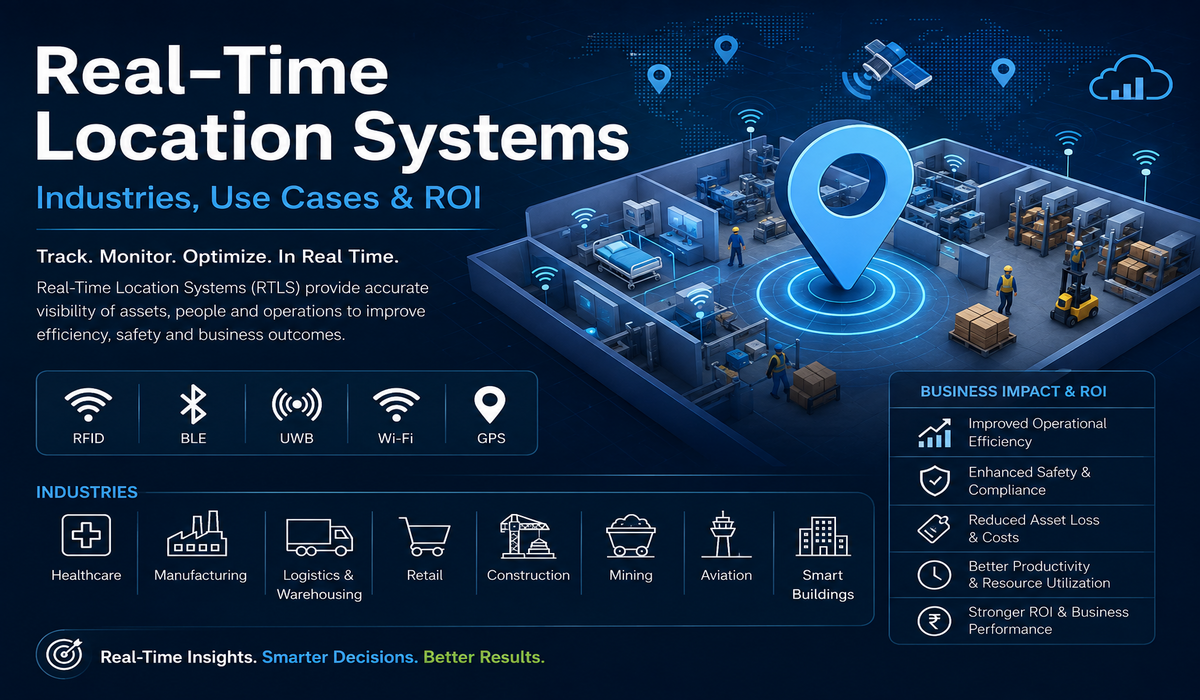
In today’s fast-paced business environment, organizations need accurate, real-time visibility into their assets, employees, and operations to remain competitive. Traditional tracking methods often rely on manual updates, barcode scanning, or periodic inventory checks, which can lead to delays, inaccuracies, and increased operational costs. This is where Real-Time Location Systems have become a game-changing technology for modern enterprises.
Real-Time Location Systems enable organizations to track the precise location of people, equipment, vehicles, and valuable assets in real time. By leveraging technologies such as RFID, Bluetooth Low Energy (BLE), Ultra-Wideband (UWB), Wi-Fi, GPS, and IoT sensors, RTLS provides continuous location intelligence that helps businesses improve operational efficiency, reduce losses, enhance workplace safety, and make informed decisions based on live data.
This article explores how Real-Time Location Systems work, the industries that benefit the most, practical use cases, and the measurable return on investment (ROI) organizations can expect from implementing RTLS solutions.
What Are Real-Time Location Systems?
Real-Time Location Systems (RTLS) are intelligent tracking solutions that continuously identify and monitor the location of physical assets, personnel, equipment, and vehicles within a defined environment. Unlike traditional tracking methods that provide only periodic updates, RTLS delivers live location information, enabling organizations to respond instantly to changing operational conditions.
The system typically consists of location tags attached to assets or carried by personnel, readers or sensors installed throughout the facility, communication gateways, and centralized software that collects, analyzes, and displays location data through intuitive dashboards.
How Real-Time Location Systems Work
The effectiveness of Real-Time Location Systems lies in their ability to collect location data continuously and convert it into actionable business intelligence. Every tracked asset or person is equipped with a tag or wearable device that communicates with strategically placed receivers or sensors throughout the facility.
Whenever the tagged asset moves, nearby readers capture its signal and transmit the information to the RTLS platform. Advanced positioning algorithms calculate the exact location using technologies such as signal strength analysis, time-of-flight measurements, or triangulation. The centralized software then displays the asset’s current location, movement history, utilization statistics, and other operational insights through interactive dashboards.
The result is an intelligent ecosystem where organizations always know the location and status of their critical assets in real time.
Core Technologies Behind Real-Time Location Systems
Different industries have unique tracking requirements, and Real-Time Location Systems support multiple technologies to meet those needs.
RFID-Based RTLS
Radio Frequency Identification (RFID) remains one of the most widely adopted technologies for asset tracking and inventory management. RFID tags communicate with readers installed across facilities, enabling organizations to identify and locate assets quickly without manual scanning. This technology is particularly valuable in manufacturing, retail, logistics, and healthcare environments.
Bluetooth Low Energy (BLE)
Bluetooth Low Energy has become increasingly popular due to its affordability and ease of deployment. BLE beacons communicate with nearby receivers to provide indoor positioning, employee tracking, and customer location analytics. Retail stores, corporate offices, hospitals, and smart buildings frequently use BLE-based RTLS solutions.
Ultra-Wideband (UWB)
Ultra-Wideband technology delivers highly accurate indoor positioning, often within a few centimeters. Industries requiring precise asset location, such as automotive manufacturing, aerospace, pharmaceuticals, and advanced production facilities, rely on UWB to monitor equipment and automate workflows with exceptional accuracy.
Wi-Fi-Based RTLS
Organizations with existing wireless infrastructure often prefer Wi-Fi-enabled RTLS because it minimizes deployment costs. Wi-Fi tracking provides reliable location visibility for laptops, medical devices, industrial equipment, and workforce monitoring without requiring significant infrastructure changes.
GPS and IoT Integration
For outdoor asset tracking, GPS remains the preferred technology. Combined with IoT sensors, GPS enables businesses to monitor fleet movement, delivery vehicles, construction equipment, shipping containers, and field personnel across large geographic areas. IoT connectivity further enhances RTLS by providing environmental data such as temperature, humidity, vibration, and equipment health.
Industries Benefiting from Real-Time Location Systems
The adoption of Real-Time Location Systems continues to grow across industries because every organization depends on efficient asset management and operational visibility. While implementation varies depending on business requirements, the benefits remain consistent: improved productivity, reduced losses, and enhanced operational control.
Healthcare
Healthcare organizations rely heavily on RTLS to improve patient care while optimizing hospital operations. Medical facilities track wheelchairs, infusion pumps, ventilators, diagnostic equipment, and surgical instruments in real time, ensuring critical resources are always available when needed.
Hospitals also use RTLS to monitor patient movement, manage emergency response workflows, and improve staff coordination. By reducing the time spent searching for equipment, healthcare professionals can focus more on delivering quality patient care.
Manufacturing
Manufacturing companies implement RTLS to monitor raw materials, work-in-progress inventory, production equipment, and finished goods throughout the manufacturing process. Real-time visibility helps eliminate production bottlenecks, reduce downtime, and improve overall equipment utilization.
Manufacturers can also monitor worker safety by identifying hazardous zones, tracking personnel movement, and generating instant alerts whenever safety protocols are violated.
Warehousing and Logistics
Warehouse operators depend on Real-Time Location Systems to optimize inventory movement, improve picking accuracy, and reduce order fulfillment times. RTLS enables businesses to locate pallets, forklifts, containers, and high-value inventory instantly, minimizing delays caused by misplaced assets.
In logistics operations, RTLS supports fleet visibility, shipment tracking, yard management, and delivery optimization, ensuring goods reach customers efficiently while reducing transportation costs.
Retail
Retail businesses are increasingly adopting Real-Time Location Systems to gain better visibility into inventory, improve customer experiences, and streamline store operations. One of the biggest challenges retailers face is inventory inaccuracy, which often results in stockouts, overstocking, and lost sales opportunities. RTLS enables retailers to track products from the warehouse to the sales floor, ensuring inventory information remains accurate and up to date.
Beyond inventory management, retailers use RTLS to analyze customer movement within stores. Understanding shopping patterns helps businesses optimize store layouts, improve product placement, and create personalized shopping experiences. Real-time insights into customer behavior also support targeted marketing campaigns and increase conversion rates.
Construction and Infrastructure
Construction projects involve expensive machinery, tools, materials, and a constantly changing workforce spread across large job sites. Real-Time Location Systems provide complete visibility into equipment utilization and worker movement, reducing delays caused by misplaced assets and improving project efficiency.
RTLS also strengthens workplace safety by monitoring restricted areas and tracking employee locations during emergencies. Project managers can quickly identify available equipment, monitor contractor activities, and ensure resources are allocated efficiently. These capabilities help construction companies reduce project delays while improving compliance with safety regulations.
Oil, Gas, and Mining
Industrial sectors such as oil, gas, and mining operate in hazardous environments where employee safety and equipment monitoring are critical. Real-Time Location Systems enable organizations to monitor workers operating in dangerous locations, ensuring rapid emergency response whenever incidents occur.
Heavy equipment, drilling machinery, and transport vehicles can also be tracked continuously, helping organizations optimize utilization and reduce equipment downtime. Environmental sensors integrated with RTLS further enhance operational safety by monitoring conditions such as gas leaks, temperature changes, or equipment failures before they become serious risks.
Airports and Transportation
Airports manage thousands of assets daily, including baggage carts, service vehicles, passenger wheelchairs, maintenance equipment, and luggage. Real-Time Location Systems improve operational efficiency by providing live visibility into these resources.
Baggage tracking has become one of the most valuable RTLS applications, helping airlines reduce lost luggage while improving passenger satisfaction. Airport authorities also use RTLS to coordinate ground support equipment, optimize vehicle movement, and improve overall operational efficiency.
Smart Buildings and Corporate Campuses
Modern office buildings and smart campuses increasingly rely on Real-Time Location Systems to optimize workspace utilization and improve employee experiences. Organizations can monitor meeting room occupancy, locate shared equipment, manage visitor movement, and improve facility management using real-time location intelligence.
RTLS also supports energy efficiency initiatives by integrating with building management systems to automate lighting, air conditioning, and security based on occupancy patterns.
Real-World Use Cases of Real-Time Location Systems
The flexibility of Real-Time Location Systems makes them suitable for countless business scenarios across industries. Organizations are no longer using RTLS solely for tracking assets; they are leveraging location intelligence to improve decision-making and automate operations.
Asset Tracking and Management
One of the most common RTLS applications is tracking valuable business assets. Hospitals track medical devices, warehouses monitor pallets, manufacturers locate production equipment, and corporate offices manage laptops and IT equipment. Continuous visibility reduces the time employees spend searching for assets while preventing unnecessary purchases caused by misplaced equipment.
Workforce Safety and Monitoring
Employee safety remains a top priority across manufacturing, construction, mining, and industrial facilities. RTLS wearable devices allow organizations to monitor worker locations in real time and send instant alerts when employees enter hazardous zones or require emergency assistance. This significantly improves emergency response times and enhances workplace safety.
Inventory Visibility
Inventory management becomes significantly more efficient with RTLS. Organizations gain accurate information about product locations, stock availability, and inventory movement across warehouses and distribution centers. This improves order fulfillment, reduces inventory discrepancies, and supports better demand planning.
Workflow Automation
RTLS enables automated workflows by triggering predefined actions based on asset movement or location changes. For example, manufacturing systems can automatically update production status when components arrive at the next workstation, while warehouses can trigger shipment notifications as goods leave designated loading areas.
Predictive Maintenance
When integrated with IoT sensors, RTLS helps organizations monitor equipment usage and operational conditions. Maintenance teams receive alerts based on equipment movement, operating hours, or abnormal behavior, allowing them to perform preventive maintenance before failures occur. This reduces downtime and extends equipment lifespan.
Measuring the ROI of Real-Time Location Systems
The return on investment from Real-Time Location Systems extends far beyond asset tracking. Organizations often experience measurable improvements in operational efficiency, employee productivity, and customer satisfaction within the first year of deployment.
Reduced asset loss is one of the most immediate financial benefits. Businesses spend less replacing misplaced equipment because every critical asset can be located instantly. Improved equipment utilization also eliminates unnecessary purchases, allowing organizations to maximize existing resources before investing in additional assets.
Operational productivity improves significantly as employees no longer waste valuable time searching for equipment, inventory, or tools. Faster access to critical resources increases workflow efficiency and enables staff to focus on higher-value activities.
Inventory accuracy also contributes directly to ROI. Better visibility reduces stock discrepancies, improves order fulfillment rates, and minimizes costly inventory write-offs. In logistics operations, optimized fleet movement and warehouse processes reduce transportation expenses while improving delivery performance.
Best Practices for Implementing Real-Time Location Systems
Successful implementation of Real-Time Location Systems begins with clearly defining business objectives. Organizations should identify the operational challenges they want to solve before selecting the appropriate RTLS technology.
Choosing the right tracking technology is equally important. GPS is suitable for outdoor tracking, while RFID, BLE, Wi-Fi, and Ultra-Wideband each offer different levels of accuracy for indoor environments. Selecting the appropriate technology ensures optimal performance while controlling implementation costs.
Integration with existing enterprise systems should also be prioritized. Connecting RTLS with ERP, WMS, MES, IoT platforms, and analytics solutions enables organizations to maximize the value of location data across business operations.
Scalability is another critical consideration. Businesses should deploy RTLS platforms capable of supporting future expansion as operational requirements evolve. Employee training and ongoing performance monitoring also play a vital role in ensuring long-term success.
The Future of Real-Time Location Systems
As Industry 4.0, artificial intelligence, and the Internet of Things continue to evolve, Real-Time Location Systems are becoming more intelligent and predictive. Future RTLS platforms will combine location data with AI-powered analytics to automate decision-making and optimize operations without human intervention.
Digital twins will increasingly rely on RTLS data to create virtual representations of physical assets and facilities, allowing organizations to simulate operations, identify inefficiencies, and improve planning. Edge computing will further enhance RTLS performance by processing location data closer to its source, reducing latency and enabling faster real-time responses.
The integration of RTLS with robotics, autonomous vehicles, smart factories, and connected supply chains will continue transforming industries, making location intelligence a core component of enterprise digital transformation.
Conclusion
Real-Time Location Systems have evolved from simple tracking solutions into strategic business technologies that deliver real-time visibility, operational intelligence, and measurable financial returns. Whether deployed in healthcare, manufacturing, logistics, retail, construction, or industrial environments, RTLS enables organizations to improve efficiency, reduce operational costs, strengthen workplace safety, and make faster, data-driven decisions.
As businesses continue investing in automation and digital transformation, the role of Real-Time Location Systems will become even more significant. Organizations that adopt RTLS today are better positioned to optimize resources, improve customer satisfaction, and build smarter, more resilient operations for the future. By selecting the right technology, integrating it with existing enterprise systems, and focusing on long-term scalability, businesses can maximize the value of their RTLS investment while gaining a lasting competitive advantage.
Frequently Asked Questions (FAQs)
Q1. What are Real-Time Location Systems (RTLS)?
Real-Time Location Systems (RTLS) are technologies that enable businesses to track the real-time location of assets, equipment, vehicles, or personnel using technologies such as RFID, Bluetooth Low Energy (BLE), Ultra-Wideband (UWB), Wi-Fi, and GPS. RTLS helps organizations improve visibility, operational efficiency, and decision-making.
Q2. Which industries benefit the most from Real-Time Location Systems?
Real-Time Location Systems are widely used across industries such as healthcare, manufacturing, logistics, warehousing, retail, construction, mining, oil and gas, airports, and smart buildings. These industries use RTLS to improve asset tracking, enhance safety, optimize workflows, and reduce operational costs.
Q3. What technologies are used in Real-Time Location Systems?
Real-Time Location Systems can use multiple technologies depending on the application. Common options include RFID for asset tracking, Bluetooth Low Energy (BLE) for indoor positioning, Ultra-Wideband (UWB) for high-precision tracking, Wi-Fi for facility-wide monitoring, and GPS for outdoor vehicle and fleet tracking.
Q4. What is the ROI of implementing Real-Time Location Systems?
The ROI of Real-Time Location Systems comes from reduced asset loss, improved inventory accuracy, higher employee productivity, optimized equipment utilization, enhanced workplace safety, and lower operational costs. Many organizations achieve measurable cost savings and efficiency improvements after deployment.
Q5. How do businesses choose the right Real-Time Location Systems solution?
Choosing the right Real-Time Location Systems solution depends on factors such as the required tracking accuracy, indoor or outdoor environment, business objectives, scalability, integration with existing systems, and budget. Evaluating these requirements helps organizations select the most suitable RTLS technology for their operations.
