

Managing valuable business assets has become increasingly challenging as organizations expand their operations across multiple locations. Whether it is manufacturing equipment, IT devices, medical instruments, warehouse inventory, or construction tools, keeping track of assets manually often results in misplaced equipment, inaccurate records, unnecessary purchases, and increased operational costs.
An RFID Asset Tracking System offers a modern and automated way to monitor, identify, and manage assets throughout their lifecycle. By using radio frequency identification technology, businesses gain real-time visibility into their assets without relying on time-consuming manual processes. This not only improves operational efficiency but also reduces asset loss and ensures better utilization of valuable resources.
As industries continue embracing digital transformation, RFID has become an essential technology for organizations looking to improve asset management, enhance compliance, and make data-driven decisions. This complete implementation guide explains how an RFID Asset Tracking System works, its components, implementation process, benefits, challenges, best practices, and future trends.
What is an RFID Asset Tracking System?
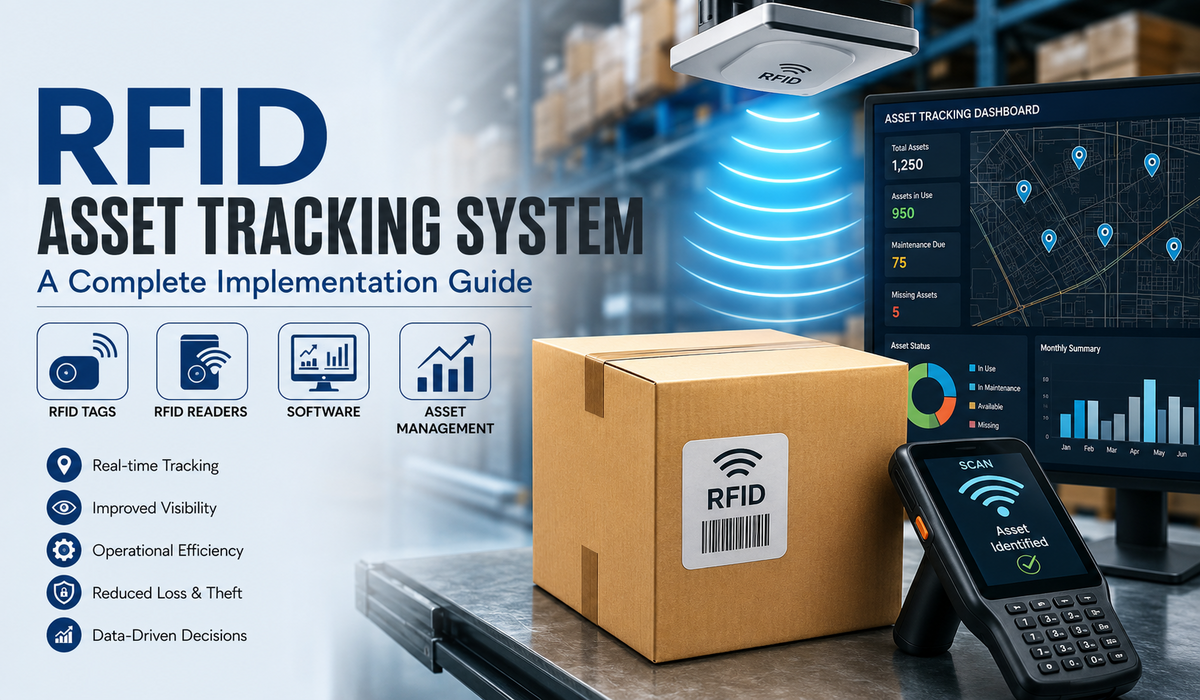
An RFID Asset Tracking System is an automated solution that uses Radio Frequency Identification (RFID) technology to identify, locate, monitor, and manage physical assets in real time. Every asset is assigned an RFID tag containing a unique identification number. RFID readers detect these tags through radio waves and transmit the collected information to centralized software, where organizations can monitor asset movement, location, status, and history.
Unlike traditional barcode systems, RFID does not require direct line-of-sight scanning. Multiple tagged assets can be identified simultaneously, making the tracking process significantly faster and more accurate. The system continuously records asset movements, enabling businesses to maintain up-to-date asset records with minimal manual intervention.
Organizations across manufacturing, healthcare, logistics, education, retail, government, construction, and IT sectors rely on RFID technology to improve asset visibility and optimize daily operations.
Why Businesses Need an RFID Asset Tracking System?
Modern businesses manage thousands of valuable assets spread across departments, facilities, warehouses, and job sites. Without automated tracking, maintaining accurate records becomes increasingly difficult, leading to misplaced assets, duplicate purchases, unexpected downtime, and inefficient resource allocation.
An RFID Asset Tracking System addresses these challenges by providing instant visibility into asset locations and usage. Employees spend less time searching for equipment, while management gains access to accurate inventory data that supports informed decision-making.
The system also improves accountability by recording who used an asset, when it was moved, and where it is currently located. This level of transparency helps reduce theft, unauthorized movement, and compliance issues while maximizing asset utilization.
How an RFID Asset Tracking System Works?
The implementation of an RFID Asset Tracking System begins by attaching RFID tags to every asset that needs to be monitored. These tags contain unique digital identifiers linked to asset information stored within the management software.
RFID readers installed at entry points, storage areas, production lines, or carried as handheld devices communicate with the RFID tags whenever they come within reading range. The captured information is automatically transmitted to the central software platform.
The software processes this data and updates asset records in real time. Users can instantly view asset locations, movement history, maintenance schedules, ownership details, and utilization reports through dashboards and reports.
As assets move throughout the organization, every transaction is automatically recorded without requiring manual scanning, ensuring accurate and reliable asset information.
Key Components of an RFID Asset Tracking System
A successful RFID Asset Tracking System consists of several integrated components working together to provide seamless asset visibility.
RFID Tags
RFID tags are attached directly to assets and store a unique identification number. Depending on business requirements, organizations may use passive, active, or semi-passive RFID tags. Passive tags are commonly selected for standard asset tracking because they are cost-effective and require no internal power source.
RFID Readers
Readers communicate with RFID tags using radio frequency signals. Fixed readers continuously monitor designated locations, while handheld readers allow employees to perform mobile asset verification and inventory checks.
RFID Antennas
Antennas transmit and receive radio signals between readers and RFID tags. Proper antenna placement significantly impacts reading accuracy and overall system performance.
RFID Asset Management Software
The software acts as the central management platform where organizations monitor asset information, generate reports, configure alerts, manage user access, and analyze asset utilization.
Database and Integration Layer
The system stores asset information in a centralized database and integrates with ERP, warehouse management systems, maintenance software, and other enterprise applications to provide complete operational visibility.
Types of RFID Tags Used in Asset Tracking
Selecting the appropriate RFID tag depends on the operating environment, asset value, reading distance, and business objectives.
Passive RFID tags are ideal for inventory management, office equipment, healthcare devices, and warehouse assets because they are affordable, lightweight, and maintenance-free.
Active RFID tags include internal batteries, allowing longer reading distances and continuous location tracking. They are commonly used for high-value equipment, vehicles, containers, and industrial machinery.
Semi-passive RFID tags combine characteristics of passive and active technologies, offering improved performance while maintaining relatively low power consumption.
The correct tag selection directly influences system accuracy, durability, and long-term operational efficiency.
Step-by-Step RFID Asset Tracking System Implementation
Assess Business Requirements
Every implementation begins by identifying the assets to be tracked, operational objectives, compliance requirements, and expected return on investment. Organizations should define which departments will use the system and determine the level of tracking required.
Identify Assets for Tagging
A complete asset inventory should be prepared before implementation. Each asset receives a unique RFID tag linked with essential information such as asset ID, category, serial number, owner, maintenance history, and location.
Choose Suitable RFID Hardware
Selecting compatible RFID readers, antennas, printers, and tags is essential for achieving reliable performance. Environmental conditions such as metal surfaces, liquids, temperature, and outdoor usage should also be considered during hardware selection.
Install RFID Infrastructure
Fixed readers are strategically installed at entrances, exits, storage rooms, production areas, and warehouses to capture asset movement automatically. Handheld readers are configured for inventory audits and mobile asset verification.
Configure Asset Management Software
The software is customized according to organizational workflows, user roles, asset categories, reporting requirements, and integration needs. Existing asset records are imported into the system for seamless migration.
Test the Entire System
Before deployment, organizations perform comprehensive testing to verify reading accuracy, hardware performance, software functionality, and integration with existing business systems.
Train Employees
Proper user training ensures employees understand tagging procedures, reader operation, software navigation, and reporting capabilities. Well-trained staff contribute significantly to successful system adoption.
Go Live and Monitor Performance
After deployment, organizations continuously monitor system performance, evaluate asset visibility improvements, and fine-tune reader placement or software configurations as operational needs evolve.
Benefits of Implementing an RFID Asset Tracking System
An RFID Asset Tracking System significantly improves asset visibility by providing real-time information about asset location, movement, and availability. Organizations no longer depend on manual spreadsheets or periodic inventory checks to maintain accurate records.
Automation reduces human errors associated with manual data entry while accelerating inventory audits that previously required several days. Businesses experience lower labor costs, faster operations, and improved employee productivity.
The system also minimizes asset loss by detecting unauthorized movement and generating immediate alerts whenever assets leave designated areas. This helps organizations reduce theft, improve accountability, and strengthen security.
Maintenance planning becomes more efficient because organizations can monitor equipment usage and schedule preventive maintenance before unexpected failures occur. Better maintenance management extends asset lifespan and reduces costly downtime.
Accurate reporting enables management to identify underutilized assets, eliminate duplicate purchases, optimize resource allocation, and improve capital investment decisions.
Industries Using RFID Asset Tracking Systems
Manufacturing companies use RFID to monitor production equipment, tools, work-in-progress inventory, and finished goods.
Hospitals rely on RFID technology to track medical equipment, wheelchairs, infusion pumps, surgical instruments, and patient care assets.
Warehouses implement RFID systems to improve inventory accuracy, accelerate receiving and shipping operations, and reduce stock discrepancies.
Construction companies track heavy machinery, tools, safety equipment, and materials distributed across multiple project sites.
Educational institutions manage laboratory equipment, computers, books, and classroom assets more efficiently using RFID-based solutions.
Government agencies utilize RFID for secure asset management, compliance reporting, and improved accountability across departments.
IT organizations monitor laptops, servers, networking equipment, and data center infrastructure while maintaining accurate audit records.
Common Challenges During Implementation
Although RFID offers significant advantages, successful implementation requires careful planning. Metal surfaces, liquids, and environmental interference may affect reading accuracy if appropriate tags and reader configurations are not selected.
Organizations must also ensure seamless integration with existing ERP, inventory management, and maintenance systems to avoid data inconsistencies.
Initial infrastructure investment may appear significant; however, long-term operational savings typically outweigh implementation costs through improved efficiency and reduced asset losses.
Employee adoption is another important consideration. Proper training and change management help ensure staff members understand new workflows and maximize system benefits.
Best Practices for Successful RFID Asset Tracking Implementation
Successful projects begin with clearly defined business objectives and measurable performance indicators. Organizations should conduct pilot deployments before implementing the solution across multiple facilities to identify potential issues early.
Selecting high-quality RFID hardware designed for the operating environment improves system reliability and long-term performance. Routine maintenance of readers, antennas, and software also helps maintain optimal accuracy.
Integrating RFID with enterprise systems creates a centralized source of asset information, enabling better reporting, analytics, and operational decision-making.
Regular audits, employee training, and continuous performance monitoring ensure the RFID Asset Tracking System continues delivering value as business requirements evolve.
Future of RFID Asset Tracking Systems
RFID technology continues to evolve alongside artificial intelligence, cloud computing, Internet of Things (IoT), edge computing, and advanced analytics. Modern asset tracking platforms increasingly provide predictive maintenance, automated asset optimization, and intelligent decision support through AI-powered insights.
Cloud-based RFID solutions enable organizations to monitor assets across multiple facilities from a centralized dashboard while supporting remote access and real-time reporting.
IoT integration allows RFID systems to combine asset identification with environmental monitoring, equipment health, temperature tracking, and location intelligence, creating smarter and more connected operations.
As businesses continue investing in digital transformation, RFID asset tracking will become even more intelligent, scalable, and data-driven.
Conclusion
Implementing an RFID Asset Tracking System is no longer just a technology upgrade—it is a strategic investment that improves operational efficiency, strengthens asset security, and provides complete visibility across the entire asset lifecycle. By replacing manual tracking methods with automated RFID technology, organizations can reduce losses, improve inventory accuracy, streamline maintenance, and make faster, data-driven decisions.
Whether deployed in manufacturing, healthcare, logistics, education, construction, government, or IT environments, RFID enables businesses to manage valuable assets with greater confidence and efficiency. Organizations that carefully plan their implementation, select the right hardware, integrate with existing systems, and continuously optimize performance will achieve the highest return on investment while building a future-ready asset management ecosystem.
Frequently Asked Questions (FAQs)
Q1. What is an RFID Asset Tracking System?
An RFID Asset Tracking System is a technology-based solution that uses RFID tags, readers, and asset management software to automatically identify, locate, and monitor physical assets in real time. It helps organizations improve asset visibility, reduce losses, and streamline asset management processes.
Q2. How does an RFID Asset Tracking System work?
An RFID Asset Tracking System works by attaching RFID tags to assets. RFID readers detect these tags using radio frequency signals and send the data to centralized software, which updates the asset’s location, movement history, and status automatically without requiring manual scanning.
Q3. What are the benefits of implementing an RFID Asset Tracking System?
Implementing an RFID Asset Tracking System improves inventory accuracy, reduces asset loss, increases operational efficiency, automates asset tracking, enhances security, minimizes manual errors, and provides real-time visibility into asset locations and utilization.
Q4. Which industries can benefit from an RFID Asset Tracking System?
Industries such as manufacturing, healthcare, logistics, warehousing, retail, education, construction, government, and IT can benefit from an RFID Asset Tracking System by improving asset visibility, reducing operational costs, and enhancing overall productivity.
Q5. What is the difference between RFID and barcode asset tracking?
Unlike barcode systems that require line-of-sight scanning, RFID technology can read multiple tagged assets simultaneously without direct visibility. This makes an RFID Asset Tracking System faster, more accurate, and better suited for large-scale asset management.
