

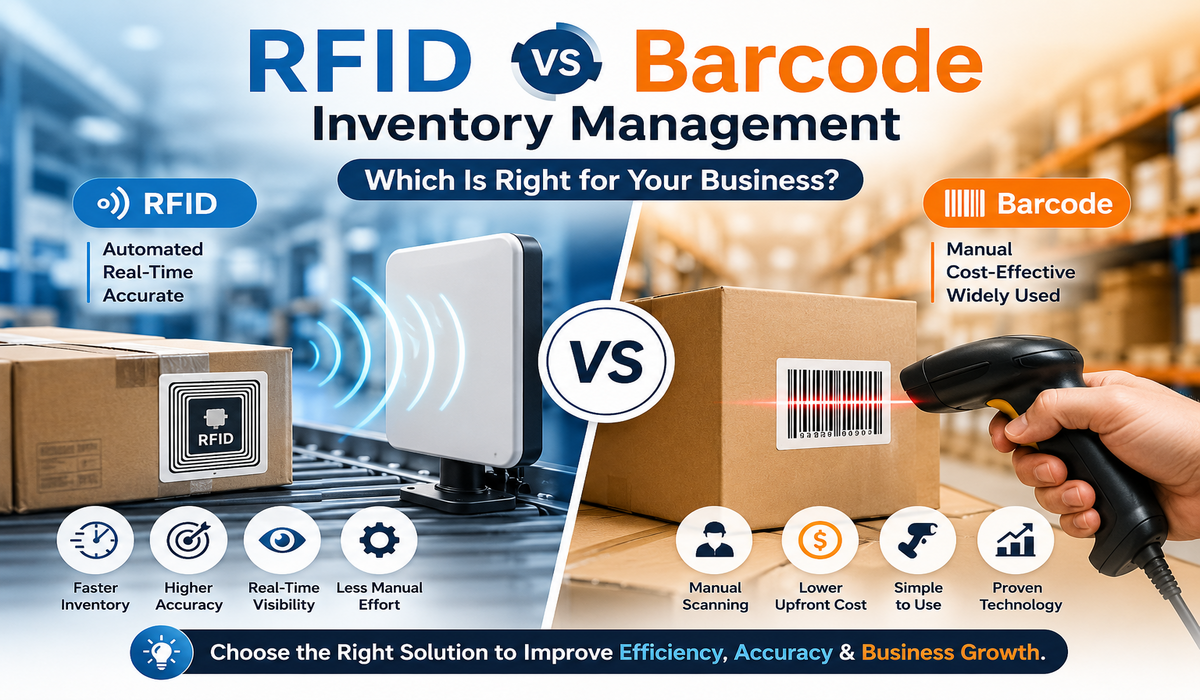
Inventory management plays a critical role in determining how efficiently a business operates. Whether you manage a retail store, warehouse, manufacturing plant, healthcare facility, or distribution center, keeping track of inventory accurately is essential for reducing costs, improving customer satisfaction, and maintaining operational efficiency. As businesses continue to digitize their operations, choosing the right inventory tracking technology has become more important than ever.
Among the most widely used inventory tracking methods are barcode systems and RFID technology. Both solutions help organizations monitor inventory movement, improve visibility, and reduce manual errors. However, their capabilities, implementation costs, and long-term business value differ significantly. While barcode systems remain popular due to their affordability and simplicity, an RFID Inventory Management System offers advanced automation, real-time tracking, and higher operational efficiency for businesses managing large volumes of inventory.
Understanding the differences between these technologies is essential before making an investment. This guide explains how RFID and barcode inventory management work, compares their advantages and limitations, and helps you determine which solution best aligns with your business requirements.
Understanding Barcode Inventory Management
Barcode inventory management has been the industry standard for decades. It uses printed labels containing machine-readable patterns that store product information. Every product is assigned a unique barcode, which is scanned using a handheld scanner or mobile device whenever inventory moves through different stages of the supply chain.
When a barcode is scanned, the inventory management software updates stock levels, records transactions, and tracks product movement. This process helps businesses maintain inventory accuracy while minimizing manual data entry.
Barcode systems are widely used across retail stores, supermarkets, pharmacies, warehouses, logistics companies, and manufacturing facilities because they are relatively inexpensive to implement and easy for employees to learn. However, barcode technology relies heavily on manual scanning, which can become time-consuming when handling thousands of products daily.
What is an RFID Inventory Management System?
An RFID Inventory Management System uses radio frequency technology to identify, locate, and monitor inventory without requiring direct line-of-sight scanning. Instead of printed labels alone, products are equipped with RFID tags containing electronically stored information.
RFID readers communicate with these tags through radio waves, automatically capturing inventory information as products move throughout warehouses, storage rooms, production facilities, or retail locations. Since multiple RFID tags can be read simultaneously, businesses can complete inventory counts much faster than with traditional barcode systems.
Unlike barcode technology, RFID enables real-time inventory visibility, automated stock updates, asset tracking, and improved operational intelligence. Organizations that require accurate inventory management across large facilities often choose RFID to eliminate manual processes and improve supply chain performance.
How Barcode Technology Works
Product Identification Through Printed Labels
Each product receives a unique barcode label that contains identifying information. Employees scan the barcode whenever the item is received, stored, transferred, sold, or shipped.
Manual Inventory Tracking
Barcode inventory depends on employees scanning every individual item. The system only updates inventory records after a successful scan, making employee accuracy essential for maintaining reliable inventory data.
Inventory Database Updates
After scanning, the inventory software records product movement, adjusts stock quantities, and generates reports that help businesses monitor inventory availability and sales performance.
Although barcode systems provide dependable inventory tracking, they require considerable manual effort, particularly for businesses managing high inventory volumes.
How an RFID Inventory Management System Works
RFID Tags Store Product Information
Every product, pallet, container, or asset receives an RFID tag containing a unique electronic identifier. These tags may be passive, active, or semi-passive depending on the business application.
RFID Readers Capture Data Automatically
RFID readers installed at warehouse entrances, loading docks, shelves, or production lines continuously detect nearby RFID tags without requiring employees to scan each item individually.
Real-Time Inventory Synchronization
The RFID Inventory Management System immediately updates inventory records whenever tagged items move within the facility. This continuous synchronization provides businesses with accurate stock visibility at all times.
Automated Inventory Monitoring
Since RFID readers operate automatically, businesses can perform inventory counts in minutes rather than hours. The system continuously monitors stock movement, reducing the likelihood of misplaced inventory or stock discrepancies.
Comparing RFID and Barcode Inventory Management
Inventory Accuracy
Barcode systems depend entirely on manual scanning. If an employee forgets to scan a product or scans the wrong barcode, inventory records become inaccurate. Human error remains one of the biggest challenges associated with barcode-based inventory management.
An RFID Inventory Management System significantly improves inventory accuracy because products are detected automatically as they move throughout the facility. Continuous monitoring minimizes missed transactions and provides more reliable inventory information.
Speed of Inventory Counting
Inventory counting with barcode technology requires employees to scan every individual product. This process becomes increasingly time-consuming as inventory volumes grow.
RFID technology allows hundreds of tagged products to be identified simultaneously. Entire warehouse sections can be counted within minutes, dramatically reducing labor requirements.
Line-of-Sight Requirements
Barcode scanners require direct visibility between the scanner and the barcode label. Damaged labels, poor lighting, or obstructed packaging can prevent successful scans.
RFID technology communicates using radio waves, eliminating the need for direct line-of-sight scanning. Products inside cartons, shelves, or containers can still be identified quickly.
Automation Capabilities
Barcode systems provide limited automation because every inventory update requires manual scanning.
An RFID Inventory Management System supports fully automated inventory tracking, allowing businesses to monitor stock movement continuously without employee intervention.
Inventory Visibility
Barcode technology only records inventory when products are manually scanned, resulting in delayed inventory updates.
RFID provides real-time inventory visibility by continuously monitoring tagged products throughout warehouses and distribution centers.
Operational Efficiency
Businesses using barcode systems often spend considerable time performing stock counts, locating missing inventory, and correcting inventory discrepancies.
RFID automates these processes, allowing employees to focus on higher-value operational tasks while improving overall productivity.
Advantages of Barcode Inventory Management
Lower Initial Investment
Barcode systems require minimal hardware investment compared to RFID implementations. Businesses can begin using barcode inventory management with basic printers, barcode labels, and handheld scanners.
Simple Implementation
Most employees quickly learn barcode scanning procedures, making implementation relatively straightforward for organizations of all sizes.
Suitable for Small Businesses
Businesses with limited inventory volumes or smaller warehouses often find barcode systems sufficient for their operational needs.
Proven Technology
Barcode systems have been successfully used for decades and integrate with most inventory management software platforms.
Advantages of an RFID Inventory Management System
Faster Inventory Operations
RFID dramatically reduces the time required for receiving, inventory counting, shipping, and stock verification by automating data collection.
Improved Inventory Accuracy
Automatic identification significantly reduces human error, resulting in more reliable inventory records.
Real-Time Asset Tracking
Organizations gain complete visibility into inventory movement across warehouses, manufacturing facilities, and retail stores.
Reduced Labor Costs
Automated inventory tracking decreases the need for manual scanning, lowering labor expenses while increasing employee productivity.
Better Supply Chain Visibility
Businesses can monitor inventory movement across multiple facilities, improving planning, replenishment, and order fulfillment.
Enhanced Customer Satisfaction
Accurate inventory information enables faster deliveries, fewer stock shortages, and improved order accuracy, creating a better customer experience.
Which Industries Benefit Most from Barcode Systems?
Barcode inventory management remains an excellent solution for businesses that have relatively straightforward inventory operations. Small retail stores, pharmacies, local distributors, libraries, educational institutions, and service businesses often find barcode systems sufficient because inventory volumes remain manageable.
Organizations with limited automation requirements and smaller operational budgets can continue using barcode technology effectively for many years.
Which Industries Benefit Most from RFID Inventory Management Systems?
An RFID Inventory Management System delivers the greatest value for businesses handling large inventory volumes, frequent stock movement, and complex supply chain operations.
Manufacturing companies benefit from automated work-in-progress tracking and raw material visibility. Warehousing and logistics organizations improve shipment accuracy and inventory counting efficiency. Retail businesses gain real-time stock visibility while reducing shrinkage. Healthcare organizations use RFID to track medical equipment, pharmaceuticals, and critical assets. Automotive companies monitor components throughout production, while aviation, defense, and industrial sectors rely on RFID for high-value asset management.
Factors to Consider Before Choosing the Right Inventory System
Selecting between barcode and RFID depends on your organization’s operational requirements rather than simply comparing technology features.
Businesses should evaluate inventory volume, warehouse size, labor costs, desired automation level, inventory accuracy requirements, future growth plans, and return on investment. Companies planning rapid expansion or digital transformation often find RFID provides stronger long-term value despite higher initial implementation costs.
Organizations with smaller operations and limited budgets may continue achieving satisfactory performance with barcode systems until operational complexity increases.
Future of Inventory Management
Inventory management is rapidly evolving as businesses embrace automation, artificial intelligence, cloud computing, and Industrial IoT technologies. RFID has become a key component of modern smart warehouses because it enables continuous inventory visibility and seamless integration with advanced analytics platforms.
As implementation costs continue to decrease and RFID technology becomes more accessible, many organizations are transitioning from barcode systems to RFID to improve operational efficiency, inventory accuracy, and supply chain resilience.
Businesses investing in digital transformation increasingly view RFID as a strategic technology rather than simply an inventory tracking tool. Its ability to provide real-time data supports better decision-making, predictive inventory planning, and enhanced customer service.
Conclusion
Both barcode technology and RFID offer valuable inventory management capabilities, but the right choice depends on your business goals, operational complexity, and long-term growth strategy. Barcode systems remain a practical and cost-effective solution for organizations with smaller inventories and limited automation needs. However, businesses seeking greater accuracy, faster inventory counts, real-time visibility, and scalable automation will benefit significantly from implementing an RFID Inventory Management System.
As supply chains become more dynamic and customer expectations continue to rise, investing in the right inventory technology can provide a lasting competitive advantage. Organizations that prioritize operational efficiency, inventory accuracy, and future scalability are increasingly choosing RFID to modernize inventory management and build smarter, more connected operations.
Frequently Asked Questions (FAQs)
Q1. What is an RFID Inventory Management System?
An RFID Inventory Management System is a technology that uses radio frequency identification (RFID) tags and readers to automatically track and manage inventory in real time. Unlike barcode systems, RFID does not require direct line-of-sight scanning, making inventory management faster and more accurate.
Q2. Is RFID better than barcode inventory management?
RFID offers several advantages over barcode inventory management, including real-time tracking, faster inventory counts, higher accuracy, and automated data collection. However, barcode systems may still be a suitable option for small businesses with limited inventory and lower automation requirements.
Q3. Which industries benefit the most from RFID Inventory Management Systems?
Industries such as manufacturing, retail, healthcare, warehousing, logistics, automotive, and aviation benefit significantly from RFID Inventory Management Systems because they handle large volumes of inventory and require accurate, real-time tracking.
Q4. Is an RFID Inventory Management System expensive to implement?
The initial investment for an RFID Inventory Management System is generally higher than a barcode system due to the cost of RFID tags, readers, and infrastructure. However, many businesses recover the investment through improved inventory accuracy, reduced labor costs, and increased operational efficiency.
Q5. Can RFID replace barcode systems completely?
Yes, RFID can replace barcode systems in many business environments. However, some organizations choose to use both technologies together, depending on their operational needs, budget, and existing inventory management processes.
