

People Also Ask (FAQs)
Q1. What is the difference between RFID and barcode technology?
Barcode systems require visible scanning of printed labels, whereas RFID uses radio waves to identify tagged items without direct contact. RFID generally enables faster automation and bulk scanning, while barcodes remain cost-effective for simpler tracking needs.
Q2. Is RFID better than barcode for inventory management?
RFID often improves inventory accuracy and speed because multiple items can be scanned simultaneously. However, barcode systems may still perform adequately for businesses with lower inventory complexity and tighter budgets.
Q3. Why is RFID more expensive than barcode systems?
RFID deployment typically involves infrastructure investment, readers, software integration, and electronic tags. Barcode systems rely on printed labels and scanners, making implementation cheaper initially.
Q4. Can RFID replace barcode completely?
Complete replacement is unlikely. Many industries continue benefiting from barcode affordability and simplicity. Future supply chains may use both technologies together depending on operational requirements.
Q5. Which industries benefit most from RFID adoption?
Manufacturing, logistics, healthcare, retail, automotive, and warehousing sectors frequently gain value from RFID because of automation needs and large inventory volumes.
Q6. Is RFID secure for supply chain tracking?
RFID systems can improve tracking security and visibility, although implementation quality, encryption methods, and system design influence overall protection levels.
Q7. What should businesses consider before choosing RFID vs Barcode?
Organizations should evaluate operational complexity, scalability requirements, budget, inventory volume, and long-term automation goals before selecting a tracking solution.
Supply chain operations today depend heavily on visibility, accuracy, and real-time tracking. As businesses manage increasingly complex logistics networks, choosing the right identification technology has become a strategic decision rather than simply an operational requirement. The debate around RFID vs Barcode continues to grow because companies want solutions that improve inventory management, reduce manual errors, enhance traceability, and support automation across warehouses and distribution centers.
Both technologies are widely used for tracking products and assets, yet they differ significantly in functionality, speed, cost, scalability, and data capture capabilities. While barcodes have served industries for decades as an affordable tracking method, RFID technology is transforming supply chains with faster, contactless, and automated identification processes. Understanding where each technology performs best helps organizations make smarter investments aligned with business goals.
Selecting between RFID and barcode systems is not about identifying one universal winner. The better option depends on supply chain complexity, operational volume, budget, and long-term digital transformation objectives.
What Are Barcode Systems in Supply Chain Tracking?
Barcode technology is one of the oldest and most commonly adopted methods for product identification and inventory tracking. A barcode consists of printed lines or patterns containing encoded information that scanners interpret to identify products, assets, or shipment details.
In supply chain environments, barcodes help track inventory movement, monitor shipments, manage warehouse stock, and support retail checkout processes. Each barcode typically contains limited information linked to a database storing additional details.
The biggest reason for widespread barcode adoption is simplicity. Businesses can implement barcode systems with relatively low investment while maintaining acceptable tracking capabilities for many operational environments.
However, barcode systems require direct line-of-sight scanning. This means every item must be physically visible to the scanner for identification, which can slow processes in large-scale operations.
What Is RFID Technology and How Does It Work?
Radio Frequency Identification, commonly known as RFID, uses radio waves to identify and track tagged objects automatically. RFID systems generally include tags, readers, antennas, and software platforms that process collected information.
Unlike barcodes, RFID does not require direct visual contact between the scanner and the tagged item. Multiple products can be scanned simultaneously, even when hidden inside boxes, pallets, or containers.
For example, instead of manually scanning hundreds of products one by one, an RFID-enabled system may capture inventory movement automatically as goods pass through checkpoints.
This capability significantly improves operational speed and visibility, especially in industries handling high-volume logistics.
Why the RFID vs Barcode Comparison Matters for Modern Supply Chains
Supply chains in 2026 demand greater efficiency than ever before. Organizations increasingly focus on automation, real-time monitoring, and traceability to manage disruptions, customer expectations, and compliance requirements.
Traditional manual processes often create delays and inaccuracies. Companies implementing digital tracking systems aim to reduce these inefficiencies.
The comparison between RFID and barcode technology matters because tracking solutions influence several critical business outcomes, including inventory accuracy, labor costs, operational speed, shipment visibility, and customer satisfaction.
As supply chains become smarter, choosing suitable identification infrastructure directly impacts competitiveness.
RFID vs Barcode: Understanding the Fundamental Differences
Although both technologies support tracking and identification, their operational approaches differ substantially.
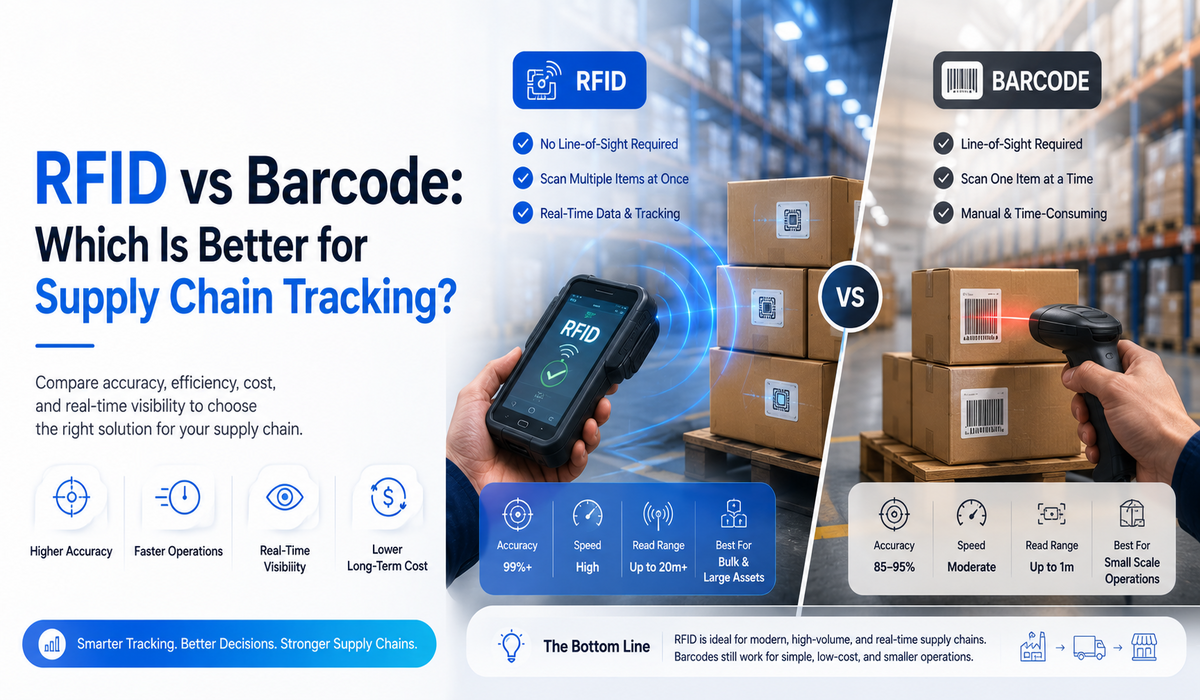
Barcodes store limited information in printed patterns and require manual scanning. RFID stores digital information inside electronic tags and enables wireless reading.
Barcode systems typically scan one item at a time, whereas RFID can capture numerous items simultaneously.
Barcodes depend heavily on human interaction. RFID supports higher automation levels.
Environmental conditions also affect performance differently. Damaged or poorly printed barcodes may become unreadable, while RFID tags generally perform better under challenging conditions, depending on tag type and deployment environment.
These differences influence scalability and long-term suitability.
RFID vs Barcode — Comparing Performance Across Key Supply Chain Factors
When businesses evaluate tracking technologies, performance metrics often determine implementation decisions.
Tracking Speed and Operational Efficiency
Barcode scanning usually requires manual handling and sequential processing. Employees scan products individually, increasing time requirements in large warehouses.
RFID enables rapid bulk reading of tagged items. This capability accelerates inventory counts, shipment verification, and warehouse operations.
Organizations prioritizing speed often see stronger advantages from RFID systems.
Inventory Accuracy
Inventory discrepancies create financial losses and operational disruptions.
Manual barcode scanning may introduce human errors due to missed scans or incorrect handling.
RFID improves accuracy through automated data capture and continuous visibility.
High-value inventory environments often benefit significantly from increased precision.
Data Storage Capability
Barcodes contain limited information.
RFID tags can store larger datasets and support updates throughout product lifecycles.
This flexibility supports advanced traceability requirements.
Scalability for Enterprise Operations
Small businesses may operate effectively using barcode systems.
Large enterprises managing extensive inventories often require greater automation, making RFID more attractive.
Scalability becomes increasingly important as operations expand.
Cost Comparison: Is RFID More Expensive Than Barcode?
Cost remains one of the most influential factors during technology selection.
Barcode implementation costs are generally lower because printed labels and scanners require minimal investment. Small organizations often prefer barcode systems due to affordability.
RFID deployment usually involves higher initial expenses, including readers, software integration, infrastructure, and RFID tags.
However, evaluating only upfront investment can be misleading.
Long-term operational savings from automation, reduced labor requirements, improved accuracy, and faster processes may offset RFID implementation costs over time.
Businesses should assess total ownership cost rather than installation expense alone.
Which Technology Offers Better Traceability?
Traceability has become increasingly important due to regulatory requirements, sustainability initiatives, and customer expectations.
Barcode systems provide traceability but often depend on manual scanning consistency.
RFID strengthens traceability through automated tracking across supply chain stages.
For industries requiring real-time visibility, product authentication, or compliance monitoring, RFID frequently delivers stronger outcomes.
This explains growing RFID adoption in pharmaceutical, manufacturing, logistics, and food supply chains.
Real-World Use Cases: Where Barcode Performs Better
Despite technological advancements, barcode systems remain valuable in numerous scenarios.
Retail environments commonly use barcode labels because implementation remains simple and economical.
Small warehouses with moderate inventory volumes often achieve sufficient efficiency through barcode tracking.
Organizations operating under tight budgets may prioritize affordability over advanced automation capabilities.
For businesses with straightforward supply chain requirements, barcode technology may continue providing reliable performance.
Real-World Use Cases: Where RFID Outperforms Traditional Tracking
RFID adoption expands rapidly in sectors requiring automation and large-scale visibility.
Manufacturing companies use RFID to monitor production movement and component tracking.
Logistics providers leverage RFID for shipment verification and warehouse optimization.
Healthcare organizations track equipment and sensitive inventory.
Retail enterprises implement RFID to improve stock accuracy and reduce shrinkage.
Airports utilize RFID-enabled baggage tracking systems to improve operational efficiency.
These environments benefit from speed and automation capabilities difficult to achieve through barcode-only systems.
Common Challenges Businesses Face During Implementation
Technology adoption rarely occurs without obstacles.
Barcode systems often struggle with damaged labels, manual dependency, and slower processing speeds.
RFID projects may encounter higher upfront costs, integration complexity, and infrastructure planning requirements.
Some organizations implement RFID expecting immediate transformation without evaluating workflow readiness.
Others continue relying exclusively on barcodes despite growing operational complexity.
Successful deployment requires aligning technology with business objectives rather than following industry trends blindly.
How to Choose the Right Tracking Technology: Step-by-Step Approach
Step 1: Analyze Operational Complexity
Businesses should first evaluate inventory volumes, warehouse size, and supply chain structure.
Higher complexity generally increases automation requirements.
Step 2: Define Tracking Objectives
Organizations must identify priorities such as accuracy improvement, labor reduction, compliance support, or real-time visibility.
Clear objectives simplify technology selection.
Step 3: Evaluate Budget Beyond Initial Costs
Decision-makers should compare long-term efficiency gains rather than focusing only on deployment expense.
Step 4: Consider Future Scalability
Rapid business growth may require systems supporting increased automation.
Technology should align with future expansion plans.
Step 5: Test Through Pilot Programs
Pilot implementations help assess practical performance before full deployment.
Testing reduces investment risk.
RFID vs Barcode — Which Technology Is Better for Supply Chain Tracking?
The answer depends on operational requirements rather than technology popularity.
If affordability, simplicity, and basic inventory tracking are primary priorities, barcode systems often remain effective.
If organizations require automation, real-time visibility, advanced traceability, and scalable performance, RFID typically offers stronger long-term value.
For many enterprises, hybrid models combining barcode and RFID technologies provide optimal outcomes.
The most successful companies choose solutions based on measurable business needs rather than assuming one approach fits every scenario.
Emerging Trends Shaping Supply Chain Tracking in 2026
Supply chain tracking technologies continue evolving alongside broader digital transformation initiatives.
Artificial intelligence increasingly complements RFID systems through predictive analytics and anomaly detection.
IoT integration enhances real-time monitoring capabilities.
Cloud-based platforms improve visibility across distributed operations.
Blockchain adoption supports trusted traceability records.
Future tracking ecosystems will likely combine multiple technologies rather than relying on a single identification method.
The focus is shifting toward connected, intelligent supply chains.
Future Outlook: Will RFID Replace Barcode Completely?
Complete replacement appears unlikely in the near future.
Barcode systems remain affordable, practical, and sufficient for many operational environments.
RFID adoption will probably continue expanding in industries demanding greater efficiency and automation.
Rather than replacement, coexistence seems more realistic.
Organizations may increasingly deploy both technologies strategically according to business requirements.
The future belongs less to technology competition and more to integrated tracking ecosystems.
Conclusion
The debate around RFID vs Barcode does not have a universal winner because the right choice depends on business objectives, operational scale, and supply chain complexity. Barcode technology continues offering affordable and practical tracking solutions, while RFID delivers stronger automation, visibility, and efficiency for organizations pursuing advanced digital transformation.
If you’d like a frank assessment of where each technology pays back fastest in your supply chain — with the numbers run on your volumes, not a vendor’s reference customer — talk to our team. We design and deploy RFID, barcode, and hybrid traceability systems across pharma, retail, manufacturing, and healthcare.
People Also Ask (FAQs)
Q1. What is the difference between RFID and barcode technology?
Barcode systems require visible scanning of printed labels, whereas RFID uses radio waves to identify tagged items without direct contact. RFID generally enables faster automation and bulk scanning, while barcodes remain cost-effective for simpler tracking needs.
Q2. Is RFID better than barcode for inventory management?
RFID often improves inventory accuracy and speed because multiple items can be scanned simultaneously. However, barcode systems may still perform adequately for businesses with lower inventory complexity and tighter budgets.
Q3. Why is RFID more expensive than barcode systems?
RFID deployment typically involves infrastructure investment, readers, software integration, and electronic tags. Barcode systems rely on printed labels and scanners, making implementation cheaper initially.
Q4. Can RFID replace barcode completely?
Complete replacement is unlikely. Many industries continue benefiting from barcode affordability and simplicity. Future supply chains may use both technologies together depending on operational requirements.
Q5. Which industries benefit most from RFID adoption?
Manufacturing, logistics, healthcare, retail, automotive, and warehousing sectors frequently gain value from RFID because of automation needs and large inventory volumes.
Q6. Is RFID secure for supply chain tracking?
RFID systems can improve tracking security and visibility, although implementation quality, encryption methods, and system design influence overall protection levels.
Q7. What should businesses consider before choosing RFID vs Barcode?
Organizations should evaluate operational complexity, scalability requirements, budget, inventory volume, and long-term automation goals before selecting a tracking solution.
