
In today’s highly regulated and globally connected supply chains, businesses face increasing pressure to ensure product authenticity, maintain compliance, and provide complete visibility across every stage of distribution. Industries such as pharmaceuticals, food and beverages, medical devices, cosmetics, electronics, and luxury goods are adopting advanced identification technologies to combat counterfeiting, reduce operational risks, and strengthen consumer trust. This is where Serialization vs. Track and Trace solutions becomes an important discussion for organizations looking to modernize their supply chain operations.
Although serialization and track and trace are often used interchangeably, they are not the same. They serve different purposes while working together to create a transparent, secure, and intelligent supply chain. Understanding the distinction between these technologies helps businesses choose the right implementation strategy while ensuring regulatory compliance and operational efficiency.
Understanding Serialization
Serialization is the process of assigning a unique identification number or code to every individual product or saleable unit. Unlike traditional batch numbers, which identify an entire production lot, serialization creates a unique identity for each product. These identifiers are commonly represented using QR codes, Data Matrix codes, RFID tags, or barcodes that store product-specific information.
Every serialized product carries a unique digital identity that can include details such as manufacturing information, production date, expiration date, batch number, product code, and serial number. This information allows manufacturers and supply chain partners to distinguish one item from another, making every product individually identifiable throughout its lifecycle.
What is Track and Trace?
Track and trace refers to the process of monitoring a product’s movement and recording every transaction as it travels through the supply chain. While serialization provides each product with a unique identity, track and trace captures where that product has been, who handled it, and where it is currently located.
Every movement—from manufacturing and packaging to warehousing, transportation, distribution, and retail—is recorded in a centralized system. This creates a complete digital history that enables businesses to monitor products in real time while improving inventory accuracy and supply chain visibility.
Track and trace solutions integrate with technologies such as RFID, barcode scanning, IoT sensors, cloud platforms, GPS tracking, and enterprise resource planning systems to deliver real-time information. Organizations gain the ability to quickly identify delays, locate shipments, manage recalls, and optimize logistics operations with greater confidence.
Serialization vs. Track and Trace Solutions: Understanding the Difference
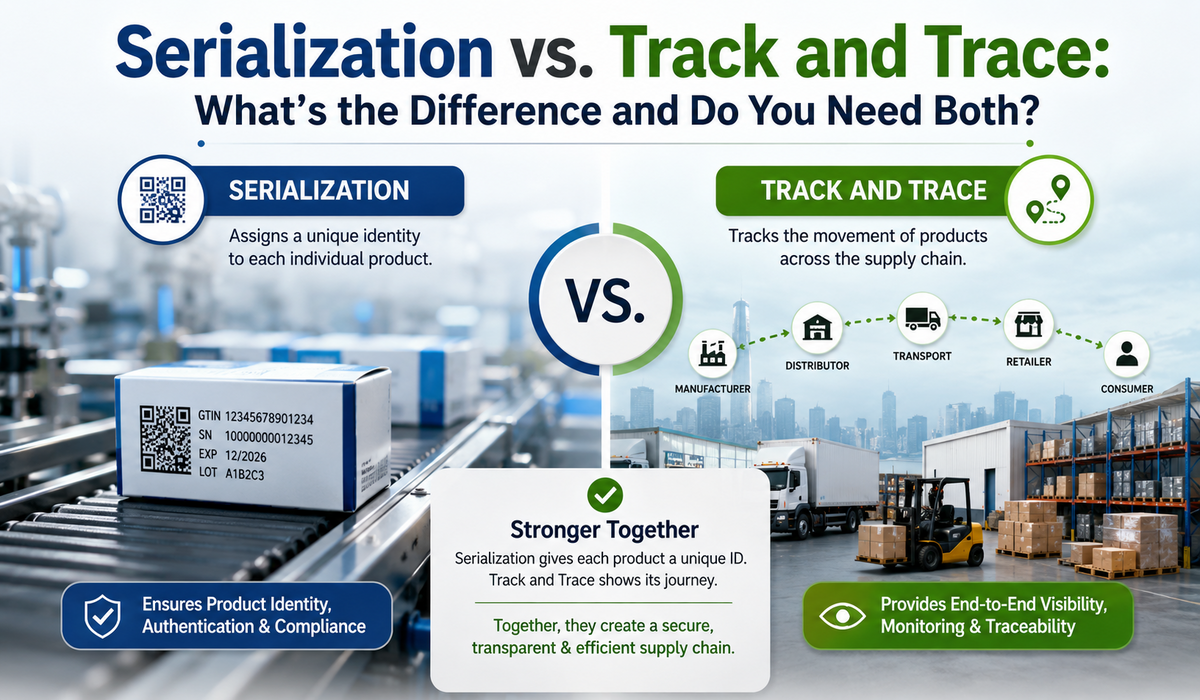
When discussing Serialization vs. Track and Trace solutions, it is important to recognize that serialization focuses on creating identity, whereas track and trace focuses on recording movement. Serialization answers the question of “What exactly is this product?” while track and trace answers “Where has this product been, and where is it now?”
Serialization assigns a unique serial number that permanently identifies each product. Track and trace uses that unique identifier to continuously monitor the product as it moves through manufacturing facilities, warehouses, transportation networks, distributors, retailers, and ultimately to the end customer.
Another important distinction lies in the business value each technology provides. Serialization primarily improves product authentication, regulatory compliance, and counterfeit prevention. Track and trace enhances operational visibility, logistics efficiency, inventory management, and supply chain transparency. When combined, they create an integrated system that delivers end-to-end product visibility from production to consumption.
Why Serialization Alone Is Not Enough
Many organizations initially implement serialization to satisfy government regulations or customer requirements. While serialization successfully creates unique product identities, it does not automatically provide information about where products travel after they leave the production line.
For example, a pharmaceutical manufacturer may serialize every medicine package before shipping it to distributors. Without track and trace capabilities, the manufacturer can verify that each package is unique but cannot determine its real-time location, identify logistics delays, monitor distribution routes, or detect unauthorized diversions within the supply chain.
Similarly, if counterfeit products appear in the market, serialization alone may identify whether a product is genuine, but it cannot reveal exactly where the supply chain was compromised. This limitation highlights why serialization should be viewed as the foundation rather than the complete solution.
Why Track and Trace Depends on Serialization
Track and trace systems rely on unique product identifiers to accurately monitor movement throughout the supply chain. Without serialization, multiple products from the same batch appear identical, making it impossible to distinguish individual items during transportation or distribution.
Serialization provides the unique digital identity that allows every scan, shipment, warehouse transaction, and delivery event to be associated with the correct product. This combination enables businesses to build an accurate digital journey for every item.
As products move through multiple facilities and trading partners, every scan updates the centralized database, creating a complete record of ownership changes, storage conditions, shipping events, and delivery confirmations.
Business Benefits of Combining Serialization and Track and Trace Solutions
Organizations that implement both technologies gain significantly greater value than those relying on either solution independently. The combination improves operational efficiency while strengthening regulatory compliance and customer confidence.
One of the most valuable benefits is enhanced product authenticity. Businesses can instantly verify whether a product is genuine by validating its unique serial number while simultaneously reviewing its complete distribution history. This capability makes it considerably more difficult for counterfeit products to enter legitimate supply chains.
The integration also improves product recalls. Instead of recalling an entire production batch, manufacturers can identify the exact serialized products affected by a quality issue and locate them quickly using their track and trace records. This targeted approach reduces financial losses while minimizing disruption for customers.
Supply chain visibility is another major advantage. Decision-makers gain real-time insights into inventory movement, shipment status, warehouse operations, and distribution performance. This visibility enables faster responses to delays, improves planning accuracy, and supports better inventory optimization.
Organizations also experience stronger compliance with industry regulations. Regulatory authorities increasingly require manufacturers to maintain detailed product records that demonstrate product authenticity and supply chain transparency. Combining serialization with track and trace simplifies audits while reducing compliance risks.
Industries That Benefit Most
The pharmaceutical industry remains one of the largest adopters because patient safety depends on authentic medicines and transparent distribution networks. Every package can be uniquely identified and tracked from manufacturing facilities to pharmacies, helping reduce counterfeit drugs and ensuring compliance with international regulations.
Food and beverage manufacturers benefit from faster recalls and improved traceability during contamination events. Instead of recalling every product on store shelves, companies can identify specific affected items and remove them quickly, protecting consumers while reducing waste.
Medical device manufacturers use serialization and track and trace technologies to maintain complete lifecycle visibility for surgical equipment, implants, and diagnostic devices. This improves patient safety while supporting strict regulatory requirements.
Luxury brands employ these technologies to combat counterfeit goods, verify authenticity, and strengthen customer confidence. Electronics manufacturers improve warranty validation, supply chain security, and component traceability while reducing unauthorized distribution.
Common Challenges During Implementation
Although the benefits are significant, implementing Serialization vs. Track and Trace solutions requires careful planning. Organizations often face challenges integrating existing ERP systems, warehouse management software, production equipment, and logistics platforms with new serialization infrastructure.
Data accuracy represents another important consideration. Employee training and standardized operational procedures play an essential role in maintaining data integrity.
Businesses operating across multiple countries must also comply with different regulatory frameworks, each requiring specific reporting standards, labeling formats, and data exchange protocols. Choosing scalable technology that supports international compliance requirements becomes increasingly important for global manufacturers.
Do You Really Need Both?
The answer depends on business objectives, regulatory obligations, and supply chain complexity. If the goal is simply assigning unique identities to products for compliance, serialization may satisfy immediate requirements. However, organizations seeking complete supply chain visibility, improved recall management, counterfeit protection, operational efficiency, and enhanced customer trust will achieve far greater value by implementing both technologies together.
Modern supply chains involve numerous manufacturers, logistics providers, warehouses, distributors, retailers, and customers. Managing this complexity requires more than unique product identification; it requires continuous visibility into every movement and transaction. Serialization establishes the product’s identity, while track and trace transforms that identity into actionable intelligence that supports better decision-making across the entire supply chain.
Conclusion
The debate around Serialization vs. Track and Trace solutions is not about choosing one technology over the other but understanding how they complement each other. Serialization creates a unique digital identity for every product, enabling authentication and regulatory compliance, while track and trace records every movement across the supply chain, providing complete visibility and operational intelligence.
As supply chains become increasingly digital and regulations continue to evolve, organizations that combine serialization with robust track and trace capabilities will be better positioned to prevent counterfeiting, improve recall efficiency, strengthen compliance, optimize logistics, and build lasting customer trust. Rather than viewing them as separate technologies, businesses should consider serialization and track and trace as two interconnected pillars of a modern, secure, and transparent supply chain strategy that delivers long-term operational and competitive advantages.
Frequently Asked Questions (FAQs)
Q1. What is the difference between serialization and track and trace?
Serialization assigns a unique identification number to every individual product, allowing each item to be distinguished from others. Track and trace uses those unique identifiers to monitor and record a product’s movement throughout the supply chain, providing complete visibility from manufacturing to the end customer.
Q2. Why are Serialization vs. Track and Trace solutions important for businesses?
Serialization vs. Track and Trace solutions help businesses improve product authenticity, comply with industry regulations, prevent counterfeiting, enhance supply chain transparency, streamline product recalls, and gain real-time visibility into inventory and logistics operations.
Q3. Can a business implement serialization without track and trace?
Yes, a business can implement serialization independently to meet regulatory requirements and assign unique identities to products. However, without track and trace capabilities, it cannot monitor product movement, identify supply chain disruptions, or maintain complete end-to-end visibility.
Q4. Which industries benefit the most from Serialization vs. Track and Trace solutions?
Industries such as pharmaceuticals, medical devices, food and beverages, cosmetics, electronics, automotive, and luxury goods benefit significantly from Serialization vs. Track and Trace solutions because they require product authentication, regulatory compliance, and end-to-end supply chain visibility.
Q5. Do small and medium-sized businesses need Serialization vs. Track and Trace solutions?
Yes. While regulatory requirements may vary, small and medium-sized businesses can benefit from Serialization vs. Track and Trace solutions by improving inventory accuracy, reducing counterfeit risks, enhancing customer trust, and building a scalable supply chain that supports future business growth.
