

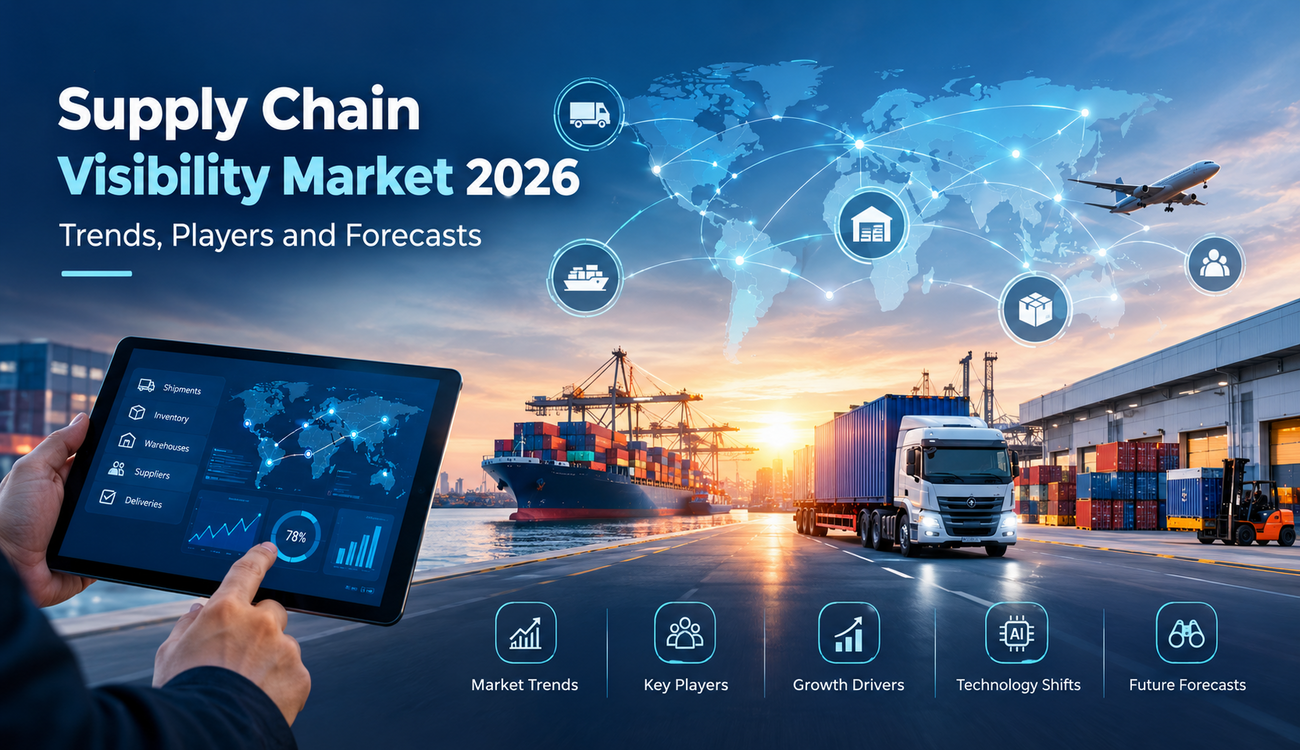
The Supply Chain Visibility Market is entering 2026 with strong momentum as companies prioritize real-time awareness across suppliers, transportation networks, inventory, warehouses, and customer fulfillment. Global disruptions, geopolitical uncertainty, changing trade conditions, rising e-commerce expectations, and pressure to control logistics costs are pushing organizations to move beyond fragmented tracking systems. Visibility platforms increasingly combine data integration, IoT, analytics, artificial intelligence, and control-tower capabilities to help decision-makers understand what is happening and respond earlier.
Recent market estimates vary because research firms define visibility differently. Reports and Data estimates the market at $5.5 billion in 2024 and projects $15.2 billion by 2034, representing a 10.5% CAGR. Technavio’s narrower software category forecasts an additional $3.85 billion in value between 2025 and 2030 at a 16.1% CAGR. These differences show why market forecasts should be compared according to their definitions, segments, and measurement periods rather than treated as identical figures.
Why Supply Chain Visibility is Becoming a Business Priority
Modern supply chains generate data at almost every stage, but data availability does not automatically create operational visibility. Information may remain distributed across enterprise resource planning systems, transportation management systems, warehouse platforms, supplier portals, carrier systems, spreadsheets, sensors, and customer applications. The result can be delayed decisions, inconsistent information, and difficulty identifying the source of a disruption.
The Supply Chain Visibility Market is responding to this problem by bringing multiple data streams into connected environments. Instead of checking individual systems, teams can monitor orders, shipments, inventory positions, supplier events, transportation milestones, and exceptions through a shared operational view. This shift is particularly important for companies managing complex international networks where a delay at one point can affect production, inventory availability, delivery schedules, and customer commitments.
From Tracking to Predictive Decision-Making
Visibility is also moving beyond simple location tracking. The Supply Chain Visibility Market is increasingly defined by platforms that use machine learning and predictive analytics to estimate arrival times, detect anomalies, identify risk patterns, and support scenario planning. AI can analyze large volumes of historical and real-time information to highlight events that may require attention.
The 2026 direction is therefore moving from “Where is my shipment?” toward “What is likely to happen next, and what should the organization do about it?” This change makes visibility technology more closely connected with planning, execution, risk management, and customer service.
Major Trends Shaping the Market in 2026
AI-Powered Predictive Visibility
Artificial intelligence is becoming one of the most important technology layers in supply chain visibility. AI-enabled platforms can combine shipment events, weather information, traffic conditions, historical delivery patterns, supplier data, and other signals to identify potential delays or disruptions. Generative AI is also being introduced through assistants that summarize exceptions, explain operational issues, and help users interact with supply chain data using natural language.
The Supply Chain Visibility Market is consequently shifting toward predictive intelligence rather than dashboards that simply display historical or current information. Research from The Business Research Company projects the supply chain visibility artificial intelligence segment to grow from $7.08 billion in 2025 to $16.4 billion in 2030, with an 18.4% CAGR. The report identifies cloud adoption, predictive analytics, IoT tracking, resilience, and real-time transparency as important growth factors.
Multimodal and End-to-End Visibility
Companies increasingly expect one visibility environment to cover road, rail, ocean, air, warehouse, and last-mile operations. Multimodal visibility reduces information gaps when shipments move between transportation modes or across geographic regions.
This trend is particularly relevant for global manufacturers, retailers, distributors, and logistics providers. A connected view can help teams understand the relationship between transportation events and inventory, production, fulfillment, and customer commitments rather than treating each movement as an isolated transaction.
IoT and Real-Time Data Collection
IoT devices, GPS technologies, RFID, connected sensors, telematics, and edge devices are expanding the amount of real-time data available to supply chain teams. These technologies can provide information about location, temperature, movement, condition, utilization, and other operational attributes.
As connected data becomes more accessible, visibility platforms can move closer to real-time operational intelligence. For industries handling pharmaceuticals, food, high-value products, industrial equipment, and sensitive materials, condition monitoring can be particularly important because knowing where an asset is may not be enough; organizations may also need to know whether it remains within acceptable operating conditions.
Control Towers and Collaborative Networks
Supply chain control towers are evolving from visualization tools into environments for exception management, collaboration, and coordinated decision-making. Instead of presenting data alone, modern platforms can connect alerts with workflows and responsible teams.
The Supply Chain Visibility Market is also being influenced by network-based models in which shippers, suppliers, carriers, logistics providers, and other participants share information through common platforms. Greater collaboration can reduce information gaps and improve the speed at which stakeholders respond to changes.
Key Players and Competitive Landscape
The competitive landscape in the Supply Chain Visibility Market includes large enterprise technology providers, supply chain software companies, transportation visibility specialists, and emerging AI-focused platforms. Companies frequently identified in market research include SAP, Oracle, IBM, Infor, Blue Yonder, Kinaxis, Descartes Systems Group, E2open, Coupa, project44, FourKites, Manhattan Associates, Shippeo, Samsara, Tive, and o9 Solutions.
Large enterprise vendors often compete through integration with ERP, planning, procurement, warehouse, and transportation capabilities. Specialized providers frequently focus on real-time transportation networks, multimodal tracking, predictive ETAs, carrier connectivity, and event management. This creates a market in which buyers may evaluate not only software functionality but also network coverage, integration depth, data quality, implementation requirements, and industry specialization.
The Supply Chain Visibility Market therefore remains diverse rather than being controlled by a single technology approach. Vendor differentiation increasingly depends on how effectively platforms connect fragmented data, maintain reliable event coverage, support predictive analytics, and turn alerts into operational action.
Regional Outlook and Growth Opportunities
North America remains a significant market because of established enterprise technology adoption, mature logistics networks, and demand for resilience and operational transparency. Europe continues to place strong emphasis on sustainability, traceability, regulatory requirements, and cross-border coordination.
Asia-Pacific is receiving increasing attention because of manufacturing expansion, e-commerce growth, complex supplier networks, and digital transformation across logistics operations. Countries such as India, China, Japan, South Korea, and Australia are important parts of the regional technology landscape.
The Supply Chain Visibility Market is also expanding beyond large multinational companies. Cloud-based deployment can make advanced visibility capabilities more accessible to mid-sized organizations, while modular platforms allow businesses to begin with transportation or inventory visibility and expand into broader use cases over time. Current market analysis also identifies Asia-Pacific as the fastest-growing regional market, while North America remains a major established market.
What Is Driving Adoption in 2026?
Several business pressures are reinforcing demand. Supply chain disruptions have demonstrated the cost of delayed information, while customers increasingly expect accurate delivery commitments. Organizations are also under pressure to reduce excess inventory, control expedited transportation expenses, improve supplier performance, and respond quickly to disruptions.
Cloud infrastructure is another important factor. Cloud-based platforms can connect data from multiple business systems without requiring every organization to build a visibility environment entirely in-house. Technavio identifies cloud deployment, AI and machine learning, real-time risk mitigation, regulatory compliance, and sustainability requirements among the forces supporting market growth.
At the same time, implementation remains challenging. Companies may have to integrate legacy systems, onboard suppliers and carriers, standardize event data, address cybersecurity requirements, and establish ownership for exception management. A sophisticated dashboard cannot compensate for poor data quality or limited network participation.
Forecast Through 2030 and Beyond
Forecasts indicate continued expansion, but the precise growth rate depends on the market definition. A 2026 buyer’s guide from Supply Chain Research notes that estimates differ substantially between real-time transportation visibility platforms, broad visibility software, and narrower multimodal categories. This distinction is important when interpreting forecasts and comparing vendor claims.
The broader direction of the Supply Chain Visibility Market remains clear: visibility technology is becoming more closely connected with predictive analytics, AI, IoT, collaboration, sustainability data, and autonomous decision support. Future platforms are likely to focus less on displaying individual events and more on coordinating responses across interconnected supply networks.
By the end of the decade, organizations may increasingly expect visibility systems to function as operational intelligence layers across procurement, production, logistics, inventory, and fulfillment. The ability to combine internal enterprise data with external signals could become as important as basic shipment tracking.
Conclusion
The Supply Chain Visibility Market in 2026 reflects a broader transformation in how companies manage uncertainty. Visibility is moving from a tracking function toward an integrated intelligence capability that connects data, predicts risks, coordinates stakeholders, and supports faster decisions.
For businesses evaluating the market, the key consideration is not simply whether a platform provides a dashboard. The more important questions involve data coverage, integration quality, predictive capabilities, multimodal support, scalability, security, and the ability to convert information into measurable operational action. As supply networks become more connected and complex, these capabilities will continue to shape investment priorities through 2030 and beyond.
FAQs
Q1. What is the Supply Chain Visibility Market?
The Supply Chain Visibility Market refers to technology solutions that help businesses monitor and manage supply chain activities across suppliers, inventory, transportation, warehouses, and deliveries. These solutions use technologies such as cloud computing, IoT, artificial intelligence, analytics, and real-time tracking to improve transparency and support faster operational decisions.
Q2. What are the major trends shaping the Supply Chain Visibility Market in 2026?
Major trends include AI-powered predictive analytics, real-time shipment tracking, IoT-enabled monitoring, multimodal visibility, digital supply chain control towers, cloud-based platforms, and collaborative data sharing. Businesses are increasingly moving from basic tracking toward predictive and proactive supply chain management.
Q3. Who are the key players in the Supply Chain Visibility Market?
Key players include SAP, Oracle, IBM, Blue Yonder, Kinaxis, Descartes Systems Group, E2open, project44, FourKites, Manhattan Associates, Shippeo, Infor, and o9 Solutions. The competitive landscape includes both large enterprise technology providers and specialized supply chain visibility platforms.
Q4. What factors are driving the growth of the Supply Chain Visibility Market?
Growth is being driven by increasing supply chain disruptions, demand for real-time information, e-commerce expansion, globalized supplier networks, customer expectations for accurate deliveries, and the need to reduce logistics and inventory costs. AI, IoT, cloud technology, and predictive analytics are also accelerating adoption.
Q5. What is the future outlook for the Supply Chain Visibility Market?
The market is expected to continue expanding as organizations invest in connected, predictive, and intelligent supply chain technologies. Future solutions are likely to combine real-time data, AI, IoT, automation, and collaborative networks to help businesses identify risks earlier and coordinate responses across increasingly complex supply chains.
