
Supply chains are becoming more complex as businesses manage multiple suppliers, warehouses, transportation partners, distribution channels, and customer expectations across different markets. With so many moving parts, having clear visibility into inventory, orders, shipments, and logistics operations has become essential for maintaining efficiency and responding quickly to disruptions. A Supply Chain Visibility Solution can help organizations bring operational data together, monitor supply chain activities, and provide teams with timely information for better decision-making.
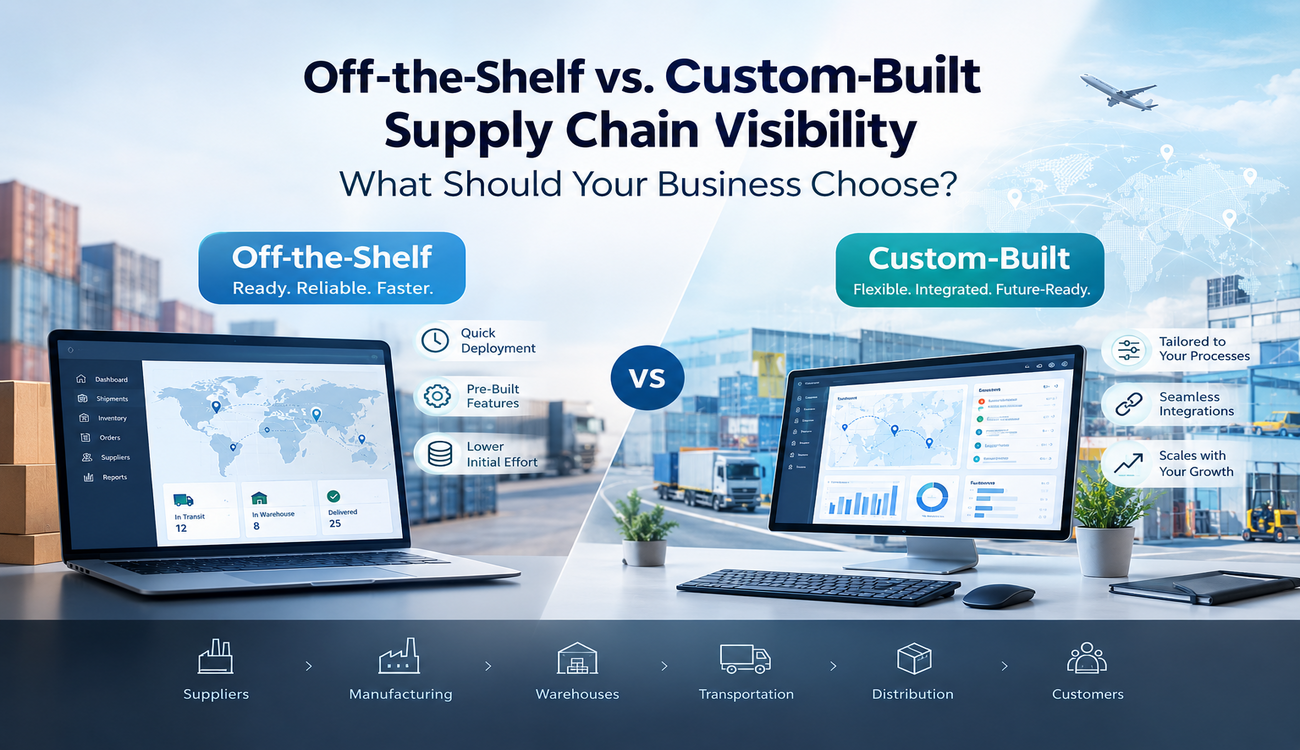
However, businesses often face an important decision when planning their visibility strategy: should they invest in an off-the-shelf platform or develop a custom-built solution? Both approaches can provide valuable capabilities, but they differ significantly in flexibility, implementation, scalability, integration, cost, and long-term control. Understanding these differences can help organizations select an approach that matches their operational requirements and future growth plans.
Understanding Supply Chain Visibility Requirements
Before comparing technology options, businesses need to understand what visibility actually means for their operations. Supply chain visibility goes beyond simply tracking shipments. It can involve monitoring inventory levels, purchase orders, supplier activities, transportation status, warehouse operations, delivery performance, and customer orders across the supply chain.
A modern Supply Chain Visibility Solution can connect information from different systems and provide a centralized view of supply chain activities. This allows organizations to identify delays, monitor exceptions, understand inventory movements, and access relevant information without depending on disconnected spreadsheets or manual updates.
The level of visibility required varies from one business to another. A small distributor with a relatively simple supply network may need basic shipment and inventory tracking, while a global manufacturer may require real-time visibility across suppliers, production facilities, logistics providers, warehouses, and regional distribution centers.
What is an Off-the-Shelf Supply Chain Visibility Platform?
These platforms generally come with pre-built features for tracking shipments, monitoring inventory, managing alerts, integrating data sources, and generating operational reports.
One of the main advantages of an off-the-shelf Supply Chain Visibility Solution is faster deployment. Because the core functionality has already been developed and tested, organizations can often begin implementation without building the entire technology foundation from the beginning. This can be particularly useful for companies that need visibility capabilities quickly.
Advantages of Off-the-Shelf Solutions
Off-the-shelf platforms can reduce the initial development effort because organizations purchase an existing product rather than creating a complete system internally. They may also provide standard integrations, dashboards, analytics capabilities, and user interfaces that can accelerate adoption.
Another benefit is predictable functionality. Businesses can evaluate demonstrations, documentation, and available features before making a purchase decision. Vendor support, product updates, security improvements, and maintenance services can also reduce the internal technical workload.
For companies with relatively standardized processes, an off-the-shelf Supply Chain Visibility Solution may provide sufficient functionality without requiring extensive customization. It can offer a practical starting point for organizations that want to improve supply chain transparency without undertaking a large software development project.
Limitations of Off-the-Shelf Solutions
The main limitation is that businesses may need to adjust their processes to fit the platform. Although many commercial products offer configuration options, their architecture and workflows are ultimately designed around a broad range of customers rather than one organization’s exact operating model.
Integration can also become complicated when a company uses legacy ERP systems, specialized warehouse applications, transportation management platforms, supplier portals, IoT devices, or internally developed software. If the required integration is not supported natively, additional development or middleware may be necessary.
Customization can create another challenge. As business requirements evolve, organizations may depend on the vendor’s product roadmap to determine which capabilities become available. This can limit control over specialized workflows and unique operational requirements.
What is a Custom-Built Supply Chain Visibility Solution?
A custom-built platform is developed specifically around an organization’s processes, technology environment, data requirements, and business objectives. Instead of adapting operations to a predefined product, the technology is designed to support the organization’s existing and future workflows.
A custom Supply Chain Visibility Solution can bring data from ERP, WMS, TMS, CRM, procurement systems, IoT devices, barcode systems, RFID infrastructure, APIs, and other enterprise applications into a centralized visibility environment.
Advantages of Custom Development
The biggest advantage of custom development is flexibility. For example, a manufacturer may require visibility from supplier procurement through production and final distribution, while an e-commerce company may prioritize warehouse inventory, order fulfillment, last-mile delivery, and returns.
Scalability is another important consideration. A well-designed Supply Chain Visibility Solution can be developed with an architecture that supports additional warehouses, suppliers, products, regions, users, data sources, and transactions as the organization expands.
Custom development can also provide greater control over integrations. Instead of relying entirely on standard connectors, businesses can build APIs and integration layers specifically for their technology ecosystem.
Challenges of Custom Development
Custom software generally requires more planning, development, testing, and implementation effort than adopting an existing product. Businesses must define requirements carefully and establish appropriate technical architecture before development begins.
The initial investment may also be higher because organizations are funding the creation of software specifically for their operational environment. A solution that closely matches operational needs can potentially reduce manual work and avoid repeated customization expenses associated with adapting generic software.
Off-the-Shelf vs. Custom-Built: Key Differences
The fundamental difference between the two approaches is flexibility. Off-the-shelf platforms generally provide faster access to standardized capabilities, while custom platforms provide greater control over functionality and workflows.
Implementation timelines can also differ. An off-the-shelf Supply Chain Visibility Solution may be deployed relatively quickly when the organization’s requirements closely match the product’s existing capabilities. Custom development usually requires additional time for discovery, architecture, development, integration, testing, training, and deployment.
Integration is another major difference. Off-the-shelf software may involve subscription, licensing, implementation, integration, and customization costs. Custom development may involve higher initial development costs but can provide greater ownership and control over the resulting platform.
How to Decide Which Approach Fits Your Business
The right approach depends largely on operational complexity and long-term requirements. Businesses should first examine how standardized or specialized their supply chain processes are.
If processes are relatively common and the required capabilities are already available in commercial platforms, an off-the-shelf solution may satisfy the organization’s immediate needs. It can provide a faster route toward better visibility while reducing the amount of software development required internally.
If the organization has highly specialized workflows, complex integrations, unique data requirements, or ambitious automation plans, custom development may provide more flexibility.
Consider Integration Complexity
Technology integration should be one of the most important evaluation criteria. Businesses should identify the systems that currently generate supply chain data and determine how easily each option can connect with them.
An organization using multiple ERP, WMS, TMS, procurement, inventory, IoT, RFID, and analytics platforms may require a sophisticated integration architecture. In such cases, the ability to create tailored APIs and data pipelines can become an important factor when selecting between off-the-shelf and custom approaches.
Consider Future Scalability
Businesses should also consider where their supply chain is heading rather than evaluating only today’s requirements. Expansion into new markets, additional warehouses, new suppliers, acquisitions, increasing order volumes, and emerging technologies can change visibility requirements significantly.
A scalable Supply Chain Visibility Solution should be capable of supporting these changes without forcing organizations to repeatedly replace or restructure their core visibility infrastructure.
Hybrid Approaches Can Also Be Considered
Some businesses adopt a hybrid approach in which they use an established platform as the foundation while developing custom components for specialized requirements.
For example, a company could use an existing visibility platform for standard shipment monitoring while developing custom integration layers, analytics dashboards, supplier workflows, or exception-management capabilities. This approach can provide a balance between deployment speed and customization.
A hybrid Supply Chain Visibility Solution can be particularly useful when an organization wants to modernize gradually instead of replacing its entire technology ecosystem at once. It can allow businesses to address the most important visibility gaps first and expand capabilities over time.
Building a Long-Term Visibility Strategy
Technology selection should ultimately support a broader supply chain strategy. Businesses need to think about data quality, integration, user adoption, security, analytics, automation, and governance alongside software functionality.
The objective is not simply to collect more supply chain data. The objective is to make relevant information accessible to the right people at the right time so they can identify problems and respond effectively.
An effective Supply Chain Visibility Solution should therefore support actionable visibility rather than simply producing large volumes of dashboards and reports. Real-time alerts, exception management, predictive analytics, automated workflows, and intelligent recommendations can help organizations move from monitoring supply chain activities toward proactive management.
Conclusion
Off-the-shelf and custom-built platforms both have a place in modern supply chain technology strategies. Off-the-shelf products can provide faster implementation, established functionality, and potentially lower initial development requirements, while custom platforms can provide greater flexibility, integration control, and alignment with specialized business processes.
The decision should be based on the organization’s current technology environment, supply chain complexity, integration requirements, scalability expectations, budget, internal capabilities, and long-term digital strategy. For businesses with standardized needs, an existing platform may provide the required visibility efficiently. For organizations with complex or highly differentiated operations, custom development can offer greater control and adaptability.
Ultimately, the most effective Supply Chain Visibility Solution is one that connects relevant data, supports operational decision-making, integrates effectively with existing systems, and can evolve as the business and supply chain continue to change.
Frequently Asked Questions
Q1. What is a Supply Chain Visibility Solution?
A Supply Chain Visibility Solution provides businesses with a centralized view of supply chain activities such as inventory, orders, shipments, suppliers, warehouses, and transportation. It helps teams access timely information and identify potential delays or operational issues.
Q2. What is the difference between off-the-shelf and custom-built supply chain visibility?
An off-the-shelf platform provides pre-built functionality designed for common supply chain requirements, while a custom-built system is developed around a company’s specific processes, integrations, workflows, and business objectives.
Q3. When should a business choose a custom Supply Chain Visibility Solution?
A custom Supply Chain Visibility Solution may be suitable when a business has complex workflows, specialized operational requirements, multiple legacy systems, or integration needs that cannot be adequately addressed by standard commercial platforms.
Q4. Are off-the-shelf supply chain visibility platforms easier to implement?
Generally, off-the-shelf platforms can be implemented faster because their core functionality is already developed. However, the actual implementation timeline depends on the organization’s data sources, integrations, customization requirements, infrastructure, and user adoption needs.
Q5. Can a Supply Chain Visibility Solution scale as a business grows?
Yes. A properly designed Supply Chain Visibility Solution can support increasing transaction volumes, additional suppliers, warehouses, users, locations, and data sources.
