
Indian manufacturing is rapidly evolving under the pressure of globalization, stricter compliance requirements, changing consumer expectations, and increasing operational complexity. Businesses today are expected to provide complete visibility into product movement, sourcing, quality, and delivery timelines across the entire value chain. This growing demand for transparency has made supply chain traceability solutions an essential part of modern manufacturing operations. Whether it is the pharmaceutical industry tracking medicine authenticity, food companies ensuring safety standards, or automotive manufacturers monitoring component quality, traceability has become a strategic requirement rather than an optional capability.
Manufacturers across India are now investing in intelligent digital systems that can monitor products from raw material sourcing to final delivery. These technologies help organizations identify operational bottlenecks, reduce losses, improve compliance, and enhance customer trust. As government regulations become more stringent and global buyers demand higher accountability, enterprises are realizing that digital traceability directly impacts competitiveness and long-term growth. Companies that fail to modernize their operations often struggle with inventory inaccuracies, delayed recalls, supplier inconsistencies, and lack of real-time visibility.
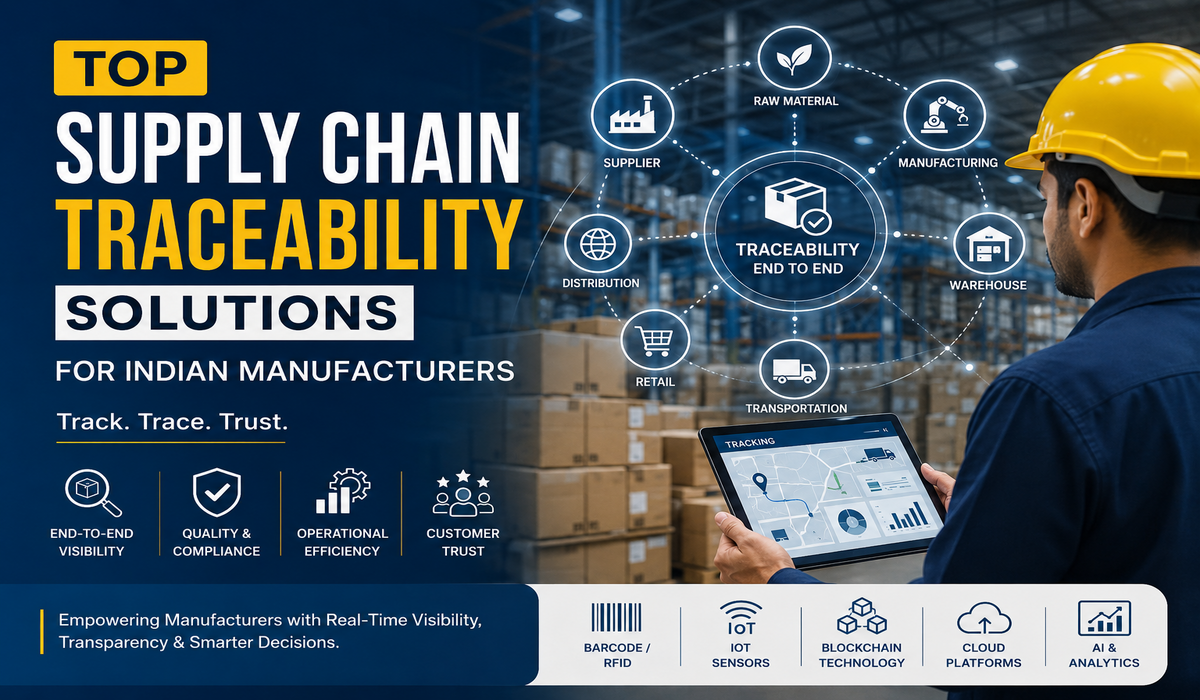
The concept of traceability in manufacturing refers to the ability to track every stage of a product lifecycle. It includes monitoring the origin of materials, production stages, warehouse movement, transportation activities, and delivery information. Modern digital systems combine technologies such as RFID, IoT, barcode scanning, blockchain, GPS, cloud platforms, and analytics to create transparent and connected ecosystems. These systems help businesses build resilient supply chains capable of adapting to disruptions, quality issues, and changing market demands.
For Indian manufacturers competing in both domestic and international markets, implementing traceability systems is no longer only about operational efficiency. It is also about meeting export requirements, improving customer confidence, protecting brand reputation, and enabling data-driven decision-making. Industries including food processing, textiles, automotive, pharmaceuticals, electronics, chemicals, and logistics are increasingly adopting advanced tracking technologies to streamline operations and improve accountability.
Understanding Modern Traceability in Manufacturing
Traceability in manufacturing is a critical part of modern supply chain traceability solutions because it enables businesses to record and monitor every activity associated with products, materials, and operational workflows. It creates a digital trail that allows manufacturers to identify where a product originated, how it was processed, who handled it, where it was stored, and how it reached customers. This level of transparency enables businesses to maintain quality standards while minimizing operational risks.
Traditional paper-based systems and disconnected spreadsheets are no longer sufficient for modern industrial environments. Manufacturers today deal with large supplier networks, multiple production units, cross-border shipments, and complex compliance regulations. Manual systems often create data silos that lead to delays, inaccuracies, and poor visibility. Digital transformation has therefore become critical for businesses aiming to achieve operational excellence.
Advanced traceability platforms collect real-time data from connected devices, machines, and enterprise applications. Information is centralized through cloud-based systems that provide actionable insights to management teams. Manufacturers can instantly identify product movement, detect irregularities, and respond to disruptions before they escalate into major operational problems. This visibility improves productivity while supporting strategic planning and forecasting.
The adoption of smart manufacturing practices in India has further accelerated the demand for digital monitoring systems. Government initiatives encouraging industrial modernization and Industry 4.0 adoption are motivating enterprises to deploy connected technologies across factories and warehouses. As a result, traceability is now viewed as a foundational pillar of intelligent manufacturing ecosystems.
Why Supply Chain Traceability Solutions Matter for Indian Manufacturers
The importance of supply chain traceability solutions has grown significantly due to changing industry expectations and increasing business risks. Manufacturers are under constant pressure to improve operational transparency while maintaining cost efficiency and product quality. Without accurate tracking systems, businesses struggle to identify the source of operational failures, defective products, or supply disruptions.
Indian manufacturers dealing with exports must comply with international standards related to safety, sustainability, and product authenticity. Buyers from global markets often require detailed information regarding sourcing, manufacturing conditions, and shipment history. A lack of visibility can lead to compliance penalties, shipment rejections, and damaged business relationships. Traceability systems help companies maintain detailed digital records that simplify audits and regulatory reporting.
Product recalls are another major concern across industries such as pharmaceuticals, food processing, and electronics. Without accurate tracking systems, businesses may face significant delays in identifying affected products. This can increase financial losses and negatively impact brand reputation. Digital monitoring systems enable faster root cause analysis and more targeted recall management, reducing operational disruption.
Consumer expectations have also changed dramatically. Modern customers want assurance regarding product authenticity, ethical sourcing, and quality standards. Transparent operational practices help manufacturers build stronger trust and long-term customer loyalty. Companies capable of providing accurate product history often gain a competitive advantage in both domestic and international markets.
In addition to compliance and customer trust, traceability systems improve operational efficiency. Businesses gain real-time visibility into inventory movement, production performance, transportation status, and warehouse operations. This helps management teams make faster and more informed decisions while reducing waste, delays, and manual errors.
Core Technologies Driving Traceability Systems
Modern manufacturing environments rely on multiple technologies working together to create transparent and intelligent operational ecosystems. These supply chain traceability solutions help manufacturers automate data collection, improve accuracy, and achieve real-time visibility across operations.
RFID technology has become one of the most widely adopted solutions for industrial tracking. RFID tags enable automatic identification and monitoring of products, pallets, and assets without requiring manual scanning. This improves inventory accuracy and speeds up warehouse operations. Industries with large-scale inventory movement particularly benefit from RFID implementation because it reduces labor dependency and minimizes tracking errors.
Barcode systems continue to play a major role in manufacturing operations due to their affordability and simplicity. Advanced barcode integration allows businesses to monitor inventory movement, production batches, and shipment activities in real time. Barcode-based systems are especially useful for small and medium-sized manufacturers looking for cost-effective digital transformation strategies.
Internet of Things technology enables connected devices and sensors to collect operational data continuously. Sensors installed across factories, vehicles, and storage facilities provide real-time information regarding temperature, humidity, equipment performance, and product movement. This is particularly important for industries such as pharmaceuticals and food processing where environmental conditions directly impact product quality.
Blockchain technology is emerging as a powerful tool for creating tamper-proof digital records. It enhances trust and transparency by ensuring that operational data cannot be altered once recorded. Manufacturers dealing with high-value goods, export operations, or sensitive compliance requirements increasingly explore blockchain-enabled systems for secure traceability.
Cloud computing has transformed how enterprises manage operational data. Cloud-based platforms centralize information from multiple locations, enabling remote access and real-time analytics. Businesses can monitor operations across factories, warehouses, and transportation networks through a single integrated dashboard.
Artificial intelligence and analytics further strengthen operational visibility by converting raw data into meaningful insights. Predictive analytics helps organizations forecast disruptions, identify inefficiencies, and optimize supply chain planning. AI-driven systems also support automated quality checks and anomaly detection.
Top Supply Chain Traceability Solutions Used in India
Indian manufacturers are adopting a wide range of technologies and enterprise platforms to improve visibility and operational control. The choice of system depends on industry requirements, operational scale, compliance needs, and digital maturity levels.
ERP-integrated traceability platforms are among the most preferred solutions because they connect procurement, production, warehousing, logistics, and finance within a single ecosystem. These platforms help organizations eliminate data silos while improving coordination across departments. Real-time visibility enables businesses to monitor inventory levels, production schedules, and shipment activities more effectively.
Warehouse management systems are widely used by manufacturers dealing with large inventory volumes. These platforms improve stock visibility, optimize storage utilization, and automate material movement tracking. Integration with RFID and barcode systems further enhances operational accuracy and efficiency.
Transportation management platforms help businesses monitor fleet movement, delivery schedules, and shipment conditions in real time. GPS integration allows enterprises to improve route optimization, reduce transportation delays, and enhance delivery reliability. Manufacturers handling sensitive goods also use environmental monitoring systems to maintain product integrity during transit.
Blockchain-based tracking systems are increasingly adopted in sectors requiring high transparency and authenticity verification. These platforms create immutable records of sourcing, manufacturing, and distribution activities. Industries such as food processing, pharmaceuticals, and luxury goods particularly benefit from blockchain-enabled visibility.
IoT-enabled monitoring systems provide continuous operational insights through connected sensors and smart devices. These solutions help businesses detect equipment failures, monitor warehouse conditions, and improve predictive maintenance strategies. Real-time alerts enable faster response to operational disruptions and quality concerns.
Step-by-Step Approach to Implementing Traceability Systems
Step 1: Evaluate Existing Operational Challenges
The first step in implementing supply chain traceability solutions involves identifying operational gaps, inefficiencies, and visibility limitations within the organization. Manufacturers should assess how inventory is tracked, how production data is recorded, and how information flows across departments. Understanding these challenges helps businesses define clear implementation goals while ensuring the selected traceability strategy aligns with operational and compliance requirements.
Step 2: Define Business Objectives
Organizations must determine what they want to achieve through digital traceability. Some companies focus on compliance management, while others prioritize inventory optimization, quality control, or customer transparency. Clear objectives help businesses select the most suitable technologies and implementation strategies.
Step 3: Choose the Right Technology Stack
Selecting appropriate technologies is critical for successful implementation. Businesses should evaluate RFID systems, IoT platforms, cloud applications, analytics tools, and ERP integrations based on operational requirements and scalability needs. Technology decisions should align with long-term business growth plans.
Step 4: Integrate Data Across Departments
Disconnected systems create visibility gaps and operational inefficiencies. Manufacturers should integrate procurement, production, warehousing, transportation, and quality management into a centralized ecosystem. Unified data improves coordination and enables better decision-making.
Step 5: Train Employees and Operational Teams
Successful implementation depends heavily on workforce adoption. Employees should understand how digital systems function and how accurate data entry impacts operational performance. Proper training minimizes resistance and improves overall system effectiveness.
Step 6: Monitor Performance and Optimize Continuously
Traceability systems require continuous monitoring and improvement. Businesses should analyze operational data regularly to identify bottlenecks, inefficiencies, and opportunities for optimization. Continuous improvement ensures long-term return on investment and operational scalability.
Business Benefits of Digital Traceability
Modern supply chain traceability solutions deliver significant operational and strategic advantages for manufacturers operating in competitive markets. One of the most important benefits is improved operational visibility. Businesses gain real-time access to inventory movement, production activities, and shipment status, enabling faster decision-making and better coordination.
Quality management also improves significantly because businesses can identify production issues at their source. This minimizes defective products and reduces the risk of large-scale recalls. Faster issue resolution protects both brand reputation and customer trust.
Regulatory compliance becomes easier through automated documentation and digital recordkeeping. Manufacturers can generate audit reports quickly while maintaining accurate historical records for inspections and certifications. This reduces administrative burden and compliance risks.
Inventory optimization is another major advantage. Real-time monitoring reduces overstocking, stockouts, and material wastage. Better inventory control improves cash flow while enhancing warehouse efficiency.
Customer satisfaction improves because businesses can provide accurate shipment information and product authenticity verification. Transparent operations help strengthen customer relationships and create long-term loyalty.
Operational automation further reduces manual errors and labor dependency. Automated tracking systems increase efficiency while allowing employees to focus on higher-value activities such as strategic planning and process optimization.
Real-World Use Cases in Indian Manufacturing
The pharmaceutical industry in India relies heavily on digital tracking systems to ensure drug authenticity and regulatory compliance. Manufacturers use serialization, barcode systems, and cloud-based monitoring platforms to track medicines across the supply chain. This helps prevent counterfeit products while maintaining patient safety standards.
Food processing companies implement IoT-enabled monitoring systems to maintain quality during storage and transportation. Temperature-sensitive goods require continuous environmental monitoring to ensure freshness and compliance with food safety regulations. Real-time alerts help businesses prevent spoilage and operational losses.
Automotive manufacturers use RFID and analytics platforms as part of advanced supply chain traceability solutions to monitor component movement across production facilities. These systems improve inventory management while reducing delays in assembly operations. Real-time visibility also enhances supplier coordination, production planning, and operational efficiency across the manufacturing ecosystem.
Textile manufacturers increasingly adopt digital traceability to support sustainability initiatives and export compliance. Buyers from international markets often require transparency regarding sourcing practices and production conditions. Digital monitoring systems help businesses meet these expectations while strengthening brand credibility.
Electronics manufacturers use advanced monitoring technologies to improve quality assurance and reduce production defects. Connected systems provide detailed visibility into component sourcing, assembly stages, and shipment tracking, ensuring higher operational accuracy.
Common Challenges and Best Practices
Despite the benefits, implementing traceability systems can present several challenges for manufacturers. One common issue is resistance to digital transformation. Employees accustomed to traditional processes may hesitate to adopt new technologies. Businesses must therefore focus on proper training and change management strategies.
High initial investment costs can also discourage smaller manufacturers. However, scalable cloud-based platforms and phased implementation approaches help businesses manage costs more effectively. Organizations should prioritize long-term operational benefits rather than focusing only on short-term expenses.
Data integration is another major challenge because many manufacturers operate with disconnected legacy systems. Businesses should choose flexible platforms capable of integrating with existing enterprise applications. Smooth integration improves visibility while minimizing operational disruption.
Cybersecurity concerns are becoming increasingly important as businesses adopt connected technologies. Manufacturers must ensure that operational data remains secure through strong cybersecurity frameworks, encrypted communication channels, and access control policies.
Successful implementation requires strong leadership support, clear objectives, continuous monitoring, and employee engagement. Businesses should also collaborate with experienced technology partners capable of providing customized solutions aligned with industry-specific requirements.
Future Trends Shaping Traceability in India
The future of manufacturing in India will be heavily influenced by intelligent automation, predictive analytics, and connected ecosystems. Industry 4.0 adoption is accelerating the integration of IoT, artificial intelligence, robotics, and cloud computing into manufacturing environments. These technologies will further enhance operational visibility and automation, making supply chain traceability solutions a critical component of next-generation manufacturing infrastructure.
Blockchain adoption is expected to increase significantly as businesses seek more secure and transparent operational frameworks. Immutable digital records will become increasingly important for industries dealing with exports, compliance, and authenticity verification.
Artificial intelligence will continue transforming operational decision-making through predictive insights and automated process optimization. AI-driven analytics will help manufacturers forecast disruptions, optimize inventory planning, and improve production efficiency.
Sustainability and ESG reporting will also play a major role in future traceability strategies. Businesses will increasingly need to provide visibility into carbon emissions, ethical sourcing, and environmental impact. Digital monitoring systems will help organizations meet these evolving expectations.
Government initiatives supporting smart manufacturing and digital transformation are expected to further accelerate adoption across Indian industries. Small and medium-sized enterprises will increasingly invest in affordable cloud-based platforms to remain competitive in modern markets.
Conclusion
As Indian manufacturing becomes increasingly competitive and digitally driven, businesses must focus on operational transparency, compliance, and real-time visibility to remain future-ready. Modern supply chain traceability solutions help manufacturers improve efficiency, strengthen quality management, reduce operational risks, and build stronger customer trust. From RFID and IoT to blockchain and AI-driven analytics, these technologies are transforming how enterprises manage production and logistics ecosystems.
People Also Ask (FAQs)
What are supply chain traceability solutions?
Supply chain traceability solutions are digital systems and technologies that help businesses track products, materials, and operational activities throughout the manufacturing and distribution process. These systems provide real-time visibility into sourcing, production, inventory, transportation, and delivery operations. Manufacturers use technologies such as RFID, IoT sensors, barcodes, GPS, blockchain, and cloud platforms to improve transparency and operational efficiency. These solutions help organizations reduce errors, improve compliance, manage recalls efficiently, and strengthen customer trust through accurate product tracking and reporting capabilities.
Why is traceability important for Indian manufacturers?
Traceability is important because it improves operational visibility, quality management, and regulatory compliance. Indian manufacturers dealing with exports often need detailed records related to sourcing, production, and logistics activities. Digital monitoring systems help businesses reduce inventory inaccuracies, improve recall management, and maintain product quality standards. Traceability also supports customer transparency and brand credibility. As industries move toward Industry 4.0 practices, businesses with strong tracking capabilities gain a competitive advantage by improving operational efficiency and decision-making.
Which industries benefit the most from traceability systems?
Industries such as pharmaceuticals, food processing, automotive, electronics, textiles, logistics, and chemicals benefit significantly from advanced tracking technologies. Pharmaceutical companies use these systems to prevent counterfeit medicines and maintain compliance. Food manufacturers rely on environmental monitoring for quality assurance. Automotive companies improve component tracking and production efficiency through digital systems. Textile exporters use traceability to support sustainability and ethical sourcing requirements. Electronics manufacturers strengthen quality control and defect management through connected operational ecosystems.
What technologies are commonly used for manufacturing traceability?
Modern manufacturing environments use technologies such as RFID tags, barcode scanners, IoT sensors, cloud computing platforms, blockchain systems, GPS tracking, artificial intelligence, and analytics software. RFID enables automatic product identification, while IoT sensors provide real-time operational monitoring. Cloud platforms centralize data from multiple locations for better visibility. Blockchain creates secure and tamper-proof digital records. AI and analytics tools help businesses identify inefficiencies, forecast disruptions, and improve decision-making capabilities across operations.
How does traceability improve supply chain efficiency?
Traceability improves efficiency by providing real-time operational visibility and reducing manual errors. Businesses can monitor inventory movement, production activities, warehouse operations, and shipment status more accurately. This reduces delays, inventory losses, and operational bottlenecks. Automated systems also improve coordination between suppliers, manufacturers, warehouses, and logistics providers. Faster issue detection and response help organizations minimize downtime and improve productivity. Better data visibility further supports strategic planning and resource optimization.
What challenges do manufacturers face when implementing traceability systems?
Manufacturers often face challenges related to high implementation costs, employee resistance, data integration issues, and cybersecurity concerns. Legacy systems can create integration difficulties, while workforce adaptation may require extensive training. Smaller businesses sometimes hesitate due to budget limitations. However, scalable cloud-based solutions and phased implementation approaches help reduce these challenges. Successful implementation requires strong leadership support, employee engagement, technology expertise, and continuous optimization strategies.
Can small manufacturers adopt digital traceability systems?
Yes, small manufacturers can adopt scalable and cost-effective digital platforms based on their operational needs. Cloud-based software, barcode systems, and mobile-enabled applications make implementation more affordable than traditional enterprise infrastructure. Small businesses can begin with basic inventory tracking and gradually expand capabilities as operations grow. Modern platforms are designed to support scalability, allowing manufacturers to improve visibility and efficiency without major infrastructure investments.
