
The automotive industry has become increasingly dependent on accurate vehicle movement and delivery information. From the moment a vehicle leaves the manufacturing facility to the time it reaches a dealership or customer, companies need visibility into its location, status, and delivery progress. This is where VIN Tracking plays an important role.
A Vehicle Identification Number, commonly known as a VIN, is a unique identifier assigned to every vehicle. By connecting this identifier with logistics, inventory, GPS, and transportation systems, automotive companies can monitor individual vehicles throughout the delivery journey. Instead of relying on spreadsheets, phone calls, or disconnected systems, businesses can create a more transparent view of where each vehicle is and what stage of delivery it has reached.
What is VIN Tracking?
VIN Tracking is the process of using a vehicle’s unique identification number to monitor its movement, status, and delivery information across the automotive supply chain. Since every vehicle has a unique VIN, companies can associate important information with a specific vehicle and follow it from production through transportation and final delivery.
The VIN can be connected with manufacturing records, inventory databases, transportation management systems, GPS data, dealership platforms, and other logistics applications. This creates a digital trail that helps automotive companies understand the current status of individual vehicles.
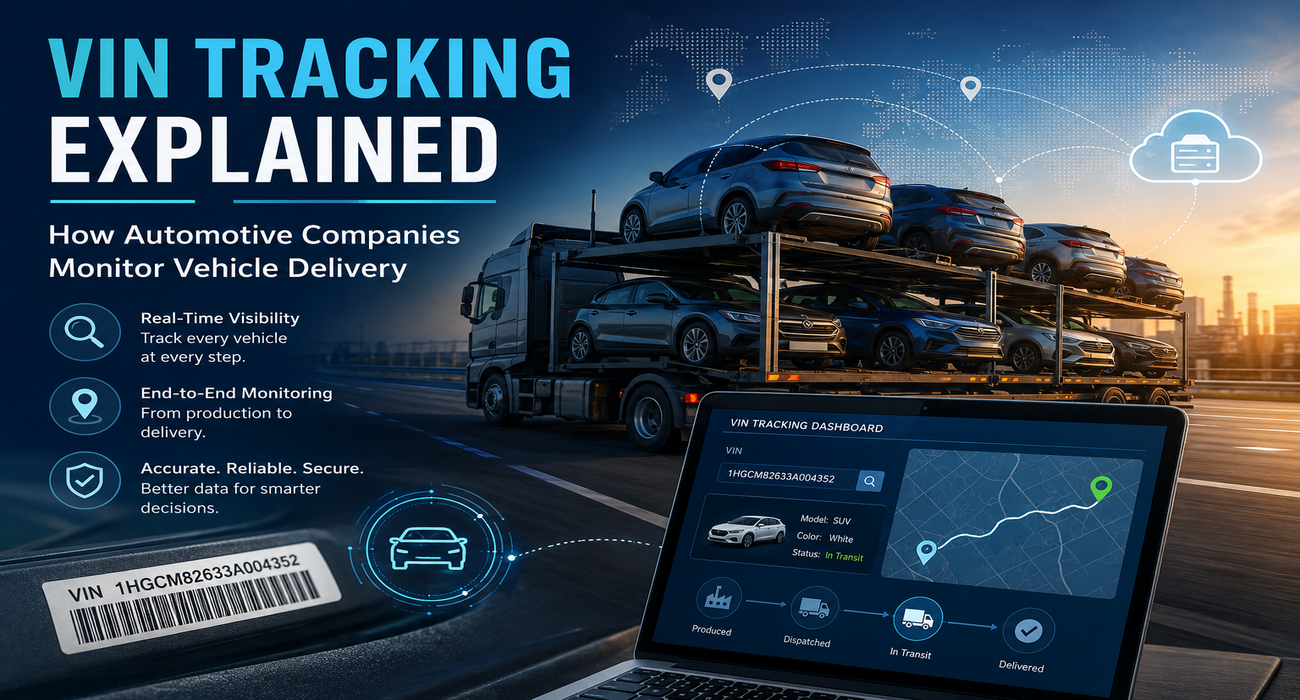
For example, when a vehicle is completed at a manufacturing plant, its VIN can be registered in the company’s tracking system. As the vehicle moves to a distribution center, the system can update its status. When it is loaded onto a carrier, transported to another location, and eventually delivered to a dealership, each stage can be recorded against the same VIN.
Why Is the VIN Important in Vehicle Logistics?
Vehicle logistics can involve thousands of vehicles moving between different locations. Without a unique identifier, it becomes difficult to distinguish between similar vehicles, especially when they belong to the same model and specification.
The VIN provides a consistent identity for each vehicle. It can help businesses connect manufacturing information with logistics events, shipment records, inspection details, and delivery confirmations. This makes the vehicle easier to identify throughout its journey and reduces confusion caused by duplicate or incomplete records.
How VIN Tracking Works in Automotive Delivery
The process of VIN Tracking typically begins when a vehicle receives its identification record within the manufacturer’s system. The VIN becomes the reference point for information collected during production, storage, transportation, and delivery.
When the vehicle leaves the manufacturing facility, its status can be updated in the tracking platform. Transportation information can then be associated with the VIN, allowing logistics teams to understand where the vehicle is being transported and which stage of the journey it has reached.
Tracking Vehicles From Manufacturing to Distribution
Once manufacturing is completed, vehicles may remain at a plant or move to an outbound yard. At this stage, the VIN can be scanned and associated with the vehicle’s current location and status.
When vehicles are transferred to a distribution center, another scan or system update can confirm the movement. This creates a digital record of the vehicle’s journey and helps companies maintain better visibility across multiple facilities.
Monitoring Transportation and Delivery
During transportation, automotive companies can combine VIN information with carrier and GPS data. This allows logistics teams to connect a specific vehicle with its transportation journey.
For example, a company may know that a vehicle with a particular VIN has been assigned to a carrier and is moving toward a specific dealership. If the delivery is delayed, the team can investigate the shipment rather than manually searching through multiple records.
The same information can also be shared with dealerships and other authorized stakeholders, creating greater transparency throughout the delivery process.
Key Benefits of VIN Tracking for Automotive Companies
VIN Tracking can improve several areas of automotive logistics by connecting vehicle identity with real-time or regularly updated operational information. The benefits become particularly valuable for manufacturers, logistics providers, dealerships, rental companies, and large automotive distributors.
Improved Vehicle Visibility
One of the biggest advantages is improved visibility. Automotive companies can determine where a specific vehicle is located and what stage of the delivery process it has reached.
Instead of asking different departments for updates, logistics teams can use a centralized system to access vehicle information. This can make it easier to identify vehicles waiting at manufacturing plants, distribution centers, yards, or dealerships.
Better Delivery Management
Vehicle deliveries involve multiple stages, and delays at one stage can affect the entire process. VIN Tracking helps companies monitor these stages more effectively.
When a vehicle does not move as expected, the system can provide information that helps logistics teams investigate the issue. This can support faster decision-making and improve delivery coordination.
Reduced Manual Data Entry
Traditional vehicle tracking processes often depend on spreadsheets, paperwork, phone calls, and manual updates. These methods can create inconsistencies and consume valuable employee time.
By connecting VIN records with digital tracking systems, companies can automate many status updates and reduce repetitive data entry. This can improve data accuracy while allowing employees to focus on higher-value logistics activities.
More Accurate Inventory Management
Automotive inventory changes constantly as vehicles are manufactured, transported, sold, transferred, or delivered. VIN-based identification gives businesses a more precise way to track individual vehicles.
Instead of viewing inventory only by model or quantity, companies can identify the exact vehicles available at a particular location. This can help improve inventory planning and reduce the possibility of misplaced or incorrectly recorded vehicles.
Technologies Used With VIN Tracking
Modern VIN Tracking systems can use several technologies to improve the accuracy and speed of vehicle monitoring. The specific combination depends on the company’s operational requirements and logistics environment.
Barcode and QR Code Scanning
Barcode and QR code technologies can be used to quickly identify vehicles and update their status. Employees can scan a code associated with the VIN when a vehicle enters or leaves a facility.
GPS and Telematics
GPS technology can provide location information for vehicles while they are being transported or operated. When combined with VIN data, GPS information can provide a clearer picture of where an individual vehicle is located.
Telematics systems can add additional vehicle information, depending on the available technology and integration. This can help logistics teams monitor transportation more effectively.
RFID Technology
RFID can support automated identification and movement tracking in facilities where vehicles pass through designated checkpoints.
For large automotive facilities, this can improve operational efficiency and create more consistent movement records. RFID tags or associated identification systems can help organizations capture vehicle movements without requiring manual data entry at every stage.
Cloud-Based Tracking Platforms
Cloud-based platforms can bring VIN information, transportation records, location data, inventory information, and delivery updates into a centralized environment.
This allows authorized users across different locations to access the same information. It can be especially useful for automotive organizations operating multiple manufacturing plants, warehouses, yards, dealerships, or logistics networks.
VIN Tracking and Real-Time Vehicle Visibility
Real-time visibility has become increasingly important as automotive supply chains become more complex. Customers and dealerships expect accurate information about vehicle availability and delivery timelines.
A VIN-based tracking platform can provide a detailed view of individual vehicle movements when it is integrated with appropriate location and logistics technologies. Instead of simply knowing that a shipment is “in transit,” businesses can potentially determine its current location, transportation status, and expected delivery stage.
Using VIN Data for Delivery Alerts
VIN Tracking can also support automated notifications. When a vehicle reaches a particular milestone, the system can trigger an update for the relevant team.
These alerts can reduce the need for teams to repeatedly check the status manually.
Challenges in Implementing VIN Tracking
Although VIN Tracking can provide significant operational benefits, implementation requires careful planning. Automotive companies often operate with multiple software platforms, logistics partners, transportation providers, and physical locations.
Integrating Multiple Systems
One of the biggest challenges is connecting VIN information with existing enterprise systems. Manufacturing software, ERP platforms, transportation management systems, dealership applications, GPS platforms, and inventory databases may all store different information.
A successful implementation needs reliable integration so that vehicle information can move between systems without creating duplicate or inconsistent records.
Maintaining Data Accuracy
VIN Tracking depends heavily on accurate data. Incorrect VIN entries, missed scans, outdated status information, or integration errors can reduce the reliability of the tracking system.
Companies therefore need standardized processes for capturing and updating vehicle information throughout the delivery lifecycle.
Managing Large-Scale Vehicle Operations
Large automotive companies may need to monitor thousands or even millions of vehicles across different locations. The tracking platform must be capable of handling large volumes of vehicle records and frequent updates without affecting performance.
Scalability is therefore an important consideration when selecting or developing a VIN tracking solution.
How Automotive Companies Can Improve VIN Tracking
Companies should first identify the stages of the vehicle lifecycle where visibility is most important. Integrating VIN information with GPS, RFID, barcode scanning, inventory systems, and transportation platforms can create a more complete picture of vehicle movement.
Companies should also establish clear data standards so that every facility and logistics partner records vehicle information consistently. Regular monitoring can help identify gaps and improve the tracking process over time.
The Future of VIN Tracking in Automotive Logistics
The future of VIN Tracking is likely to become increasingly connected with artificial intelligence, IoT, automation, and advanced analytics. As automotive supply chains generate more data, companies can use this information to move beyond basic vehicle location tracking.
AI-powered systems could analyze historical delivery information to identify potential delays and predict expected delivery times. IoT technologies could provide additional vehicle and transportation information, while automated workflows could update vehicle statuses without requiring constant manual intervention.
Advanced analytics can also help automotive companies identify recurring transportation bottlenecks, improve route planning, optimize inventory distribution, and understand delivery performance across different regions.
As electric vehicles, connected vehicles, and digitally managed automotive ecosystems continue to expand, having a reliable digital identity for every vehicle will become even more important.
Conclusion
VIN Tracking provides automotive companies with a structured way to monitor individual vehicles throughout their delivery journey. By connecting the unique VIN with inventory, transportation, GPS, RFID, barcode, and enterprise systems, organizations can gain better visibility into vehicle movement and delivery status.
For manufacturers, logistics providers, dealerships, and distributors, this visibility can support better inventory management, reduce manual processes, improve delivery coordination, and provide more accurate information to stakeholders.
As automotive logistics continues to become more connected and data-driven, VIN Tracking will play an increasingly important role in creating transparent, efficient, and technology-enabled vehicle delivery operations.
