
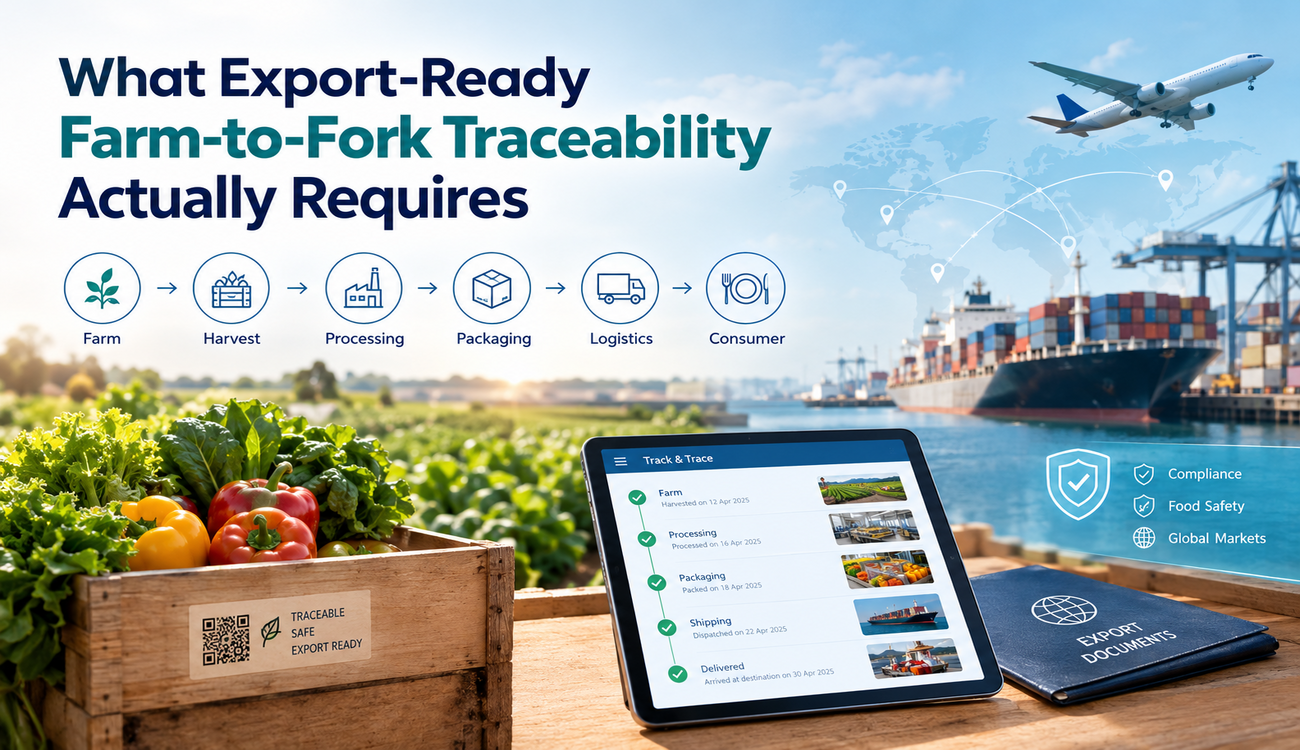
Food exports are no longer judged only by product quality, competitive pricing, and timely delivery. International buyers increasingly expect exporters to demonstrate where their products originated, how they were produced, how they were handled, and whether every stage of the supply chain meets applicable food safety and traceability requirements. For agricultural producers, food processors, exporters, and distributors, maintaining this level of visibility requires more than invoices and paper-based records.
A reliable Farm to Fork Traceability Solution helps businesses connect information from farms, collection centers, processing facilities, warehouses, transportation networks, and international buyers. It creates a structured record of a product’s journey, making it easier to verify its origin, monitor handling conditions, respond to food safety concerns, and provide supporting documentation during export inspections.
However, export readiness involves more than implementing traceability software. Businesses must establish consistent data collection practices, standardize product identification, maintain reliable supplier records, integrate operational systems, and ensure that traceability information remains accessible throughout the product lifecycle. Understanding these requirements is essential for organizations seeking to strengthen buyer confidence and expand into international markets.
What Does Export-Ready Farm-to-Fork Traceability Mean?
Export-ready traceability means a business can demonstrate the movement and transformation of a food product from its original source to its final destination through accurate, verifiable, and accessible records. These records should establish the identity of the product, its production history, the organizations that handled it, and the relevant events that occurred along the supply chain.
For example, an exporter shipping fresh mangoes to an overseas retailer should be able to identify the farms that supplied the fruit, the harvesting dates, the collection batches, the packing facility, the shipment details, and the destination. If a quality concern arises, the exporter should be able to identify the affected batches without manually reviewing hundreds of disconnected documents.
A Farm to Fork Traceability Solution supports this process by connecting information across supply chain participants and maintaining relationships between raw materials, production batches, finished products, and shipments. This visibility helps businesses demonstrate accountability while improving their ability to investigate discrepancies and respond to buyer requests.
Export readiness also depends on the destination market, product category, and applicable regulations. Requirements can differ between fresh produce, processed foods, meat, seafood, dairy products, and packaged agricultural commodities. Therefore, traceability processes must reflect the actual obligations associated with each product and export market.
Why Exporters Need More Than Basic Traceability
International Buyers Expect Verifiable Product Information
International buyers increasingly need reliable information about product origin, handling, quality controls, and supplier practices. Importers, retailers, and food manufacturers may request supporting records before approving suppliers or accepting shipments.
A spreadsheet containing supplier names and purchase dates may provide basic information, but it may not establish a complete connection between a farm, a specific batch, a processing operation, and an exported shipment. Missing links can create delays during audits and make it difficult to investigate product quality concerns.
A well-designed Farm to Fork Traceability Solution helps exporters maintain consistent records and retrieve relevant information when buyers, auditors, or regulatory authorities request verification. It also supports more transparent business relationships by reducing dependence on informal communication and fragmented documentation.
Food Safety Incidents Require Rapid Responses
Food safety concerns can arise from contamination, incorrect storage conditions, undeclared allergens, pesticide residue findings, or inadequate handling practices. When such concerns affect an exported product, businesses may need to identify the affected batches, determine where they were distributed, and provide accurate information to relevant stakeholders.
Without connected traceability records, investigations can become time-consuming and may result in unnecessarily broad product withdrawals or recalls. A connected system helps businesses narrow the investigation to the relevant lots and establish which products may have been affected.
Documentation Must Match the Physical Shipment
Export documentation must accurately reflect the products being shipped. Differences between batch identifiers, quantities, packaging records, supplier information, and shipment documents can create questions during inspection or customs clearance.
Traceability processes should connect product records with packing lists, invoices, shipment references, certificates, and other documents required for the relevant product and destination. Digital records can improve consistency, but they do not replace official certificates or declarations where authorities require them.
Essential Requirements for Export-Ready Farm-to-Fork Traceability
1. Reliable Farm and Supplier Identification
The traceability process begins with identifying the farms, growers, cooperatives, collection centers, and other suppliers involved in production. Each participant should have a consistent identifier that can be connected to purchasing, harvesting, inspection, and delivery records.
Supplier information may include farm location, registration details where applicable, crop variety, production period, and relevant certification records. Businesses should also establish procedures for verifying this information and updating it when supplier circumstances change.
A Farm to Fork Traceability Solution can centralize supplier records and connect each delivery to its original source. This makes it easier to determine which farms contributed to a particular batch and whether the necessary supplier documentation is available.
2. Standardized Batch and Lot Identification
Product identification is one of the most important foundations of traceability. Every relevant batch or lot must be distinguishable from other products, and its identifier must remain connected to the records generated throughout processing, packaging, storage, and distribution.
For instance, when tomatoes from several farms are combined at a processing facility, the business needs a documented method for connecting the incoming lots to the resulting processed batch. If one finished batch is divided into several shipments, the records should preserve the relationship between the original batch and each outgoing shipment.
Barcode labels, QR codes, RFID technologies, and standardized identification systems can support this process when selected according to operational needs. The objective is not simply to generate labels but to maintain reliable relationships between product identities and recorded events.
3. Complete Records Across Every Supply Chain Stage
Farm-to-fork traceability requires information from all relevant stages of the product journey. Farm records may document planting, harvesting, and input usage, while collection centers record deliveries, weighing, grading, and aggregation.
Processing facilities may need to record cleaning, sorting, treatment, packaging, and batch transformation. Warehouses and logistics providers may maintain dispatch, receipt, storage, and transportation records.
A Farm to Fork Traceability Solution connects these events into a coherent product history instead of leaving them in separate systems or physical files. Each record should identify the product or batch involved, the event, the date and time where appropriate, and the responsible organization or facility.
Businesses must also define how they handle missing records, corrections, rejected products, and changes in batch composition. These procedures help preserve data reliability when real-world operations do not follow an ideal workflow.
4. Food Safety and Quality Documentation
Traceability becomes more useful when product movement records are connected to relevant food safety and quality information. Depending on the product and market, this may include inspection results, laboratory reports, pesticide residue testing, temperature records, sanitation checks, and applicable certifications.
Exporters should establish which records are mandatory, which are requested by buyers, and which provide additional operational assurance. They must also ensure that supporting documents refer to the correct products, suppliers, production periods, or batches.
Digital storage can simplify retrieval, but the presence of a document alone does not establish that the product complies with a particular regulation. Records must be valid, current where required, and supported by appropriate verification procedures.
5. Integration With Processing, Inventory, and Export Systems
Traceability data often originates in several operational systems, including farm management platforms, ERP software, warehouse management systems, quality management applications, and logistics platforms. When these systems operate independently, employees may need to enter the same information repeatedly, increasing the likelihood of errors.
Integration allows relevant information to move between systems while preserving the relationships between products, batches, transactions, and shipments. It can also reduce discrepancies between inventory balances, production records, and export documentation.
An integrated Farm to Fork Traceability Solution gives authorized users a more consistent view of the product journey and helps them retrieve information without manually reconciling multiple records. Integration should include appropriate validation, access controls, error handling, and procedures for resolving synchronization failures.
6. Destination-Specific Regulatory Compliance
Exporters must understand the requirements that apply to their products and target markets. These may include food safety regulations, traceability recordkeeping obligations, labeling rules, importer responsibilities, certification requirements, and specific documentation associated with particular commodities.
For example, the European Union’s General Food Law establishes traceability obligations for food and feed businesses, while the United States has additional requirements for certain foods under the FDA Food Traceability Rule. The applicable obligations depend on the product, business activities, exemptions, and destination-specific rules.
A Farm to Fork Traceability Solution should therefore be configured around verified regulatory requirements rather than a generic checklist. Exporters should review official guidance and consult qualified compliance professionals when interpreting requirements for specific markets.
7. Data Security, Ownership, and Accessibility
Traceability information may contain commercially sensitive supplier details, production volumes, pricing references, and operational data. Businesses must determine who can access these records, who is responsible for maintaining them, and how information can be shared with buyers, auditors, and authorized authorities.
Role-based permissions, secure authentication, audit logs, backups, and documented retention policies can help protect information and maintain accountability. Businesses working with multiple suppliers should also agree on data-sharing responsibilities and acceptable record formats.
A secure traceability environment should make essential records accessible when needed without exposing unrelated confidential information. Data ownership and access arrangements are particularly important when several independent organizations contribute to the same product journey.
How to Implement an Export-Ready Traceability Framework
Start With a Supply Chain Assessment
Before selecting technology, businesses should map their existing processes from supplier onboarding through final delivery. This assessment should identify where product identifiers are created, how batches are combined or divided, which records are collected, and where information becomes disconnected.
The assessment should also compare existing processes with the requirements of the intended export markets. This establishes a practical baseline and helps businesses prioritize gaps that could affect shipment approval, product safety, or buyer confidence.
Establish Data Standards and Operating Procedures
Once the gaps are understood, the business should define common identifiers, mandatory data fields, record ownership, and procedures for documenting product movements. Employees and supply chain partners need clear instructions on when records must be created, how corrections are handled, and how discrepancies are escalated.
A Farm to Fork Traceability Solution will deliver limited value if different facilities use incompatible identifiers or fail to record important product transformations. Consistent operating procedures are therefore as important as the technology supporting them.
Pilot the System Before Expanding
A pilot involving one product category, supplier group, or export route allows the organization to test whether its traceability records reflect actual operations. The pilot should verify that the business can trace products backward to their sources and forward to their destinations.
It should also test record retrieval, batch reconciliation, shipment documentation, and the handling of missing or inconsistent data. Once these processes work reliably, the business can expand the framework across additional facilities and product categories.
Measure Performance and Maintain Readiness
Traceability performance should be evaluated through practical measures such as record completeness, batch identification accuracy, retrieval time, unresolved data discrepancies, and the time required to investigate a simulated recall.
Regular internal reviews, supplier assessments, employee training, and periodic traceability exercises help ensure that the system remains effective as operations change. Export readiness is an ongoing capability rather than a one-time software implementation.
Common Mistakes That Can Undermine Export Readiness
One common mistake is treating digital traceability as a substitute for accurate operational records. Automated data collection can reduce manual work, but it cannot reliably correct incorrect source information without suitable validation.
Another mistake is tracking products only at the shipment level. Shipment records are useful, but they may not provide enough detail to identify the farms, ingredients, or production batches associated with an individual product or affected lot.
Businesses may also overlook supplier participation, staff training, and integration requirements. If suppliers cannot provide consistent information or employees bypass the established process, important gaps can remain even when the software is technically functional.
Finally, exporters should avoid assuming that blockchain, QR codes, or any other individual technology automatically guarantees compliance. Technology choices must support defined traceability objectives, verified data, suitable operating procedures, and the requirements of the relevant export markets.
The Role of Digital Technology in Building Export Confidence
Modern traceability platforms can combine product identification, event recording, document management, and supply chain integration within a connected environment. Mobile applications can help field teams capture farm and collection data, while barcode scanning can improve batch identification during receiving, processing, and dispatch.
Sensors and connected devices can record relevant environmental conditions during storage and transportation when the product requires such monitoring. Analytics can help identify missing records, unusual patterns, and operational bottlenecks before they affect export processes.
An effective Farm to Fork Traceability Solution brings these capabilities together around a clear objective: providing reliable evidence of where a product came from, what happened to it, and where it went. The specific technologies should be chosen according to product characteristics, transaction volumes, infrastructure, budget, and compliance obligations.
Conclusion
Export-ready farm-to-fork traceability requires a coordinated approach to product identification, supplier verification, data collection, food safety documentation, system integration, and regulatory compliance. Businesses must be able to connect each relevant product or batch with its origin, processing history, handling records, and final destination.
A reliable Farm to Fork Traceability Solution can make these connections easier to maintain, verify, and retrieve. However, successful implementation depends on accurate source data, consistent procedures, supplier cooperation, secure information sharing, and regular testing.
Frequently Asked Questions
Q1. What is a Farm to Fork Traceability Solution?
A Farm to Fork Traceability Solution is a digital system that tracks food products from their original source to the final consumer. It connects information about farming, harvesting, processing, packaging, storage, and transportation, helping businesses maintain accurate records, improve food safety, and meet applicable export requirements.
Q2. Why is farm-to-fork traceability important for food exporters?
Farm-to-fork traceability helps exporters demonstrate product origin, maintain food safety records, and provide supporting documentation to international buyers and regulatory authorities. It also enables faster investigations when quality issues arise, reduces the risk of incorrect batch identification, and strengthens buyer confidence in the exported products.
Q3. What technologies are used in farm-to-fork traceability?
Common technologies include barcode scanning, QR codes, RFID, cloud-based traceability platforms, ERP integration, mobile applications, and IoT sensors. These technologies help businesses capture product information, monitor relevant storage conditions, connect supply chain records, and retrieve traceability data when required.
Q4. How does farm-to-fork traceability help meet export compliance requirements?
A traceability system helps businesses maintain records of suppliers, product batches, processing activities, quality checks, and shipments. These records support audits and regulatory verification when properly maintained. However, exporters must configure their processes according to the specific food safety, labeling, documentation, and traceability requirements of each destination market.
Q5. How can businesses implement an export-ready Farm to Fork Traceability Solution?
Businesses can begin by mapping their supply chain, identifying documentation gaps, and establishing standardized product and batch identifiers. They should then integrate relevant operational systems, train employees and suppliers, and test backward and forward traceability. Regular audits and performance reviews help maintain data accuracy and ongoing export readiness.
