

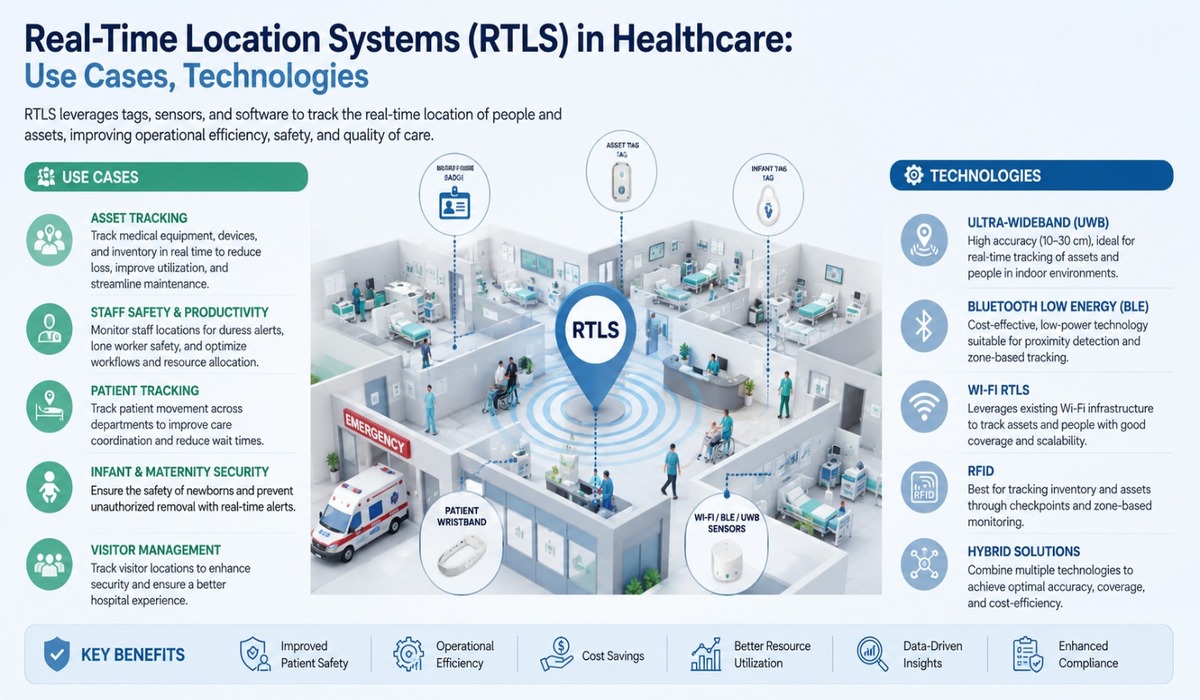
Healthcare organizations worldwide are under constant pressure to improve patient safety, reduce operational inefficiencies, optimize medical asset utilization, and deliver better care experiences. Hospitals today manage thousands of patients, medical devices, staff members, medications, and critical resources simultaneously. In such complex environments, maintaining visibility becomes a major challenge. This is where Real-Time Location Systems in Healthcare are transforming modern healthcare ecosystems by enabling continuous tracking, monitoring, and management of people, equipment, and workflows in real time.
In 2026, healthcare institutions are increasingly investing in intelligent tracking technologies to improve operational efficiency and patient outcomes. Delayed equipment availability, prolonged patient wait times, inefficient staff coordination, and resource mismanagement can directly impact care quality. Real-time tracking solutions help healthcare providers make faster decisions, improve workflow transparency, and create more connected healthcare environments. As digital transformation accelerates, RTLS is becoming a strategic technology rather than simply an operational enhancement.
What Are Real-Time Location Systems in Healthcare?
Real-Time Location Systems (RTLS) refer to technologies designed to identify, track, and monitor the location of assets, equipment, healthcare personnel, and patients within healthcare facilities. These systems use wireless technologies and sensors to provide live location information, enabling hospitals and medical institutions to gain visibility into daily operations.
Unlike traditional tracking systems that rely on manual updates, RTLS continuously collects and updates movement data. This allows healthcare providers to know where critical equipment is located, monitor patient flow, identify workflow bottlenecks, and optimize staff response times.
For example, if an emergency department urgently requires a ventilator or infusion pump, RTLS can instantly display the nearest available device, reducing delays in treatment. Similarly, patient movement through admission, diagnostics, treatment, and discharge can be tracked to improve care coordination.
The purpose of RTLS extends beyond tracking. Its broader objective is improving efficiency, enhancing safety, and supporting data-driven healthcare operations.
Why Real-Time Tracking Matters in Modern Healthcare
Hospitals operate in environments where even small delays may have serious consequences. Missing equipment, overcrowded departments, inefficient resource allocation, and communication gaps can increase operational costs and affect patient experiences.
Healthcare systems are evolving rapidly due to rising patient expectations, increasing regulatory requirements, workforce shortages, and growing adoption of digital healthcare technologies. In this environment, visibility into operations becomes essential.
Real-time location technologies help healthcare institutions address challenges such as:
Delayed patient transfers between departments
Long waiting times in emergency care
Equipment loss or underutilization
Staff coordination inefficiencies
Inventory tracking challenges
Infection control monitoring
Compliance and documentation requirements
Rather than relying on manual processes, healthcare organizations gain continuous operational intelligence.
How Real-Time Location Systems in Healthcare Work
RTLS environments combine multiple technologies to collect, process, and display location information. The system generally involves tags, sensors, network infrastructure, and software platforms working together.
A tag is attached to an asset, patient wristband, staff badge, or medical equipment. Readers or sensors positioned across facilities detect signals emitted by these tags. The collected information is then processed through centralized software that displays location data in real time.
Healthcare administrators can monitor dashboards showing equipment utilization, patient movement patterns, and workflow performance.
The accuracy and capabilities depend heavily on the technology being used.
Core Technologies Powering RTLS in Healthcare
Healthcare organizations use different RTLS technologies based on tracking requirements, budget, and accuracy expectations.
RFID Technology
Radio Frequency Identification remains one of the most widely adopted tracking technologies in healthcare environments. RFID tags attached to assets communicate with readers to provide location information.
Hospitals often use RFID for tracking wheelchairs, infusion pumps, surgical instruments, and inventory items. RFID contributes significantly to reducing equipment loss and improving asset utilization.
Bluetooth Low Energy (BLE)
BLE technology provides indoor positioning with relatively low power consumption. Wearable devices and smart badges commonly use BLE for staff and patient tracking.
Healthcare institutions increasingly prefer BLE because of cost efficiency and scalability.
Wi-Fi Based Tracking
Hospitals with existing Wi-Fi infrastructure may leverage networks for RTLS deployment. This reduces implementation complexity while enabling asset visibility.
However, accuracy may vary depending on infrastructure design.
Ultra-Wideband (UWB)
Ultra-Wideband offers highly precise indoor positioning. It is often used where centimeter-level accuracy matters, such as operating rooms or critical care environments.
Although more expensive, UWB supports advanced use cases requiring high precision.
Infrared Technology
Infrared tracking provides room-level accuracy and is commonly applied in patient monitoring scenarios.
GPS Integration
GPS is useful for outdoor tracking, ambulance monitoring, and fleet management but less effective for indoor healthcare environments.
Real-Time Location Systems in Healthcare: Major Use Cases Transforming Hospitals
RTLS adoption continues expanding because healthcare providers are discovering practical applications beyond basic asset tracking.
Patient Tracking and Workflow Optimization
Patient flow directly influences healthcare quality and operational efficiency. Delays during admissions, diagnostics, treatment, and discharge create bottlenecks that increase wait times.
RTLS enables hospitals to monitor patient journeys continuously. Healthcare providers can identify delays, optimize scheduling, and improve coordination between departments.
Improved visibility often contributes to better patient experiences and reduced overcrowding.
Medical Equipment Tracking
Hospitals frequently struggle with locating critical equipment quickly.
Devices such as infusion pumps, wheelchairs, portable imaging machines, and ventilators are often misplaced or remain underutilized because their location is unknown.
RTLS improves equipment visibility, reducing unnecessary purchases while increasing utilization rates.
Instead of acquiring additional equipment, hospitals can optimize existing resources.
Staff Safety and Workforce Management
Healthcare workers operate in high-pressure environments where rapid communication is essential.
Real-time location technologies help monitor staff availability and support emergency response coordination.
Some systems include panic alert capabilities that allow healthcare workers to request immediate assistance.
This contributes to workplace safety improvements.
Infection Prevention and Control
Healthcare-associated infections remain major concerns globally.
RTLS can help monitor interactions, patient movement patterns, and compliance with hygiene protocols.
During infectious disease outbreaks, tracking contact exposure becomes valuable for containment efforts.
Elderly Care and Patient Monitoring
Hospitals and long-term care facilities increasingly use RTLS for monitoring vulnerable patients.
Patients with dementia, cognitive disorders, or mobility challenges benefit from location awareness systems that reduce wandering risks.
Healthcare providers receive alerts when unusual movement patterns occur.
Emergency Department Optimization
Emergency departments often face overcrowding and treatment delays.
RTLS helps track patient waiting times, bed occupancy, equipment availability, and staff movement.
Greater visibility supports faster decision-making under pressure.
Pharmaceutical and Inventory Management
Medication storage, transportation, and utilization require strict monitoring.
RTLS supports inventory visibility and reduces losses related to expired or misplaced pharmaceuticals.
Improved inventory management contributes to operational efficiency.
Step-by-Step Approach for Implementing RTLS in Healthcare Facilities
Successful implementation requires strategic planning rather than simply deploying tracking devices.
Step 1: Identify Operational Challenges
Healthcare organizations must first determine the problems they intend to solve.
The objective may involve reducing equipment loss, improving patient flow, or optimizing workforce management.
Clear goals increase implementation success.
Step 2: Define Tracking Requirements
Different use cases require varying accuracy levels.
Tracking critical surgical equipment demands higher precision than monitoring inventory movement.
Technology selection depends on operational needs.
Step 3: Choose Suitable RTLS Technology
Healthcare providers evaluate RFID, BLE, UWB, Wi-Fi, or hybrid systems according to infrastructure and budget.
Technology compatibility influences long-term effectiveness.
Step 4: Integrate With Existing Hospital Systems
Integration with electronic health records, asset management software, and hospital information systems improves operational value.
Disconnected deployments often limit outcomes.
Step 5: Train Healthcare Personnel
Successful adoption depends on staff acceptance.
Training improves utilization and reduces resistance.
Step 6: Monitor Performance and Optimize
Healthcare institutions should continuously evaluate metrics including utilization rates, patient flow improvements, and operational savings.
Optimization supports long-term ROI.
Benefits Hospitals Gain Through RTLS Adoption
The advantages of RTLS extend beyond visibility.
Healthcare providers often experience improved operational efficiency because staff spend less time searching for equipment and resources.
Patient care quality may improve due to faster response times and smoother workflows.
Resource utilization increases when asset availability becomes transparent.
Operational costs may decline through reduced equipment loss and unnecessary purchases.
Workforce productivity improves as manual processes decrease.
Patient satisfaction can increase because of reduced waiting periods and improved coordination.
Data-driven decision-making becomes easier when continuous operational insights are available.
Challenges Limiting RTLS Adoption in Healthcare
Although RTLS delivers substantial benefits, implementation challenges remain.
Initial deployment costs may discourage some organizations, especially smaller healthcare institutions.
Integration with legacy systems can create complexity.
Data privacy and security concerns require careful governance because location tracking involves sensitive information.
Infrastructure limitations may affect accuracy.
User resistance sometimes slows adoption if healthcare personnel perceive tracking as monitoring rather than operational support.
Organizations must address these concerns proactively.
Best Practices for Successful RTLS Deployment
Healthcare institutions achieving strong outcomes often focus on practical implementation strategies.
They begin with targeted use cases rather than enterprise-wide deployment.
They involve stakeholders early, including clinicians, administrators, and IT teams.
Most importantly, successful deployments align RTLS initiatives with measurable healthcare outcomes.
They prioritize cybersecurity and compliance.
They choose scalable technologies capable of supporting future expansion.
Future Trends: How RTLS in Healthcare Is Evolving Beyond 2026
Healthcare technology continues advancing toward intelligent and predictive ecosystems.
Artificial Intelligence integration is expected to enhance RTLS capabilities by enabling predictive workflow optimization and anomaly detection.
IoT expansion will improve connectivity across healthcare infrastructure.
Digital twins may support hospital simulations using real-time operational data.
Predictive analytics could help anticipate equipment shortages and patient surges before disruptions occur.
Automation will increasingly transform hospitals into more responsive, data-driven environments.
The future of RTLS is moving beyond location awareness toward intelligent operational decision-making.
Is RTLS Worth the Investment for Healthcare Organizations?
The value of RTLS depends on organizational challenges, scale, and strategic goals.
Hospitals facing equipment shortages, inefficient workflows, long patient wait times, and operational visibility gaps often achieve significant benefits from implementation.
Smaller facilities with limited complexity may pursue targeted deployments rather than full-scale systems.
The strongest outcomes typically emerge when RTLS initiatives focus on solving specific operational problems rather than adopting technology for its own sake.
Conclusion
Healthcare systems increasingly depend on real-time visibility to improve efficiency, reduce delays, optimize resources, and enhance patient experiences. Real-Time Location Systems in Healthcare are becoming essential technologies that support smarter hospital operations and better care delivery through continuous tracking and actionable insights.
People Also Ask (FAQs)
Q1. What are Real-Time Location Systems in Healthcare?
Real-Time Location Systems are technologies used to monitor and track patients, staff, equipment, and assets within healthcare facilities. These systems provide continuous location visibility through technologies such as RFID, Bluetooth, Wi-Fi, and Ultra-Wideband. Healthcare organizations use RTLS to improve operational efficiency, patient care, and resource utilization.
Q2. How do RTLS improve patient safety?
RTLS enhances patient safety by improving response times, reducing treatment delays, monitoring vulnerable patients, and supporting infection control measures. Better visibility helps healthcare providers deliver faster and more coordinated care.
Q3. Which technology is most commonly used in healthcare RTLS?
RFID remains among the most widely adopted technologies because of its effectiveness in asset tracking and inventory management. However, BLE and UWB adoption is increasing for applications requiring higher accuracy.
Q4. Are RTLS expensive to implement in hospitals?
Implementation costs vary depending on infrastructure requirements, technology choice, and deployment scale. Large hospitals may require higher investment, while targeted implementations can offer cost-effective entry points.
Q5. Can RTLS integrate with hospital management systems?
Yes. Modern RTLS platforms often integrate with electronic health records, asset management software, and hospital information systems to improve operational visibility and workflow coordination.
Q6. What industries besides healthcare use RTLS?
RTLS technologies are also used in manufacturing, logistics, retail, warehousing, aviation, and supply chain management for asset tracking and operational optimization.
